
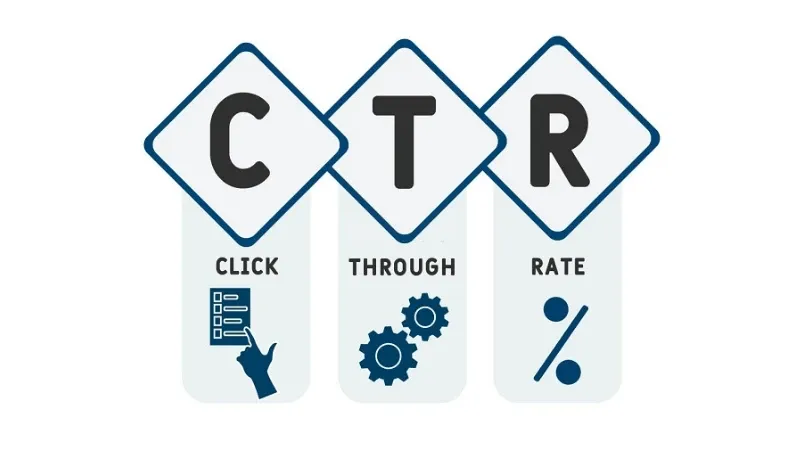
In SEO, click-through rate (CTR) is one of the most commonly tracked performance metrics on the search engine results page (SERP). It measures how often people who see your listing actually click it, and SEO professionals use it alongside title tags, meta descriptions, and search intent to judge whether a page's SERP presentation is working. A strong title, a clear match to what the searcher is looking for, and recognizable branding can all influence whether someone clicks — which is why organic CTR is treated as a useful diagnostic signal, even though its direct relationship to rankings is debated rather than officially confirmed by Google.
Against that backdrop, a market of “CTR bot” tools has grown up around the idea of influencing this metric directly. A CTR bot is a general term for software or a traffic service that generates or coordinates clicks and website sessions, rather than waiting for those clicks to happen organically. Depending on the provider, this traffic may come from scripted/automated systems, from networks of real paid clickers, or from a mix of both — and the distinction matters a great deal for both risk and effectiveness.
Heading into 2026, this space is worth examining carefully because of how the tools themselves have evolved: more automation in campaign management, more granular geo-targeting, dashboard-based workflows instead of manual setup, and a wider spread of pricing models from pay-as-you-go credits to monthly subscriptions. None of this is tied to any specific new Google ranking algorithm — there is no verified 2026 algorithm change referenced in this article — but the tool landscape, pricing, and policy exposure are all worth understanding on their own terms before considering this category of tool.
This article walks through what CTR bot tools are and how they work, compares five commonly discussed tools (SerpClix, CTR Booster, ClickSEO, SearchSEO, and SparkTraffic) based on verified, current information where available, and lays out the real risks involved — including how this activity intersects with Google's search spam policies. It closes with a responsible-evaluation framework and a look at how browser automation tools like Hidemium Antidetect Browser fit into (and are limited to) the technical side of this workflow, separate from the SEO manipulation question itself.
Quick Answer: What Is a CTR Bot in 2026?
A CTR bot is a tool or service designed to generate, coordinate, or automate clicks and on-site sessions to influence a website's click-through rate on search results. Depending on the provider, traffic may come from scripts and automated browsers, from paid networks of real human clickers, or from a mix of both. This article compares five commonly discussed options — SerpClix, CTR Booster, ClickSEO, SearchSEO, and SparkTraffic — on traffic source, automation level, geo-targeting, and pricing. None of these tools can be confirmed to guarantee ranking improvements, and all carry some degree of policy risk under Google's search spam guidelines. They are best understood as a supplement to, not a replacement for, sustainable, organic SEO work.
What Is a CTR Bot and How Does It Work?
A CTR bot is a tool or traffic service that generates, coordinates, or automates clicks and website sessions. Depending on the platform, this traffic may come from scripts, automated browsers, real-user click networks, or other traffic-generation systems, and providers typically differ on which of these they actually use.
In practical terms, these tools are built around a few common mechanics: triggering a click on a search result for a target keyword, spending time on the destination page, and in some cases interacting with on-page content such as scrolling or clicking internal links. Providers frame this as sending “engagement signals” to search engines, though the extent to which any search engine actually treats these signals as trustworthy — or can distinguish them from organic behavior at all — is not something this article can verify.
SEO professionals research this category of tool for a few practical reasons: to understand how browser fingerprints are built and used in traffic-simulation contexts, to evaluate whether a given provider's traffic could distort their own analytics, and to weigh the policy risk of using such services against their potential upside. It's worth being direct about a few claims that circulate in marketing copy for these tools but are not verifiable: there is no confirmed mechanism by which “Google trusts a site because bots clicked it,” no tool can guarantee a ranking improvement, and no CTR bot is inherently risk-free from a policy standpoint.
Does CTR Affect SEO Rankings?
CTR is best understood as an observed search-performance metric rather than a confirmed, direct ranking factor. Google has not published CTR as an explicit ranking signal, and independent studies on the topic generally show correlation between position and CTR rather than proof that CTR itself causes ranking changes.
Organic CTR as a Search Performance Metric
Organic CTR reflects how a listing performs at its current SERP position, shaped heavily by title tag, meta description, and how well the result matches search intent. Data from an analysis of organic CTR across millions of search results shows that average CTR drops sharply as position falls — for example, the #1 organic result received roughly 27.6% average CTR in that dataset, far higher than results lower on the page. That pattern is consistent with higher-ranked pages naturally attracting more attention; it does not by itself establish that raising CTR causes a page to rank higher.
CTR Optimization vs CTR Manipulation
It's useful to separate two very different activities that both get called “CTR optimization.” Legitimate CTR optimization means improving how a real listing performs with real searchers: writing a stronger, more accurate title, refining the meta description, aligning the page more closely with search intent, adding structured data where relevant, and improving the page's actual usefulness and brand presentation. CTR manipulation, by contrast, means artificially generating clicks — through scripts, automated sessions, or incentivized/paid clicking — specifically to influence how a page appears to perform, independent of whether real searchers would click it.
CTR, Dwell Time and Pogo-Sticking
Dwell time (how long a visitor stays before returning to the search results) and pogo-sticking (quickly bouncing back to the SERP after a click) are terms often discussed alongside CTR. Neither has been confirmed by Google as a direct ranking factor; they are behavioral concepts SEOs use to reason about content quality and user satisfaction, and they should not be presented as verified ranking signals.
What Features Do CTR Bot Tools Offer?
Feature sets vary by provider, but most CTR bot tools are built around a similar set of capabilities.
Geo-Targeting in Automated CTR Tools
Geo-targeting means limiting traffic or campaign activity to selected countries, cities, or regions. CTR bot tools commonly offer this as a way to simulate demand from a specific market, which can matter for local SEO testing or region-specific keyword campaigns.
Automated CTR and Session Behavior
Many tools let users configure session parameters such as time-on-page, number of pages visited, or scroll depth. These settings are used to shape how a session looks in analytics, though how convincingly they replicate genuine user behavior varies significantly by provider.
Traffic Sources Used by CTR Bot Tools
Providers draw on different traffic sources: some rely on networks of paid human clickers, some use automated/scripted sessions, and some blend both. This is one of the most important things to verify before choosing a tool, since it directly affects both traffic authenticity and policy exposure.
Proxy and Network Support
Some CTR bot tools rely on proxy networks or varied IP sources as part of how they distribute traffic across sessions. This is a feature-level detail about how these providers route traffic; it does not change the underlying policy risk of using artificial clicks to influence rankings, and this article does not provide guidance on using proxies to reduce detection. If you want to configure proxies in an antidetect browser for legitimate testing, QA, or account-management workflows, that's a separate technical topic from CTR manipulation.
Reporting and Automation
Most platforms offer a dashboard for scheduling campaigns, monitoring click volume, and reviewing basic reporting. The degree of automation ranges from largely manual order placement to fully automated, recurring campaigns.
Which CTR Bot Tools Should You Compare in 2026?
The five tools below are commonly referenced in CTR bot discussions. Each profile reflects information gathered directly from the provider's official site where accessible; where information could not be verified, that is stated explicitly rather than filled in.
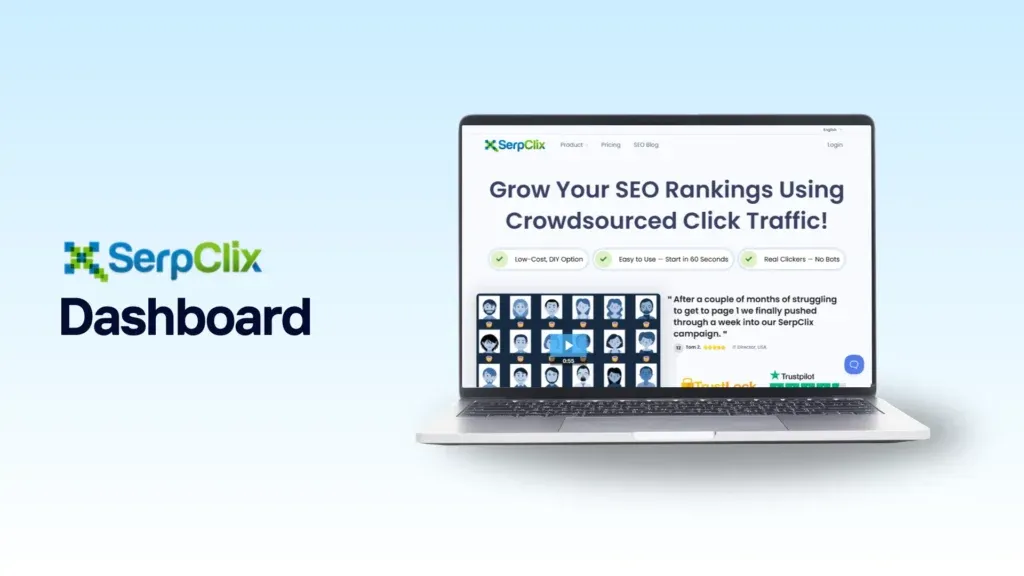
SerpClix
SerpClix is a service that sells clicks performed by a network of paid human clickers rather than automated scripts.
Best for: Buyers who specifically want clicks that are verifiably performed by real people rather than bots.
Traffic source: Real users (the provider states it uses a network of 400,000+ human clickers and blocks VPNs/proxies from its clicker pool).
Automation level: Low — order setup and targeting are managed through a dashboard, but the click itself is performed manually by a person.
Geo-targeting: Yes — clickers are available across 160+ countries.
Key features:
Country- and language-specific targeting
Support for Google, Bing, Maps, Images, Video, News, and YouTube order types
Credits that don’t expire, usable across one-time packs or monthly plans
Limitations:
Cost per click is meaningfully higher than automated alternatives
No ranking outcome is guaranteed, and results depend heavily on competition and keyword difficulty
Pricing: Monthly plans start at $197/month (Starter, ~660 clicks) and scale to $997/month (Gold, ~6,000 clicks) and $2,497/month (Platinum); one-time credit packs start at $100; a 7-day free trial with 500 credits is available.
Source: SerpClix’s official pricing page (verified directly).
CTR Booster
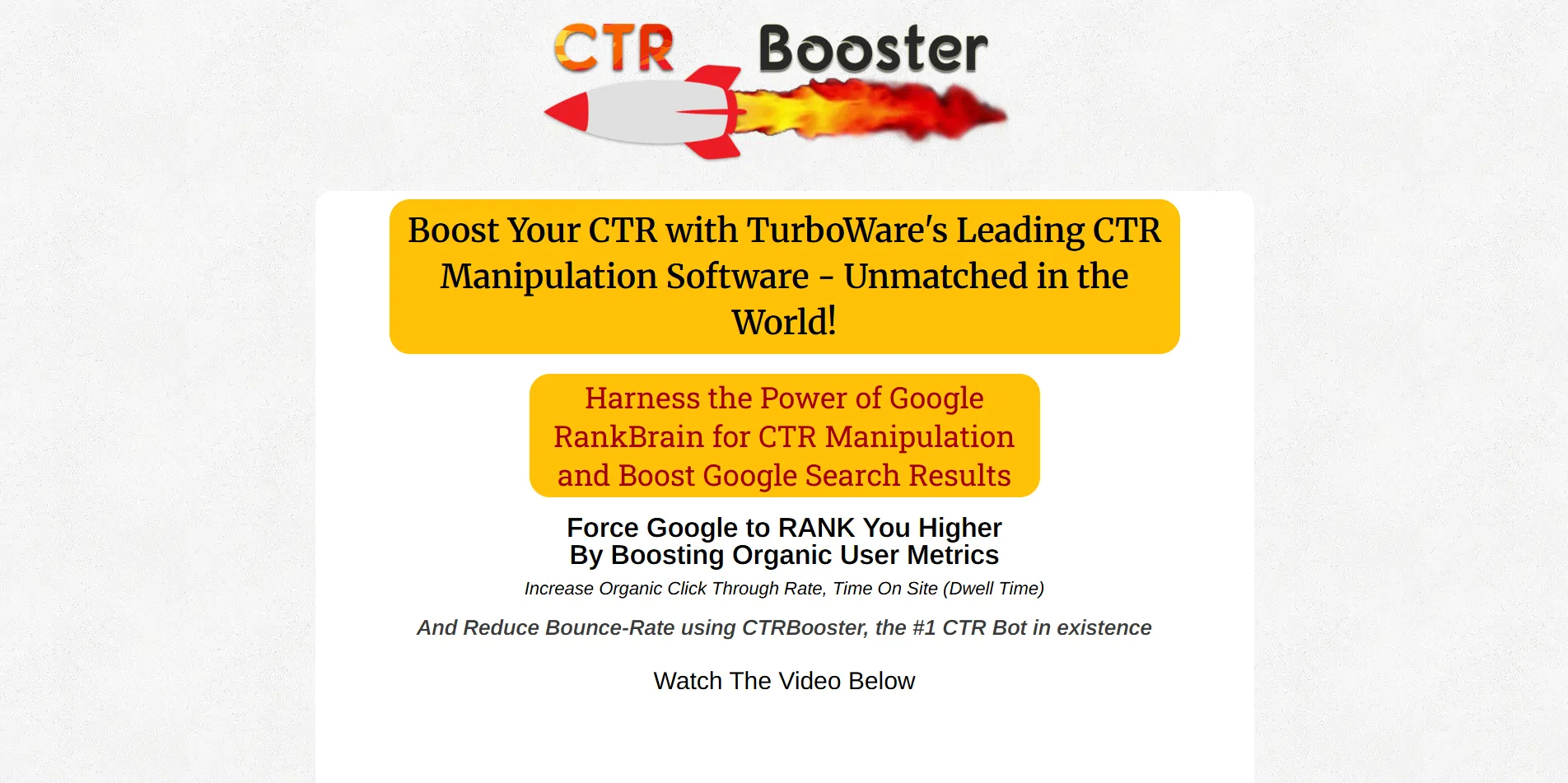
CTR Booster is marketed as a tool for automating CTR-related behavioral signals and campaign management.
Best for: Users interested in automated, scheduled CTR campaigns, based on the provider's own marketing description.
Traffic source: Unclear — the provider's own marketing describes behavioral signal simulation; this could not be independently confirmed as real-user or automated traffic during this review.
Automation level: Described by the vendor as high; not independently verified.
Geo-targeting: Described by the vendor as available; not independently verified.
Key features (as described by the vendor; unverified in this review):
Simulated click and on-site interaction behavior
Support for Google, YouTube, and Google Business listings
Scheduled campaign automation
Limitations:
The provider’s website could not be loaded directly during this review, so current features and claims could not be independently confirmed
As with any service simulating engagement rather than sourcing it from real searchers, policy risk applies
Pricing: Not independently verified during this review. Check current pricing on the provider's official website (ctrbooster.com) directly.
Source: Official product page (unable to load directly during this review; existence confirmed only via search engine indexing).
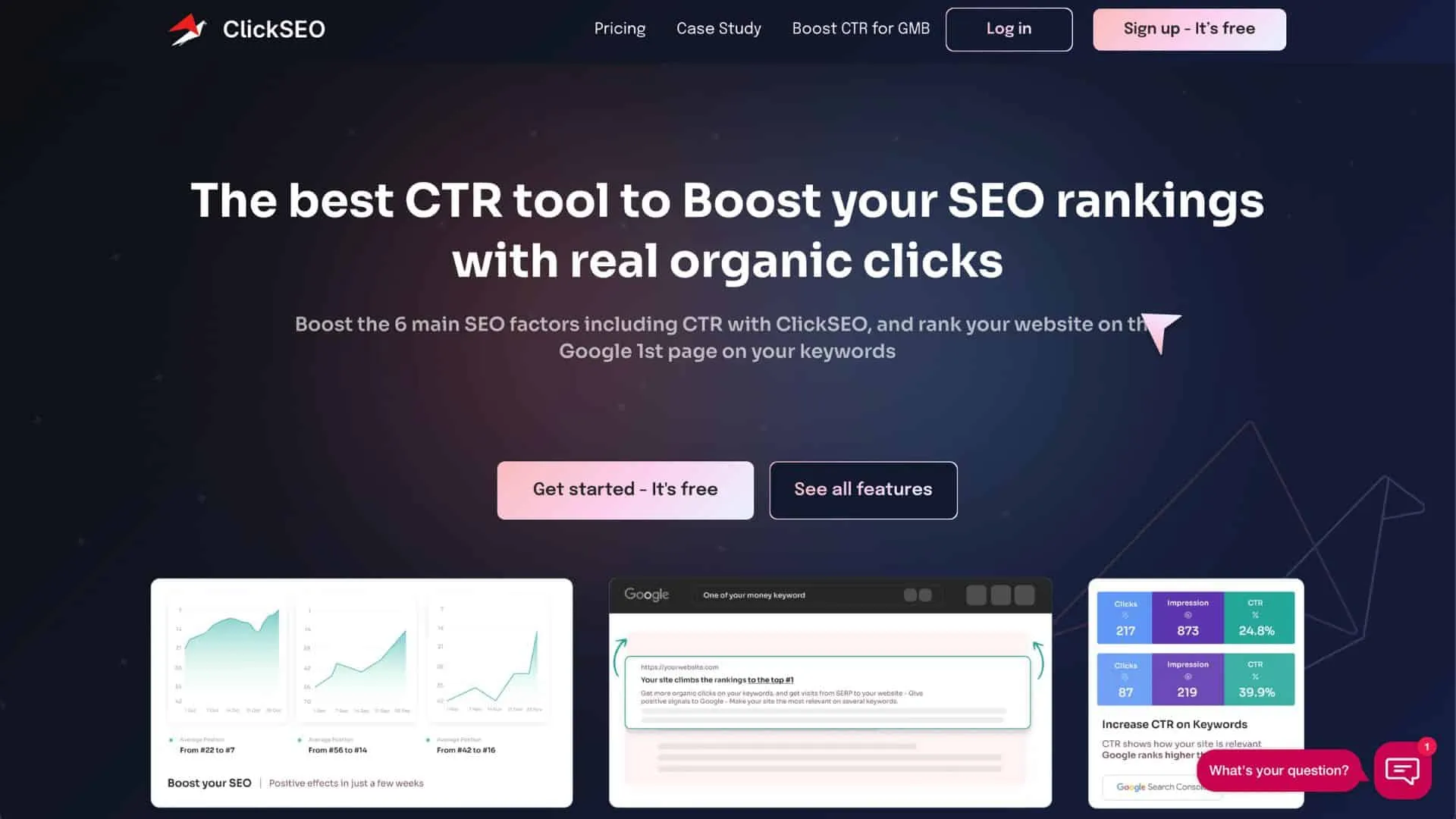
ClickSEO
ClickSEO positions itself as a CTR bot that sources clicks from real human clickers on residential internet connections, aiming to have that traffic recorded as organic in Google Search Console.
Best for: Teams that want a managed, dashboard-based service with clear tiered limits on sites, clicks, and keywords.
Traffic source: Per the provider, real human clickers on residential 4G/Wi-Fi connections — this is the vendor's own claim and was not independently verified beyond what's stated on their site.
Automation level: Medium — campaigns are configured and run through a token-based dashboard.
Geo-targeting: Yes — the provider states coverage across 170+ countries.
Key features:
Token-based plans tied to number of connected websites, daily clicks, and keywords
Configurable session duration and pages-visited settings
Real-time reporting dashboard
Limitations:
Entry-level plans cap daily clicks (as low as 30/day), keyword count, and number of connected websites
Higher tiers are required for any meaningful campaign scale
Pricing: Basic $30/month (30 clicks/day, 1 site), Standard $50/month, Premium $90/month, Ultimate $130/month.
Source: ClickSEO’s official site (verified directly).
SearchSEO
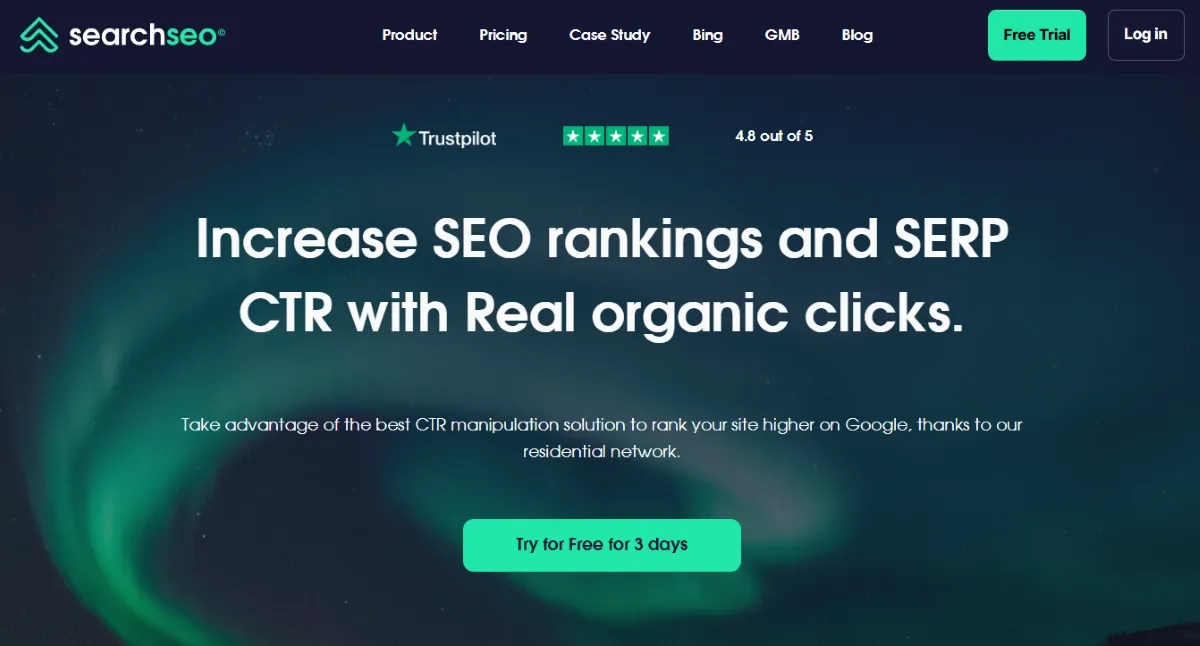
SearchSEO offers configurable click campaigns with the stated goal of increasing CTR and supporting local SEO, including Google Business Profile clicks.
Best for: Users who want granular control over daily click volume, keyword count, and session duration.
Traffic source: The provider describes its traffic as coming from a “residential network,” while also explicitly labeling its own service a “traffic bot” and “CTR manipulation” tool in its own marketing — so this is best treated as mixed/unclear rather than confirmed real-user traffic.
Automation level: Medium to high, based on dashboard-managed, scheduled campaigns.
Geo-targeting: Yes — country- and city-level targeting is offered.
Key features:
Adjustable daily click volume, keyword count, and pages-visited settings
Local SEO / Google Business Profile click support
Real-time statistics dashboard and a 3-day free trial
Limitations:
Meaningful click volume requires the higher-priced tiers
The provider’s own terminology mixes “real” and “bot” language, making the true traffic composition hard to pin down from public information alone
Pricing: Mini $29/month (25 clicks/day), Medium $49/month, Large $89/month, Ultimate $129/month — prices exclude VAT.
Source: SearchSEO’s official site (verified directly).
SparkTraffic
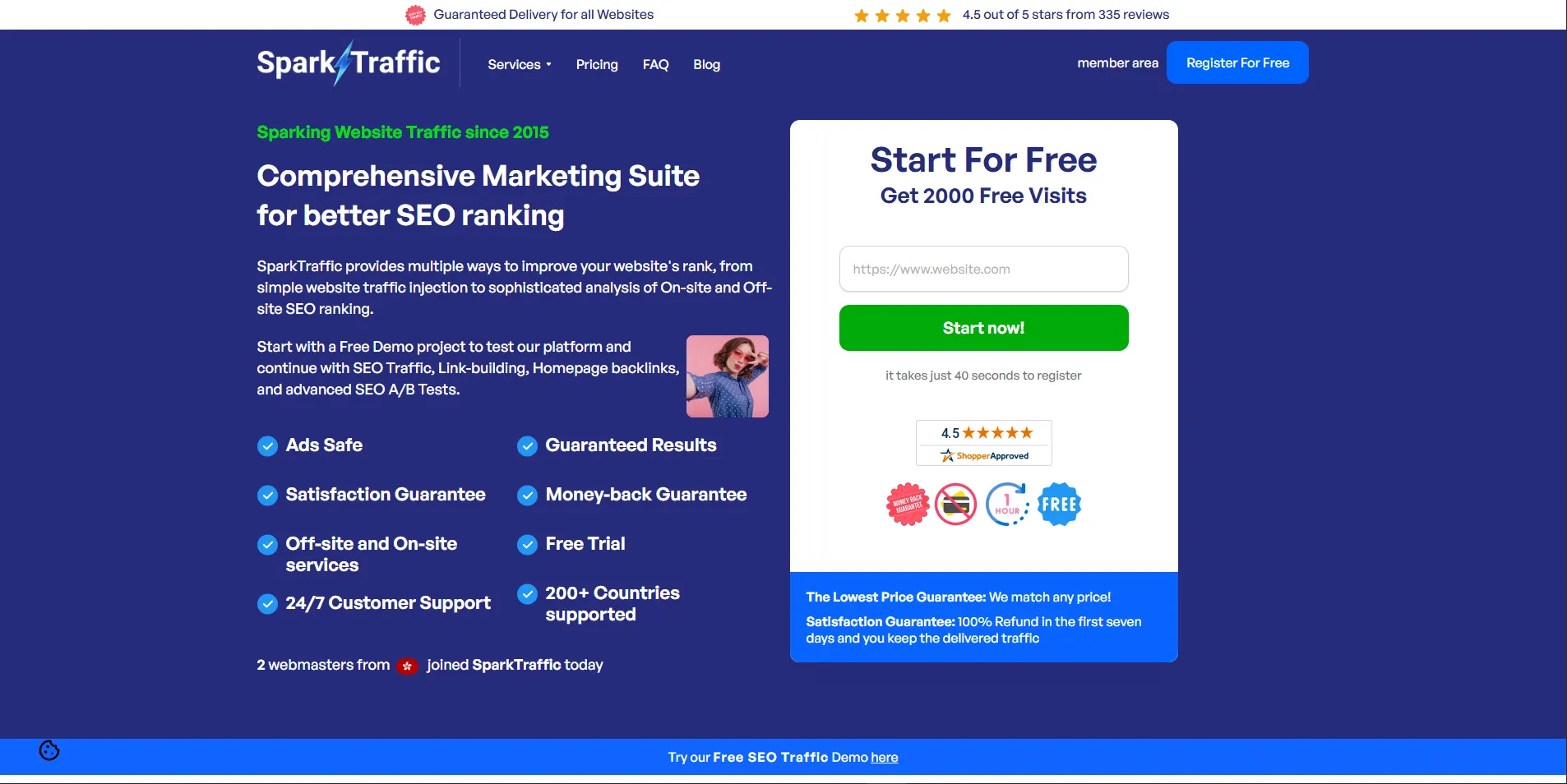
SparkTraffic is a broader website-traffic platform (operating since 2015) that offers geo-targeted visits through a publisher/ad network, rather than positioning itself specifically as a SERP-click service.
Best for: Users wanting low-cost, geo-targeted website traffic at scale, rather than specifically SERP-click simulation.
Traffic source: Automated delivery through a publisher network, per the provider's own description of how the platform works; not marketed as human SERP clickers in the way SerpClix or ClickSEO are.
Automation level: High — campaigns run largely on autopilot once configured.
Geo-targeting: Yes — the provider states targeting across 200+ countries, with city- and device-level options.
Key features:
Credit-based pricing that rolls over and does not expire
Country, city, and device-type targeting
Real-time delivery dashboard and a free 2,000-credit demo
Limitations:
Traffic is delivered through a general publisher/ad network rather than direct SERP interaction, so its relevance to organic CTR specifically should be evaluated carefully before use
Not positioned as a niche-specific SEO click tool
Pricing: Mini 60K plan from $9.96/month; Large 500K at $57.96/month; Ultimate 10M at $699.96/month; pay-as-you-go credits from $0.08 per 1,000.
Source: SparkTraffic’s official pricing page (verified directly).
CTR Bot Tools Comparison
Tool | Traffic Source | Best For | Automation Level |
Geo-Targeting | Pricing | Main Limitation | Policy Considerations |
| SerpClix | Real users | Verifiable human-sourced clicks | Low | Yes | $197–$2,497/month | High cost at scale | Artificial click intent may still conflict with search engine spam policies |
| CTR Booster | Unclear (unverified) | Automated CTR campaigns (vendor claim) | Unclear (unverified) | Unclear (unverified) | Not independently verified | Claims could not be confirmed during this review | Same policy exposure as any engagement-manipulation service |
| ClickSEO | Real users (vendor claim) | Managed dashboard-based CTR service | Medium | Yes | $30–$130/ month | Low click/keyword caps on entry plans | Vendor self-describes the service as a “CTR bot” |
| SearchSEO | Mixed/unclear | Granular click-volume control | Medium–High | Yes | $29–$129/ month | Mixed “real”/“bot” claims | Vendor self-describes the service as “CTR manipulation” |
| SparkTraffic | Automated (publisher network) | Low-cost geo-targeted traffic | High | Yes | $9.96–$699.96/month | Not SERP-click-specific | Relevance to organic SEO CTR should be verified before use |
Each of these tools differs enough in traffic source, transparency, and pricing that the “right” choice depends heavily on what you're trying to test and how much policy risk you're willing to accept — not on which one is marketed most aggressively.
What Are the Risks and Google Policy Considerations for CTR Bots?
Using CTR bots for SEO can create meaningful risks because artificial clicks may distort analytics and may conflict with search-engine or platform policies. They should not be treated as a guaranteed or risk-free ranking technique, regardless of how any individual provider markets its service.
Search Engine Policy Risk
Google's own Search spam policies describe a range of techniques search engines treat as attempts to manipulate rankings rather than earn them organically. Artificially generated clicks intended to influence how a page performs in search results fall within the general category of manipulative ranking signals that these policies are designed to address, independent of whether the traffic is scripted or performed by paid human clickers.
Analytics Distortion
Traffic from CTR bots — whether automated or human-sourced — gets recorded in tools like Google Analytics and Google Search Console alongside genuine visitor data. This can distort session counts, bounce rate, conversion rate, and average engagement time, making it harder to draw accurate conclusions about how real visitors are actually behaving on the site.
Artificial or Low-Quality Traffic
Even when a provider uses real human clickers, that traffic is fundamentally different from organic search demand: the clicker is being paid or incentivized to visit, not searching because they have a genuine need. This can produce shallow engagement (a quick click and exit) that looks different from a typical organic visit, even if it isn't obviously “bot-like.”
Cost and Scalability
Pricing for these services ranges widely, from under $10/month for entry-level traffic-only plans to nearly $2,500/month for large-scale human-clicker packages. Costs generally scale with volume, and there is no verified data establishing a reliable return on that spend in terms of ranking outcomes.
Legal and Ethical Considerations
Some jurisdictions and platforms have rules around data authenticity, advertising claims, and automated traffic that could be relevant depending on how a service is used. This article is not a legal analysis, and readers should not treat anything here as legal advice — if this matters to your specific situation, consult a qualified professional.
CTR Bots vs Sustainable SEO
CTR bots, at best, address one narrow metric. They do not replace the work that actually tends to drive durable organic performance: solid technical SEO, genuinely useful content that matches search intent, a healthy backlink profile, good site UX, structured data, sensible internal linking, and brand recognition built over time. Treating a CTR bot as a substitute for that work, rather than a minor and risky supplement to it, is a common and costly mistake.
Is Using CTR Bots Black Hat SEO?
Using CTR bots to artificially generate clicks is generally considered a manipulative practice by search-engine-policy standards, though it exists on a spectrum depending on the technique. It's worth being precise about the distinction rather than treating “CTR work” as one single thing.
White-hat CTR optimization focuses on improving how a real, existing listing performs with real searchers: better titles, clearer meta descriptions, tighter alignment with search intent, structured data, and stronger UX and branding. None of this depends on generating clicks that wouldn't otherwise happen.
Manipulative CTR practices involve generating clicks that would not otherwise occur — through automated scripts, paid clicker networks, or other artificial engagement — specifically to change how a page appears to perform in search results. This is the category CTR bot tools generally fall into, and it's the category addressed by search engine spam policies. This article does not provide guidance on how to avoid detection for this kind of activity, since doing so would run counter to the policies it's discussing.
How Should You Evaluate CTR Bot Tools Responsibly?
Evaluating a CTR bot tool responsibly means treating it as a claim to be tested and monitored, not a guaranteed solution to adopt on faith. A few practical habits help with that.
Start by reviewing the current version of Google's Search spam policies before considering any tool in this category, since policy language and enforcement emphasis can change over time. Separately track any campaign's data in your analytics so you can see, in isolation, whether it's distorting your broader metrics rather than mixing it in with organic traffic data. Treat vendor claims about “safety,” “real users,” or “zero penalty risk” as marketing language to verify, not as settled fact — several providers use similar language while describing meaningfully different traffic sources. Keep your core SEO work (content quality, technical health, search intent alignment, internal linking, backlinks) as the primary investment, with any CTR bot spend treated as a small, closely monitored experiment rather than a strategy on its own. And review a provider's refund, cancellation, and data-privacy terms before committing budget, the same way you would for any other paid marketing tool.
CTR Bot Evaluation and SEO Best Practices Checklist
Verify the current Google Search spam policies before evaluating any CTR bot tool.
Identify whether a provider’s traffic is automated, human-sourced, or a mix of both.
Review whether the service may distort your analytics, and track it separately if you proceed.
Avoid unsupported ranking guarantees made in provider marketing.
Verify current pricing directly on the provider’s official site rather than relying on third-party summaries.
Check refund and cancellation terms before subscribing.
Keep any experiment measurable and time-bound, with a clear way to isolate its effect.
Prioritize organic CTR optimization — title, meta description, and search-intent alignment — over artificial traffic.
Improve content quality and page UX as the primary lever for sustainable performance.
Review a provider’s privacy terms before sharing any site or account data.
Verify all 2026-specific claims (features, pricing, availability) directly, since these details change.
How Hidemium Supports Browser Automation and Isolated Profiles
Hidemium is an antidetect browser and browser-profile management platform that supports isolated browser environments, configurable fingerprints, proxy assignment, and browser automation. These capabilities can be useful for testing, QA, marketing operations, account management, and controlled multi-profile workflows, but they do not make artificial search manipulation compliant or risk-free — Hidemium is a browser infrastructure tool, not a CTR bot, and using it alongside a CTR manipulation service does not change the policy considerations described above.
Concretely, this means: each browser profile can maintain its own separate configuration and fingerprint settings, while users can assign a dedicated proxy to a profile when separate network routing is needed for a given workflow. It's worth being precise here, since browser fingerprint and IP address are not the same thing — a fingerprint is a device/browser configuration signature, while an IP address is a network-routing detail typically handled through a separately assigned proxy. Hidemium also supports scripted browser automation (navigating pages, interacting with elements) and running multiple profiles in parallel, which is relevant to teams managing several accounts or client environments at once — for example, understanding how an antidetect browser differs from a regular browser is useful context for anyone evaluating this category of tool, as is managing separate browser profiles for multiple accounts in a team setting.
None of this is a mechanism for making automated SEO traffic invisible to a search engine, and it should not be treated as one.
FAQ About CTR Bots in 2026
What Is a CTR Bot?
A CTR bot is a tool or service that generates, coordinates, or automates clicks and website sessions to influence a site's click-through rate on search results. Traffic may come from scripts, paid human-clicker networks, or a mix of both, depending on the provider.
How Do CTR Bots Work?
Most CTR bot tools let a user configure a target keyword and URL, then trigger a click on that result in search, followed by a set amount of time on the page and sometimes further on-site interaction. Providers differ mainly in whether that click is performed by an automated script or a real paid clicker.
Do CTR Bots Improve Google Rankings?
This can't be confirmed either way. Google has not published CTR as a direct ranking factor, and no CTR bot provider's marketing claims should be treated as proof that their service reliably changes rankings. Any ranking movement during a campaign cannot be reliably separated from other factors without controlled testing.
Are CTR Bots Risky for SEO?
Yes, to varying degrees. Risks include potential conflict with search engine spam policies, distortion of analytics data, and spending money on traffic with no confirmed effect on rankings. The specific risk level depends heavily on the traffic source and how the tool is used.
Is Using CTR Bots Against Google’s Guidelines?
Artificially generated clicks intended to influence rankings fall within the general scope of practices addressed by Google's Search spam policies, which cover techniques used to manipulate ranking signals rather than earn them organically. Readers should review the current policy language directly, since enforcement emphasis can change.
Which CTR Bot Tools Can I Compare in 2026?
Commonly discussed tools include SerpClix, CTR Booster, ClickSEO, SearchSEO, and SparkTraffic. They differ significantly in traffic source, automation level, geo-targeting, and pricing, so comparing them on verified specifics matters more than comparing marketing claims.
How Can I Improve Organic CTR Without Bots?
Focus on writing clearer, more accurate title tags and meta descriptions, aligning content more closely with search intent, adding relevant structured data, and strengthening page UX and brand presentation. These changes improve how a real listing performs with real searchers, without the policy risk of artificial traffic.
Conclusion
A CTR bot is a tool or service built to generate, coordinate, or automate clicks and website sessions in an attempt to influence a site's click-through rate on search results, with traffic sourced from scripts, paid human-clicker networks, or some mix of the two depending on the provider.
The five tools compared in this article — SerpClix, CTR Booster, ClickSEO, SearchSEO, and SparkTraffic — differ substantially once you look past their marketing: traffic source ranges from verified real humans to unclear or automated delivery, automation level ranges from largely manual to fully hands-off, geo-targeting is broadly available across most providers, and pricing spans from under $10/month to nearly $2,500/month depending on scale and traffic type.
None of this changes the underlying risk picture: artificial clicks can conflict with search engine spam policies, can distort your own analytics, and come with no verifiable guarantee of ranking improvement. The more durable path for organic CTR and rankings overall remains the standard SEO fundamentals — search-intent-matched content, strong titles and meta descriptions, technical health, backlinks, and good UX — with any CTR bot experiment treated as a small, closely monitored side test rather than a core strategy.
Hidemium's role in this picture is limited and specific: it's a browser automation and profile-isolation platform useful for legitimate testing, QA, and multi-account workflows, not a mechanism for making CTR manipulation safe, undetectable, or policy-compliant. Anyone considering a CTR bot service should evaluate it on its own risk terms, independent of what browser infrastructure they happen to be using alongside it.
🎁 Try Hidemium free for 3 days to Discover outstanding features and experience ultimate security!
Related Blogs

1. What is Captcha Typing for Money?Captcha (Completely Automated Public Turing test to tell Computers and Humans Apart) is a security tool used to distinguish real users from bots, by requiring them to re-enter distorted characters displayed in an image.Typing Captcha to earn money is the job of re-entering these characters on online platforms and receiving corresponding remuneration. After[…]
In the current market, when consumers form an opinion about your business by just taking a glance at your visuals, it is essential to pay attention to your brand identity.The logo, brand colors, slogan, and even fonts and text styles are what make your brand stand out. Especially in 2026, when the market is more competitive than ever before, it is essential to create unique features for your[…]
.png)
In the competitive arena of Amazon e-commerce, ranking higher in search results is pivotal for success. With over 2 million active sellers vying for customer attention as of 2024, optimizing your product listings with effective Amazon SEO techniques is no longer optional—it's a necessity for any dropshipping business. Whether you're wondering "what is dropshipping" or you're an experienced seller[…]

In an era of shrinking internet privacy, the need for anonymity while browsing the web has become more important than ever. In fact, most websites now use fingerprinting techniques to collect user data. Even when using incognito mode, these technologies can still identify your device through the unique characteristics of your browser and system.Modes like “Incognito” or “Private Browsing” only[…]

Websites are always on the lookout for bots. If your data collection tool is recognized as automated, it will be quickly blocked. Today, most platforms deploy advanced detection technologies such as CAPTCHAs, browser fingerprinting, and behavioral tracking to prevent bots.When collecting data at scale for SEO, ecommerce, or market research, getting blocked not only wastes your time, but also[…]
How to Get More Views on TikTok: 10 Proven Steps That Actually Work If your TikTok views are stuck or falling, the problem is rarely just “the algorithm.” The issue is usually a mix of content, targeting, and signals TikTok uses to decide who should see your videos.Here’s how to get more TikTok views using a simple system: diagnose what’s wrong, optimize your videos for discovery, post[…]
