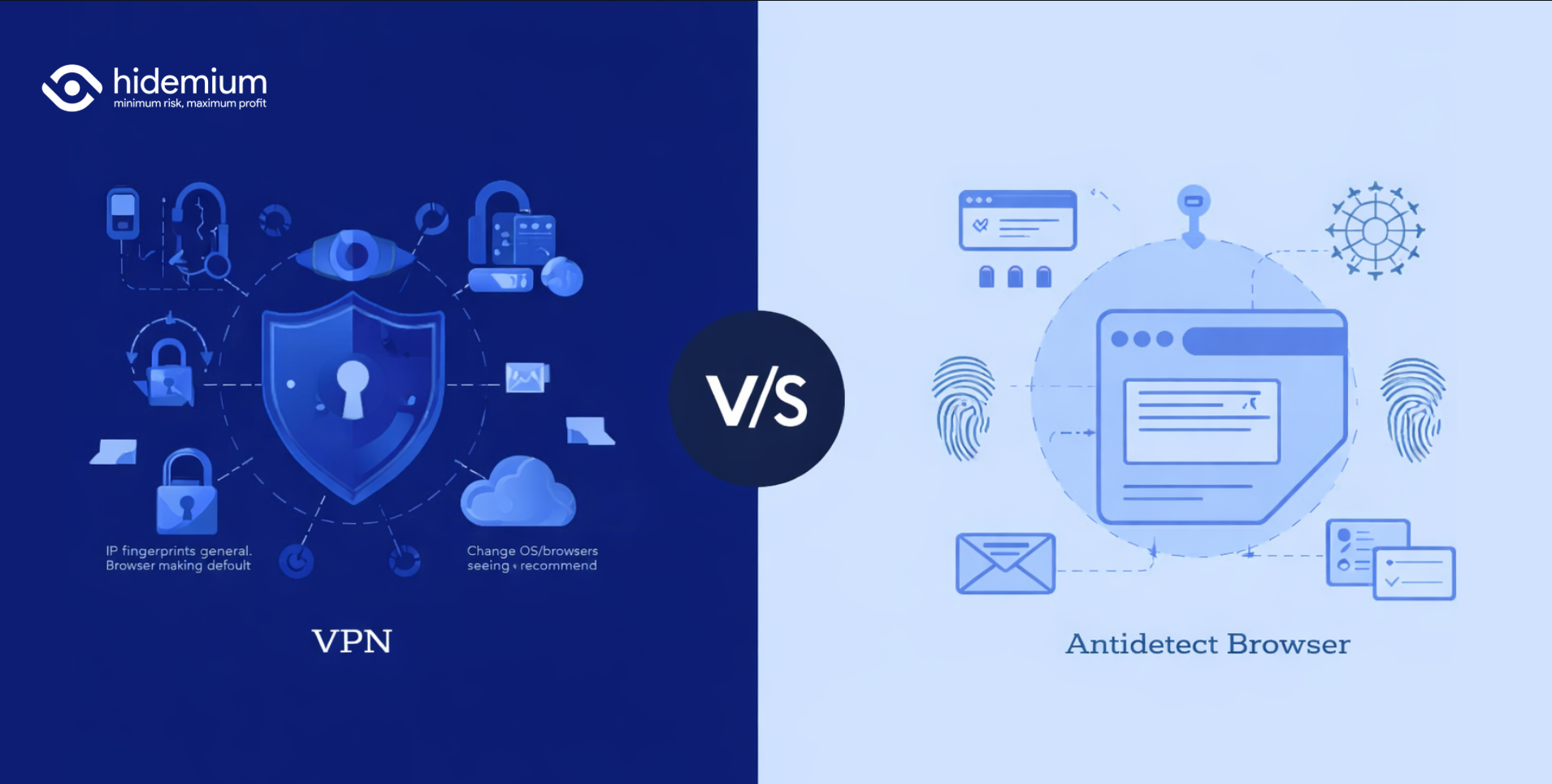

Is an Antidetect Browser or a VPN truly the “lifeline” for your account network?
While many people mistakenly believe that simply changing an IP with a VPN is enough, in reality, platforms can still easily detect device fingerprints and shut down accounts in bulk. The conflict between only hiding your IP (VPN) and fully masking your digital identity (Antidetect Browser) is the very line that separates success from costly losses in the MMO world.
1. Reasons for choosing to use a VPN
A VPN (Virtual Private Network) is a technology that creates a secure network connection when you use public networks such as the Internet.
1.1 Reasons to Use a VPN
Using a VPN is not limited to tech experts. Below are practical reasons that any internet user should consider:
Protecting personal data: A VPN encrypts your information, helping prevent hackers from stealing passwords and credit card details when you use public Wi-Fi at cafés or airports.
Complete privacy: Your Internet Service Provider (ISP) will not be able to track your browsing history.
1.2 How a VPN works
To protect you, a VPN carries out a sophisticated technical process that happens almost instantly:
Connection: When you activate the VPN software, it establishes a secure connection to a VPN server.
Encryption: All your web requests are encrypted into unreadable code before leaving your device.
Tunneling: The data travels through a private “tunnel” from your device to the VPN server.
Forwarding: The VPN server decrypts the data and sends it to the website you want to access using a new IP address (the server’s IP).
1.3 Key Characteristics of a VPN
A high-quality VPN typically has the following standout features:
Strong security protocols: Uses protocols such as OpenVPN, WireGuard, or IKEv2 to ensure your data remains secure.
No-logs policy: Commits to not storing any information about users’ activities on its system.
Kill Switch feature: Automatically disconnects your internet if the VPN connection is suddenly interrupted, preventing data leaks.
Multi-platform support: Can be installed on a wide range of devices, from smartphones (iOS, Android) to computers (Windows, macOS), and even Smart TVs.
>>> Learn more: Top 10 best free VPN applications
2. What is an Antidetect Browser? The optimal solution for multi-accounting
An Antidetect Browser is a type of browser that allows users to create multiple separate browsing profiles on the same computer. It deeply manipulates system parameters to anonymize your real digital identity.
2.1 Reasons to Use an Antidetect Browser
Why do MMO professionals consider this an indispensable “weapon”?
Multi-account management: You can log into large numbers of accounts on the same computer without worrying about bans for violating multi-account policies.
Anti-linking protection: If one account gets banned, the others remain safe because each operates in a completely isolated environment.
Bypassing advanced detection systems: Modern e-commerce platforms and social networks use AI to scan browser fingerprints. Antidetect Browsers help you “get past the gate” in a legitimate way.
Efficient teamwork: You can share browser profiles with teammates anywhere without changing device parameters, reducing the risk of checkpoints or security flags caused by unfamiliar logins.
2.2 How an Antidetect Browser Works
To bypass detection systems, an Antidetect Browser does more than just change your IP address—it modifies your entire set of digital identification parameters, including:
Browser fingerprint: Modifies parameters such as user agent, screen resolution, language, and time zone.
Hardware fingerprint: Emulates hardware-related attributes like CPU, RAM, graphics card (WebGL), battery information, and even the MAC address.
Canvas and WebGL: Introduces noise into graphics rendering techniques that websites use to identify your browser.
Cookie isolation: Each profile has its own separate cookie storage and cache, with no overlap between profiles.
2.3 Key Characteristics of an Antidetect Browser
A professional Antidetect Browser typically includes the following features:
Features | Details |
|---|---|
Profile isolation | Each profile operates like an independent virtual machine within the browser. |
Integrated proxy support | Allows assigning a unique IP address (HTTP, SOCKS5) to each profile. |
Fingerprint customization | Users can manually configure fingerprints or let the system generate random ones automatically. |
Automation support | Provides APIs to integrate with automation tools such as Selenium or Puppeteer. |
Browser engine base | Typically built on Chromium or Firefox to ensure maximum web compatibility. |

>>> Learn more: Top 7 best anti-detect browsers for affiliate marketing
3. Five Key Differences Between VPNs and Antidetect Browsers
Below is a quick comparison table highlighting five major differences to help you clearly understand the distinction:
Criteria | VPN | Antidetect Browser |
Primary purpose | Security & single IP change | Multi-identity management |
IP address change | Yes (shared server IP) | Yes (combined with dedicated proxies) |
Fingerprint modification | ❌ No | ✅ Yes |
Multi-account management | ❌ No | ✅ Yes |
Anti-linking protection | ❌ No | ✅ Yes |
Isolated environments | ❌ No (shared browser environment) | ✅ Yes (separate cookies/cache) |
Best suited for | General users | MMO, advertising, e-commerce, seeding |
4. When should you use a VPN?
A VPN is suitable for general users or simple tasks that do not require managing multiple accounts:
Personal security: When you want to browse anonymously and avoid being tracked by your ISP.
Bypassing firewalls: Accessing websites that are blocked in your country.
Streaming & gaming: Changing regions to watch foreign content or reducing ping when playing international games.
Note: A VPN is not suitable for managing multiple accounts within the same browser.
5. When should you use an Antidetect Browser?
If you are a professional working in online business, an Antidetect Browser is an essential tool:
Managing advertising accounts: Running Facebook Ads or Google Ads without worrying about “linked-account” bans.
E-commerce operations: Managing multiple stores on Amazon, eBay, Etsy, or Shopee without being flagged for duplicate identities.
Crypto & airdrops: Participating in airdrops or whitelist campaigns with large numbers of accounts to increase your chances of success.
Affiliate marketing: Placing affiliate links across multiple platforms without being marked as spam.
Advice: If you only need to protect your personal data, a VPN is sufficient. If you manage multiple accounts or work in professional marketing, an Antidetect Browser is the optimal choice.
Conclusion: In an environment where platforms are increasingly tightening controls with fingerprinting technology and AI, relying solely on a VPN to change your IP is no longer safe for managing multiple accounts. A VPN only hides your IP address, while your digital identity can still be easily identified through your browser, hardware characteristics, and stored data.
Therefore, to maintain accounts sustainably, avoid account linking, and minimize the risk of mass bans, an Antidetect Browser is a must-have solution for anyone working in MMO, advertising, e-commerce, or affiliate marketing. Among the tools available today, Hidemium Antidetect Browser stands out for its ability to create fully isolated browser environments, generate natural-looking fingerprints, and deliver high stability—making it suitable for both beginners and professional users.
Related Blogs

Looking to expand your Print on Demand (POD) sales while keeping your account safe? Printify – one of the most popular POD platforms today – offers many attractive passive income opportunities. However, when you start scaling up to multiple accounts to optimize business efficiency, the risk of account suspension, data linking, or spam marking also increases.In this article, Hidemium will help you[…]
.png)
Reddit continues to maintain its position as one of the most engaging platforms today, with over 50 million daily active users. However, users cannot always access Reddit smoothly. Some regions may have restricted access, while the mechanism strict bot detection Reddit's system makes account management and data collection more difficult. Therefore, proxy has become an essential supporting[…]
.png)
Why Most Video Workflows Still Feel BrokenIf you’ve ever tried to produce video content consistently, you already know the friction points. Ideation is slow. Editing is repetitive. And the gap between concept and final output is often where projects stall. Even with the rise of the ai video generator category, many tools still behave like traditional editors with a thin AI layer on top—they[…]
BrowserLeaks is a browser privacy testing website that shows what information your browser exposes to websites, including IP data, WebRTC information, browser configuration, Canvas/WebGL signals, and other fingerprinting attributes.A browser privacy test can help you identify potential browser data leaks and understand how browser fingerprinting may be used to distinguish one browser environment[…]

In the digital age, protecting your identity and managing multiple online accounts has become increasingly important. Proxy 911 S5 has been known as one of the most powerful and stable residential proxy solutions on the market. This article will help you understand what Proxy 911 S5 is, its pros and cons, and whether this is the right tool for your security, business, or automation needs. Let's[…]

The best antidetect browser for affiliate marketing depends on your workflow, team size, proxy requirements, automation needs, and budget. Hidemium is worth evaluating for organized browser-profile workflows and team collaboration; GoLogin emphasizes accessible profile management; Multilogin appeals to technical teams; Dolphin Anty is positioned toward ad-oriented workflows; AdsPower offers[…]
