

Amazon and Amazon Marketplace are part of the same e-commerce ecosystem, but they are not the same selling model. Amazon Retail sells products directly to customers, while Amazon Marketplace allows third-party sellers to list and sell products through Amazon’s platform.
The main differences between Amazon vs Amazon Marketplace involve who owns the inventory, seller fees, fulfillment, customer service, Prime eligibility, and seller control.
Although coexisting on the same platform, these two models have clear differences in terms of operation, product types, sales fees, and customer service. Understanding these important differences not only helps buyers have a better experience but also helps businesses optimize their business strategies, choose the right sales channels, and increase profits.
In the following content, Hidemium will analyze in detail the difference between Amazon and Amazon Marketplace, and introduce options to help you maximize your sales potential on the platform.
Key Takeaways: Amazon vs Amazon Marketplace
- Amazon Retail sells products directly to customers and manages the retail inventory.
- Amazon Marketplace hosts third-party sellers who sell through Amazon.com.
- Marketplace sellers may use FBA or manage fulfillment themselves through FBM.
- Seller fees, inventory responsibility, customer service, and Prime eligibility depend on the selling model.
- Sellers managing more than one approved business account should follow Amazon’s current account policies and keep operations clearly separated.
Quick Comparison: Amazon vs Amazon Marketplace
| Feature | Amazon (Retail) | Amazon Marketplace |
|---|---|---|
| Who sells? | Amazon directly | Third-party sellers |
| Product condition | New only | New & used |
| Monthly fee | $0.99/item (Personal) or $39.99/mo (Pro) | Same + referral & closing fees |
| FBA available? | Built-in | Yes (optional, extra cost) |
| Inventory control | Amazon owns & manages | Seller manages |
| Customer service | Amazon handles | Seller handles (A-to-Z Guarantee applies) |
| Prime eligible? | Always | Only via FBA or SFP |
| Best for | Large brands / vendors | Independent & multi-account sellers |
| Approval required? | Yes (Vendor Central invite-only) | No (open to all sellers) |
| Multi-account allowed? | Not permitted | With Amazon approval + anti-detect tools |
1. What is Amazon?
Amazon.com is one of the world's largest e-commerce platforms. Here, users can buy almost any product – from clothes, shoes, electronic devices to even… rabbit cages.
In the US market alone, Amazon is one of the largest e-commerce platforms in the United States and globally, offering millions of products across a wide range of categories. These products are packaged and shipped by Amazon, many orders can even be delivered the same day thanks to the Amazon Prime service — a factor that creates an outstanding competitive advantage for this platform.
1.1 Ways to sell on Amazon
To become a seller, Amazon offers three main programs: Amazon Vendor Central, Amazon Seller Central, and Amazon Advantage.
a. Amazon Vendor Central
With Vendor Central, you sell directly to Amazon at wholesale prices. Amazon then lists the products on its website and keeps all the profits. This program is invite-only, typically for large manufacturers or distributors.
b. Amazon Seller Central
This is the most popular option for third-party sellers. Through Seller Central, you can sell products directly to customers and share a portion of the profits with Amazon. Sellers can either self-manage orders and inventory or use Fulfillment by Amazon (FBA).
With FBA, sellers just need to send products to Amazon's warehouse. Amazon handles order confirmation, packaging, shipping, and customer care.
Benefits of selling via FBA:
- Prime eligibility: Eligible FBA listings may qualify for Prime benefits, depending on Amazon’s current requirements.
- Fulfillment support: FBA lets Amazon handle storage, picking, packing, shipping, returns, and parts of customer service.
- Operational efficiency: FBA can reduce the amount of fulfillment work sellers need to handle directly.
c. Amazon Advantage
This is a consignment program specifically for media products like books, music, and DVDs. Sellers ship products to Amazon, which handles fulfillment and shipping to customers.
1.2 How Do Amazon Seller Fees Work in 2026?
Amazon selling fees depend on the seller plan, product category, fulfillment method, and other services used. Marketplace sellers should always verify current fees before calculating margins because Amazon may update pricing over time.
Whichever model you choose, selling on Amazon comes with certain fees. The most important are:
- Referral Fee — a percentage of each sale
- Fulfillment Fee — if using FBA
Understanding the fee structure will help you be more proactive in calculating profits and business strategies.
2. What is Amazon Marketplace?
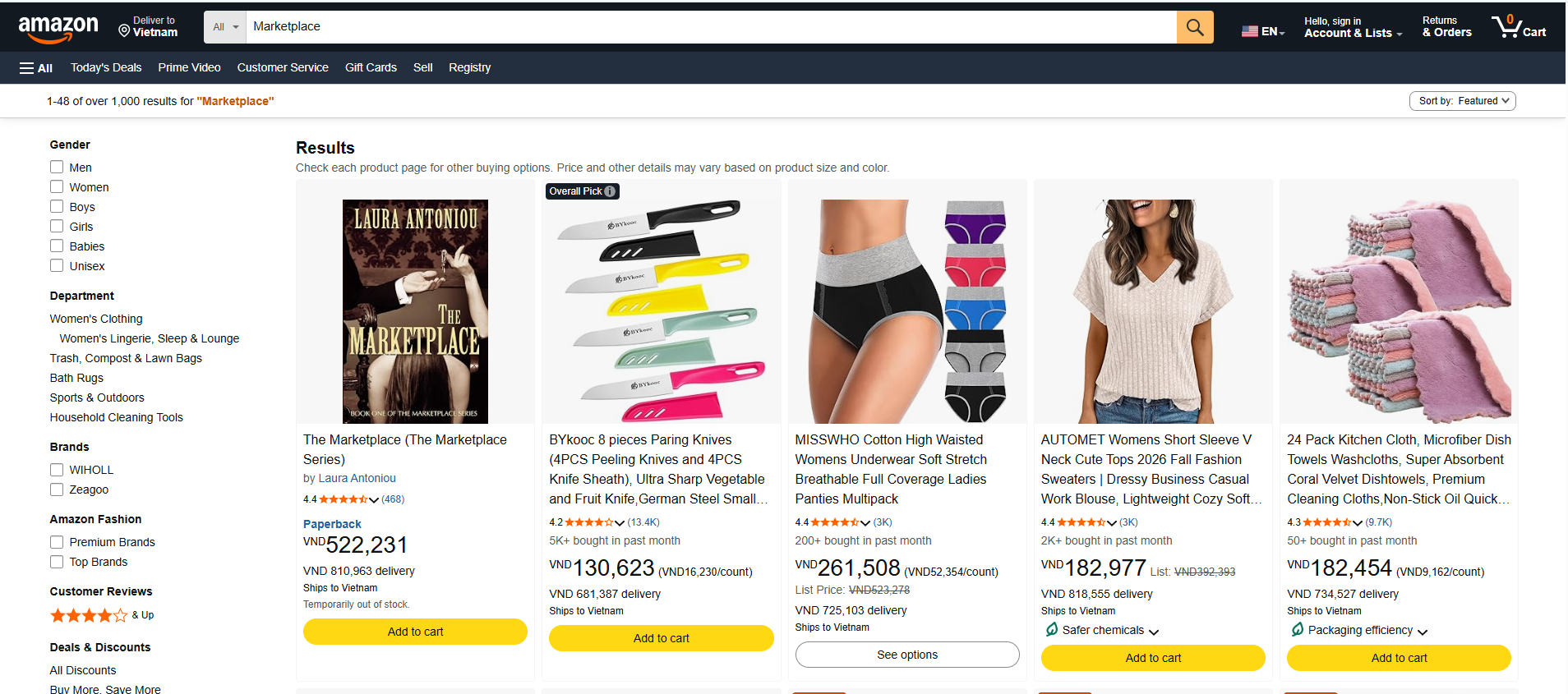
Amazon Marketplace is the part of Amazon.com that allows independent third-party sellers to list and sell products directly to Amazon customers. Sellers control their own listings and inventory while using Amazon’s marketplace infrastructure, payment system, and optional fulfillment services.
>>> Learn more: What is Amazon Marketplace 2026? What buyers and sellers need to know.
2.1 What is different about shopping on Amazon Marketplace?
For consumers, shopping on Amazon Marketplace has almost no visible difference compared to buying directly from Amazon. The entire ordering, payment, and order confirmation process takes place on the same Amazon domain, creating a sense of security and familiarity.
The key difference: when a product is sold through Amazon Marketplace, Amazon only collects a commission fee, while the profit goes to the third-party seller. As a result, you can find a wide variety of products, including new and used goods — often at lower prices than products distributed directly by Amazon.
2.2 How to identify products from Amazon Marketplace
To distinguish Marketplace goods, pay attention to the product detail page. Right next to the "Add to cart" button, you will see:
- "Shipped from"
- "Sold by"
If it is a third-party product, the "Sold by" section will display the store name or specific seller name. Amazon-direct products will show "Sold by Amazon".
>>> Learn more: 17 Amazon SEO Tools to Help Your Products Stand Out and Increase Sales
3. Amazon vs Amazon Marketplace: 6 Key Differences
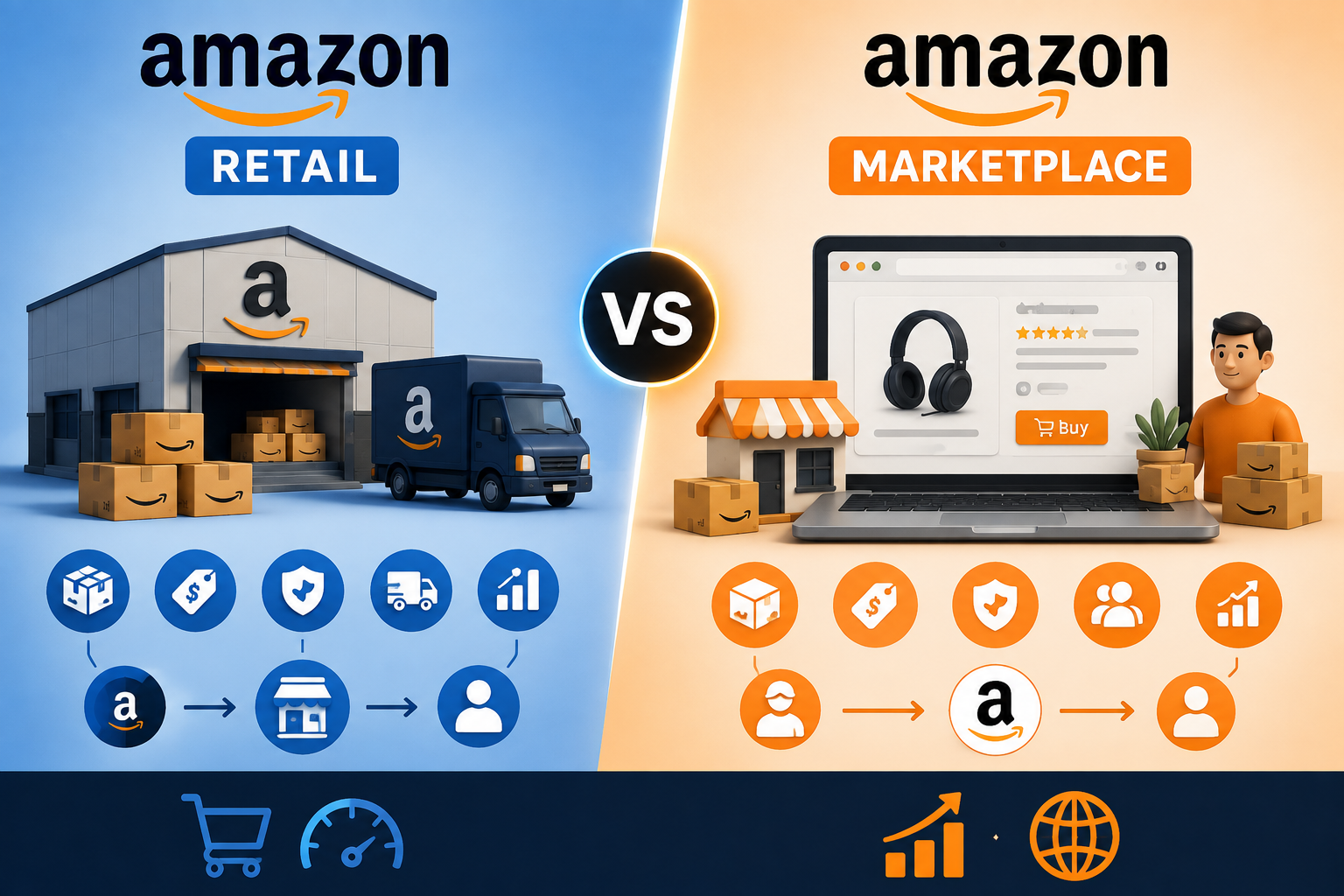
In this section, we explore the difference between Amazon.com and Amazon Marketplace — two concepts that are often confused but have distinct characteristics. Here are 6 important differences:
3.1. How Do Amazon and Amazon Marketplace Differ as Selling Models?
Amazon started as a small online bookstore, but has now become the world's leading e-commerce and technology corporation. With a customer-centric strategy, Amazon continuously innovates technology, expands its global reach, and builds a huge ecosystem serving millions of users. It is also particularly successful with AWS (Amazon Web Services) cloud services.
Amazon Marketplace, in contrast, is a third-party e-commerce platform. It allows independent sellers to post products and reach customers directly through the Amazon system. The platform focuses on sellers, providing services to help them promote and distribute goods for a fixed fee. Third-party sellers represent a significant share of the products and units sold through Amazon, making Marketplace an important part of Amazon’s e-commerce ecosystem.Personal
3.2. What Products Can Be Sold on Amazon vs Amazon Marketplace?
The product categories of both are almost the same — cosmetics, electronics, consumer goods. However:
- Amazon Retail Products: Amazon branded items, always 100% new, and most are eligible for the Amazon Prime program.
- Amazon Marketplace Products: Offered by third-party sellers, products may be new or used. Not all are eligible for Amazon Prime benefits.
Every product must have a genuine UPC code to ensure transparency. Amazon reserves the right to remove non-compliant products.
3.3. How Do Amazon vs Amazon Marketplace Fees Differ?
On Amazon.com, sellers choose between two service packages:
- Personal Package: No monthly fee, but $0.99 per product sold.
- Professional Package: Flat fee of $39.99/month, no per-order commission.
On Amazon Marketplace, third-party sellers additionally pay:
- Closing fee (for media products)
- FBA fees when using the service
- Referral fee and other additional charges
Compared to Amazon Marketplace, Amazon's fee structure is considered simpler and more cost-effective for most sellers.
3.4.Who Controls Inventory on Amazon vs Amazon Marketplace?
Amazon acts as an online retailer with full control over the inventory management process — from importing goods to storing to delivery. Products users receive are shipped directly from Amazon's warehouse system.
Amazon Marketplace does not directly own or manage products. It is a connecting platform where third-party sellers are responsible for all sourcing, warehousing, and distribution. Amazon Marketplace only provides infrastructure and services to facilitate the buying and selling environment.
3.5. How Does Fulfillment Differ Between Amazon and Marketplace?
Amazon provides FBA (Fulfillment by Amazon), allowing sellers to store products in Amazon's warehouses and let Amazon handle all packaging and shipping. Programs like Seller-Fulfilled Prime and Amazon Easy Ship support fast shipping and a convenient shopping experience.
Amazon Marketplace sellers can choose from multiple fulfillment options:
- FBM (Fulfillment by Merchant) — self-managed orders
- 3PL (Third Party Logistics) — outsourced fulfillment
- Hybrid Approach — combining FBM and 3PL
3.6. Who Handles Returns and Customer Service?
Amazon.com applies a transparent, user-friendly return system. Each product group has clear regulations. Amazon has a professional customer care team always ready to ensure buyer satisfaction.
On Amazon Marketplace, the return process and customer service are managed by third-party sellers. However, Amazon's A-to-Z Guarantee program helps quickly and fairly handle complex situations, protecting the rights of both sellers and buyers.
>>> Learn more: Effective Strategies to Increase Sales on Amazon
4. Can You Manage Multiple Amazon Marketplace Seller Accounts?
Many experienced Amazon sellers operate multiple seller accounts to manage different product lines, enter new markets, or separate business entities. While Amazon's policy generally restricts one account per seller, there are legitimate business cases where multiple accounts are permitted — with prior approval from Amazon.
Many sellers combine Amazon Marketplace with broader make money online (MMO) strategies to diversify their income. >>> Learn more: Get Rich from AI and MMO: How to Make Money Online Effectively
Managing multiple Amazon seller accounts requires careful separation of browser environments. If Amazon detects the same device fingerprint or IP address across accounts, it may suspend all linked accounts. This is where anti-detect browsers become essential.
Hidemium is an anti-detect browser designed for multi-account management on Amazon Marketplace and other e-commerce platforms. It creates isolated browser profiles with unique fingerprints, cookies, and proxies — ensuring each account appears as an independent user. This helps sellers:
- Manage multiple Amazon storefronts safely from one device
- Avoid account bans and fingerprint detection
- Scale their Amazon Marketplace business without risk
- Automate routine tasks across accounts efficiently
If you're scaling your Amazon Marketplace business across multiple accounts or storefronts, explore how Hidemium's use cases can support your growth.
5. Conclusion
Through the analysis, it is clear that Amazon and Amazon Marketplace, although operating on the same platform, have distinct differences:
- Amazon Marketplace allows third-party sellers to list new or used products on the world's largest e-commerce platform.
- Amazon provides shipping, fulfillment, and customer service, but sellers need to share in the profits.
- Buyers can easily identify whether a product comes from Amazon directly or from a third party to make the right decision.
So, you can now clearly distinguish the difference between Amazon and Amazon Marketplace to choose the safest and most effective shopping and selling channel.
>>> Learn more: 21 Ways to Make $100 Online Every Day — expand your income beyond Amazon Marketplace
6. FAQ
Should I sell on Amazon Marketplace?
Yes. Selling on Amazon Marketplace requires effort but brings great value. Many businesses have succeeded with the right products, marketing strategy, and support from management tools and quality customer service. Despite fierce competition, the opportunity to grow and expand revenue remains very open.
Is Amazon Marketplace safe?
Amazon Marketplace is a trusted and secure platform. Buyers should pay directly through Amazon's official system to ensure transparent and protected transactions.
Why is Amazon Marketplace considered a "marketplace"?
Amazon Marketplace brings thousands of third-party sellers together on one platform. Customers access a wide range of products and can easily compare prices, bringing healthy competition and maximum benefits to buyers.
Why is Amazon Marketplace the ideal sales channel?
Amazon Marketplace has a huge customer base, comprehensive sales tools, flexible shipping methods, and strong advertising opportunities. With quality products and the right business strategy, sellers can create a sustainable source of income and quickly expand their brand.
How does Amazon Marketplace reach customers differently than Amazon?
Marketplace allows sellers to offer both new and used products, expanding customer reach and catering to a wider variety of needs than Amazon's own retail channel.
How to identify products on Amazon Marketplace?
When purchasing, check the "Delivery from" and "Sold by" information on the product page. This clearly displays the seller's name and helps you easily distinguish whether the product comes from Amazon or a Marketplace seller.
Can I use multiple Amazon seller accounts on Marketplace?
Amazon generally allows only one seller account per person. However, with a legitimate business reason and Amazon's approval, multiple accounts may be permitted. Tools like Hidemium help manage multiple accounts safely by isolating browser profiles and preventing cross-account detection.
Related Blogs

Radmin VPN is a free Windows tool that creates a virtual LAN between computers over the internet. Unlike a traditional VPN, it is mainly designed for LAN gaming, remote access, and file sharing rather than hiding your public IP address.In this guide, you’ll learn what Radmin VPN does, whether it is safe, how to download and install it, and how to use it for gaming or remote work in just a few[…]

Scaling Multi-Accounting: How Proxies Complement Anti-Detect BrowsersIf you have ever done multi-accounting, you know that this activity can lead to a ban. Websites and social networks prohibit managing several accounts at the same time and block violators.However, strict bans do not stop everyone. Many users who work on the Internet successfully bypass them and manage accounts without any[…]
The “big five” business functions - campaign management, audit, and commercial asset management - are common to modern digital marketing agencies, e-commerce, or performance teams working across several geographic regions. For optimized local asset management, it’s important to have strong controls over network connections and browser environments.Without having to package physical SIMs, send[…]

In the context of relationships with cyber security threats as cyberattacks continue to increase, protecting small businesses from cyberattacks has become a top priority. 2025 marks a turning point with many advanced technology solutions that help small businesses improve their defenses without spending too much money.This article Antidetect Browser Hidemium will introduce Top 13 Cyber Security[…]

Bluesky is a decentralized social network that is gaining popularity, developed by Jack Dorsey – co-founder of Twitter. With the goal of becoming a transparent and open alternative to traditional platforms, Bluesky is attracting strong attention from the global user community.As Bluesky's popularity grew, especially among brands, marketers and entrepreneurs, a question often asked is: Can I use[…]
.png)
Captcha is a popular security tool used on websites to prevent suspicious activities from automated programs (bots). However, Captcha can sometimes be frustrating for users, especially when fast access is needed or when the Captcha becomes overly complex. In this article, we will explore 7 effective ways to bypass Captcha in 2025, allowing you to overcome these barriers legally and safely.1. What[…]
