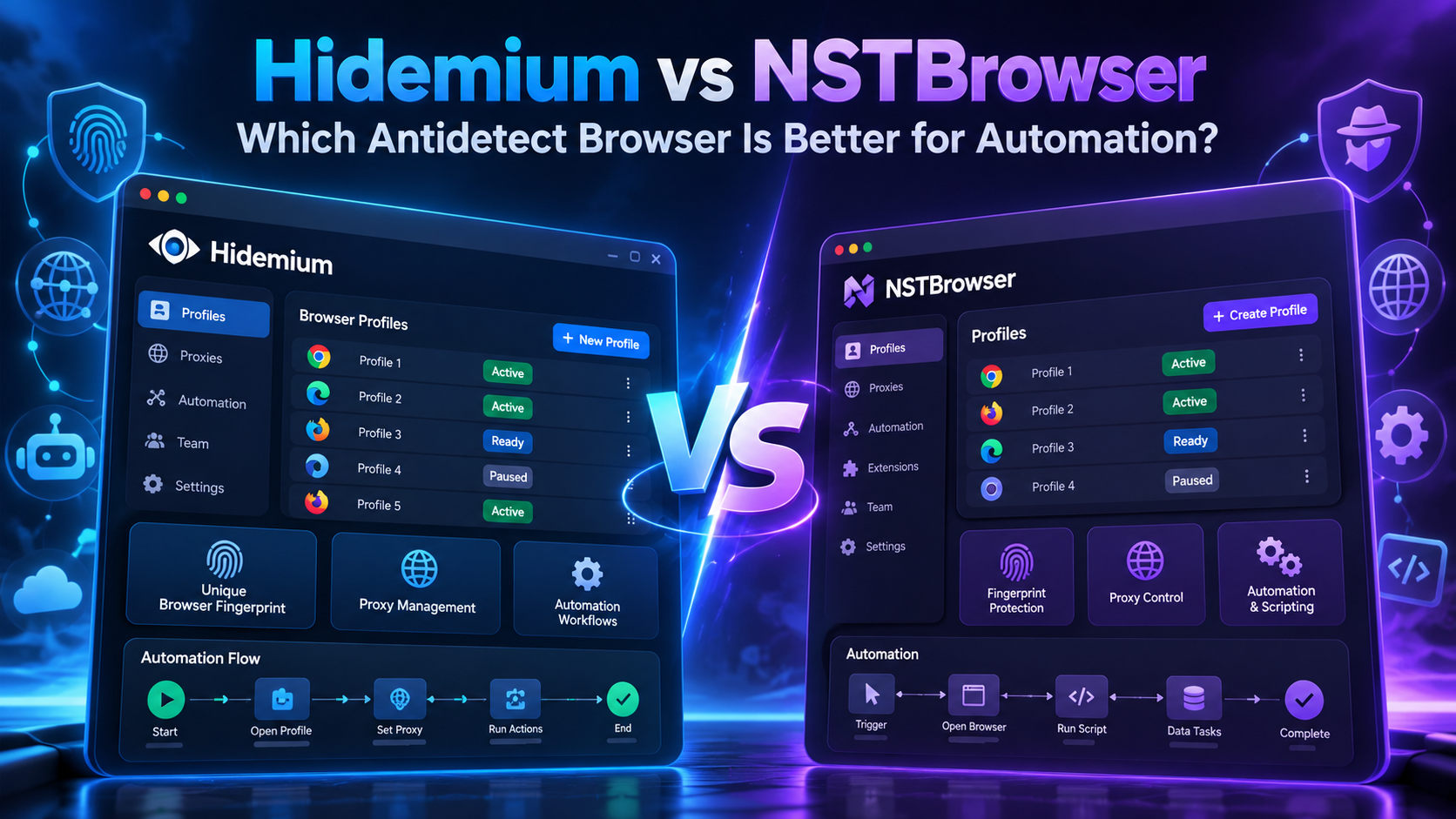

Choosing the right antidetect browser is becoming increasingly important for teams that manage multiple browser profiles, automate repetitive workflows, work with proxies, or operate multiple online accounts.
Two platforms that often appear in this conversation are Hidemium and NSTBrowser.
Both tools are designed to help users create isolated browser environments, manage multiple profiles, configure proxies, and build more efficient browser workflows. However, they approach automation, usability, profile management, and team operations differently.
So, which platform is the better choice?
In this Hidemium vs NSTBrowser comparison, we will examine their features, pricing approach, browser fingerprinting capabilities, automation tools, proxy management, API options, team collaboration, ease of use, and common use cases.
If you are currently researching an NSTBrowser alternative, this guide will also help you determine whether Hidemium fits your workflow.
For readers who are new to this category, you may want to first learn what an antidetect browser is.
Hidemium vs NSTBrowser: Quick Overview
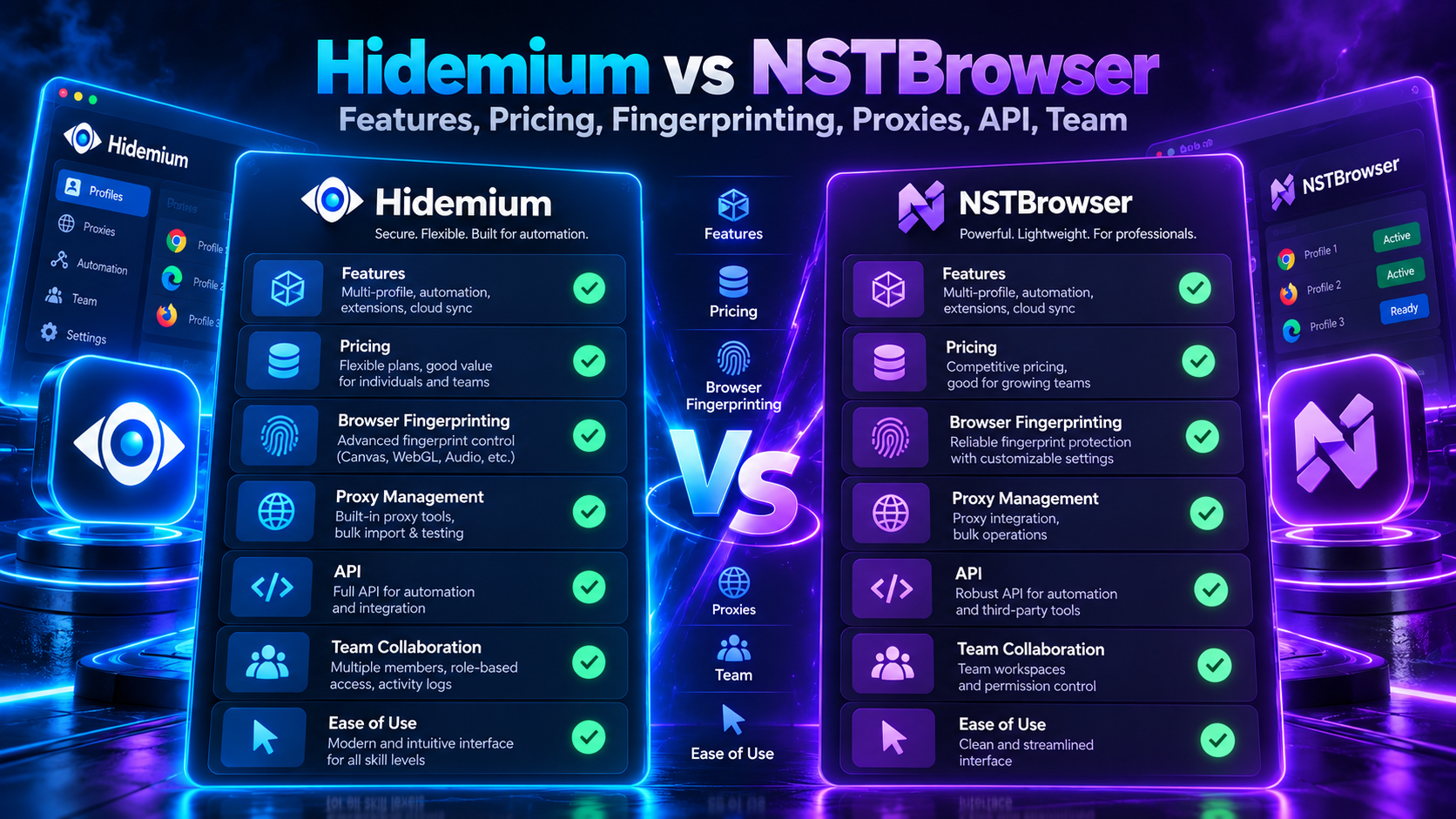
Hidemium and NSTBrowser belong to the same broad category of tools: antidetect and multi-profile browsers.
Instead of using one normal browser environment for every task, these platforms allow users to create separate browser profiles with independent configurations.
This can be useful for workflows involving:
- Multiple account management
- E-commerce operations
- Social media management
- Affiliate marketing
- Browser automation
- Web testing
- Research workflows
- Team-based account operations
- Proxy-based browser environments
Hidemium focuses heavily on combining browser profile management with automation capabilities, making it suitable for users who want to manage both manual and automated workflows from a single platform.
NSTBrowser also combines antidetect technology with browser automation and is particularly relevant to users interested in automation-heavy workflows.
The better option therefore depends less on whether the platforms have similar features and more on how those features fit your workflow.
Before choosing either platform, it is worth understanding how browser fingerprinting works and why isolated browser environments matter.
Features: Hidemium vs NSTBrowser
At the core level, both platforms provide tools for creating and managing isolated browser profiles.
A typical antidetect browser profile can contain its own:
- Cookies
- Local storage
- Browser configuration
- Proxy
- Fingerprint parameters
- Login sessions
- Website data
This helps users separate different browsing environments instead of running everything through the same browser session.
Hidemium Features
Hidemium is designed around multi-profile browser management combined with automation.
Users can organize browser profiles, configure proxy settings, maintain separate sessions, and automate repetitive browser actions.
One of Hidemium's advantages is the possibility of combining profile management and automation within the same workflow.
For example, a team managing dozens or hundreds of browser profiles may not want employees to manually repeat the same sequence of actions for every profile.
Automation can reduce that repetitive work.
Users interested in this functionality can explore Hidemium automation to understand how automated browser workflows can be integrated into profile management.
NSTBrowser Feature
NSTBrowser similarly focuses on antidetect browser environments and automation.
Its positioning is particularly relevant for users working with browser automation, scraping, testing, and multi-profile operations.
For technical users, NSTBrowser can therefore be attractive when browser automation is a significant part of the workflow.
Features Verdict
Both platforms cover many of the same fundamental requirements.
The important question is not simply:
“Which platform has more features?”
Instead, ask:
“Which platform allows my team to complete our workflow with fewer tools and less manual work?”
For businesses managing multiple browser identities, workflow efficiency can be more important than a long feature checklist.
Pricing: Hidemium vs NSTBrowser
Pricing is one of the most important considerations when comparing antidetect browsers.
However, users should avoid comparing plans based only on the advertised monthly subscription price.
The real cost of a multi-account browser depends on several factors:
- Number of browser profiles
- Number of team members
- Automation requirements
- API access
- Cloud features
- Proxy costs
- Number of devices
- Required profile capacity
A cheaper entry-level subscription may become more expensive once additional profiles, team members, or automation capabilities are required.
The opposite can also happen: a plan with a higher starting price may include features that eliminate the need for additional software.
H3: How to Compare Hidemium and NSTBrowser Pricing
When comparing Hidemium pricing vs NSTBrowser pricing, calculate the cost based on your actual operating requirements.
For example, estimate how many profiles your team expects to manage over the next six months rather than only how many profiles you currently use.
You can review Hidemium pricing plans to select the package that best matches your expected number of profiles and workflow requirements.
Because software pricing and plan limits can change, always verify the current pricing pages of both providers before making a purchase decision.
Browser Fingerprinting: Hidemium vs NSTBrowser
Browser fingerprinting is one of the core technologies behind antidetect browsers.
Websites may observe numerous browser and device characteristics, including:
- Operating system
- Browser version
- Screen resolution
- Time zone
- Language
- WebGL information
- Canvas characteristics
- Hardware parameters
- Fonts
- WebRTC configuration
Together, these signals can contribute to a browser fingerprint.
Antidetect browsers create separate browser environments and allow users to manage these parameters across different profiles.
Both Hidemium and NSTBrowser provide functionality designed around isolated browser profiles and fingerprint management.
Why Fingerprint Consistency Matters
Users should remember that successful profile management is not simply about changing as many parameters as possible.
Consistency matters.
For example, browser characteristics, operating system information, time zone, language, and proxy location should make sense together.
Creating unrealistic combinations can make a profile less coherent rather than more convincing.
If fingerprint management is an important part of your workflow, read our browser fingerprint management guide before configuring large numbers of profiles.
Browser Fingerprinting Verdict
Both Hidemium and NSTBrowser operate in a category where fingerprint management is a core feature.
Instead of comparing only the number of configurable parameters, teams should evaluate:
- Profile consistency
- Setup simplicity
- Browser updates
- Stability
- Profile cloning or creation workflow
- Compatibility with automation
For large-scale operations, ease of maintaining profiles can be just as important as advanced configuration options.
Automation: Hidemium vs NSTBrowser
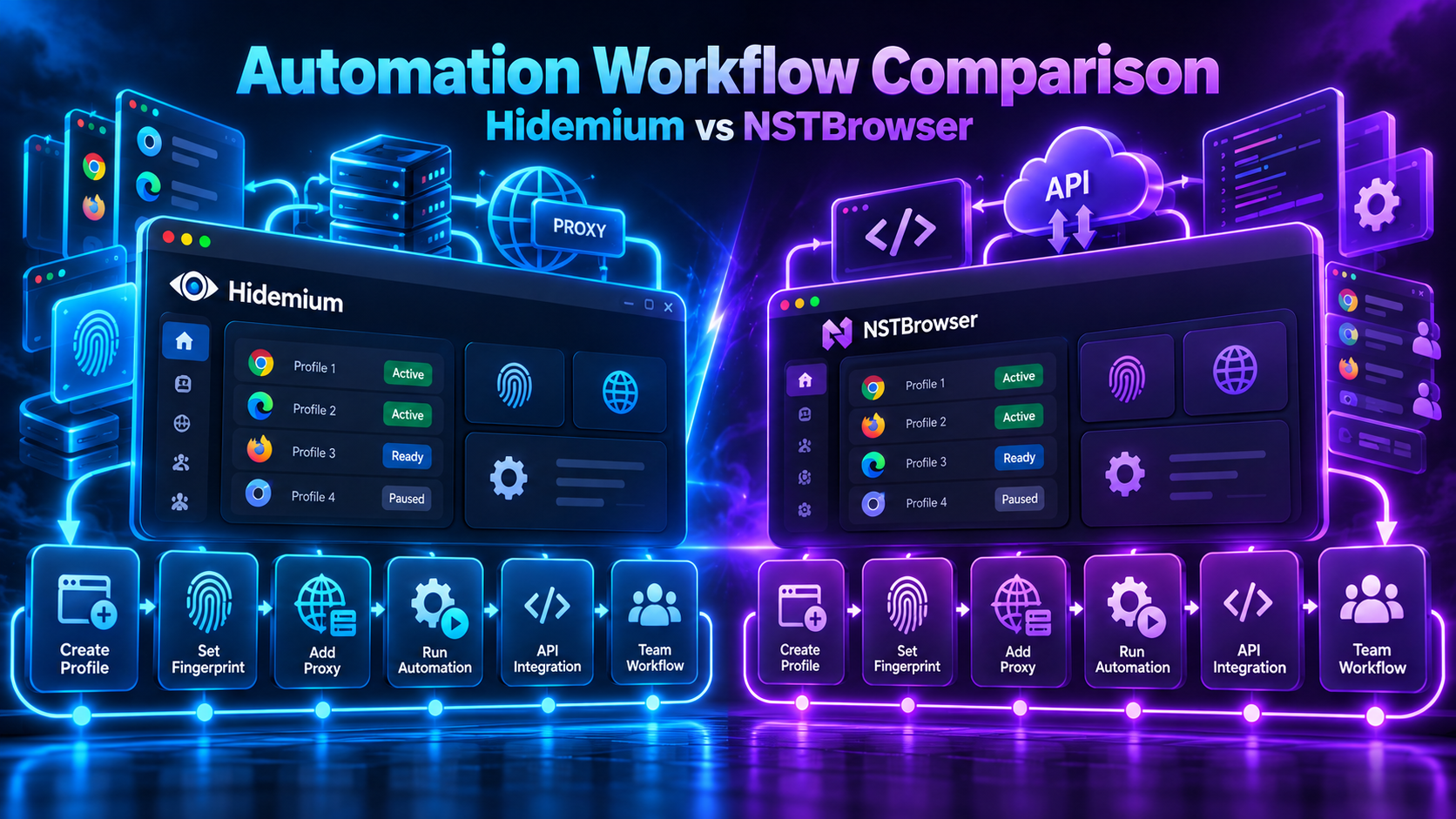
Automation is where the comparison becomes especially interesting.
Modern multi-account workflows often contain repetitive tasks.
Employees may need to:
- Open a profile
- Navigate to a website
- Log in
- Visit specific pages
- Collect information
- Fill forms
- Upload content
- Perform routine browser actions
Doing these tasks manually across many profiles can consume significant time.
Browser automation can reduce repetitive work and help teams standardize processes.
Hidemium Automation
Hidemium combines antidetect browser profile management with automation capabilities.
This makes it possible to create workflows where browser profiles are not simply stored and launched manually but can become part of a broader automated process.
For teams scaling from a handful of profiles to dozens or hundreds, this can have a major impact on operational efficiency.
A useful starting point is our guide to automating multiple browser profiles.
NSTBrowser Automation
NSTBrowser also places significant emphasis on browser automation.
It can be attractive to technically oriented users who want to combine browser profiles with automated browsing workflows.
The right platform depends partly on the technical level of the team.
Some organizations prefer highly customizable developer-oriented automation.
Others want workflows that non-developers can configure and operate without maintaining complex automation infrastructure.
Automation Verdict
If automation is your primary requirement, test both platforms using a real workflow from your business.
Do not compare automation tools only through product screenshots.
Build the same workflow in both tools and measure:
- Setup time
- Execution reliability
- Maintenance effort
- Error handling
- Profile integration
- Required technical knowledge
This produces a much more useful comparison than a simple feature checklist.
Proxy Management: Hidemium vs NSTBrowser
Proxies are another important component of multi-profile browser workflows.
Users may need to assign different proxies to different profiles and maintain a consistent network environment for each browser session.
Both Hidemium and NSTBrowser support workflows involving proxy configuration.
H3: What to Compare in Proxy Management
When evaluating proxy management, consider:
- Supported proxy types
- Proxy assignment
- Proxy testing
- Profile-to-proxy mapping
- Bulk configuration
- Proxy replacement workflow
- Geographic consistency
Managing proxies manually becomes increasingly difficult as the number of browser profiles grows.
For example, managing five profiles manually may be easy.
Managing 500 profiles requires a structured system.
If you are building a large profile environment, read how to use proxies with an antidetect browser.
The goal should be to maintain an organized relationship between browser profiles and their associated network configurations.
API: Hidemium vs NSTBrowser
API access becomes increasingly important as businesses scale.
A small user may simply launch profiles manually from the application.
A larger operation may want to integrate browser profile management into internal systems, scripts, dashboards, or automation infrastructure.
Why API Access Matters
An API can potentially allow workflows such as:
- Creating browser profiles
- Starting profiles
- Stopping profiles
- Updating profile information
- Connecting automation scripts
- Managing profile groups
- Integrating browser operations with internal software
Both Hidemium and NSTBrowser should therefore be evaluated not only as standalone applications but also as components of a broader automation stack.
Developers considering programmatic browser management can explore the Hidemium API documentation.
Before selecting a platform for API-driven operations, test the exact endpoints and capabilities required by your application.
API availability and limits may also depend on subscription plans.
Team Collaboration: Hidemium vs NSTBrowser
Individual users and teams have very different requirements.
A freelancer managing ten profiles may primarily care about usability and price.
An agency managing hundreds of accounts may need:
- Multiple team members
- Profile sharing
- Workspace organization
- Access permissions
- Profile grouping
- Operational consistency
- Centralized management
This is why team functionality should be evaluated early rather than after an organization has already migrated hundreds of profiles.
Hidemium for Teams
Hidemium can be considered by teams looking to centralize browser profile operations and automation.
This can be useful for agencies, e-commerce teams, marketing teams, and distributed operations where several employees need access to the same working environment.
NSTBrowser for Teams
NSTBrowser can also fit collaborative workflows depending on the organization's requirements and selected plan.
When comparing the two, consider how quickly a new employee can understand the system.
A technically powerful platform that requires extensive training may create unnecessary operational overhead.
Conversely, an easy interface may not be enough if the platform lacks the controls needed by a larger team.
For agencies and distributed operations, see our guide to managing multiple accounts with a team.
Ease of Use: Hidemium vs NSTBrowser
Features matter, but usability determines whether those features actually improve productivity.
A good multi-account browser should make common operations straightforward.
For example:
- Create a profile.
- Configure the browser environment.
- Assign a proxy.
- Organize the profile.
- Launch the browser.
- Run the required workflow.
Ease of Use for Hidemium Users
Hidemium may appeal to users looking for a combination of multi-profile management and automation within one environment.
This can make it easier for users who do not want to rely on several separate tools for browser profiles, automation, and account organization.
Ease of Use for NSTBrowser Users
NSTBrowser may appeal strongly to users whose workflows are centered around browser automation and technical operations.
The best choice depends on your team.
A developer, an affiliate marketer, an e-commerce operator, and a social media manager may each prefer a different interface.
The easiest way to evaluate usability is to create several profiles and perform an actual workflow rather than judging the products from their landing pages alone.
Use Cases: Hidemium vs NSTBrowser
Both tools can support several overlapping use cases.
Multi-Account Management
Businesses that legitimately operate multiple accounts may need separate browser environments to maintain organized sessions and workflows.
A multi-account browser can make profile organization significantly easier than maintaining dozens of normal browser installations.
E-Commerce Operations
E-commerce teams may work across multiple stores, marketplaces, or client environments.
Profile organization, proxy management, team collaboration, and automation can all become relevant as the operation grows.
For agencies or sellers operating at scale, browser profile organization can help simplify daily account management.
Social Media Management
Agencies and social media teams frequently work with multiple client environments.
Separate profiles can help teams organize cookies, sessions, and account-specific browser data.
This can be especially useful when several team members need to work across different projects.
Affiliate Marketing
Affiliate marketers often operate across multiple campaigns and platforms.
Automation and browser profile organization can reduce repetitive tasks while improving workflow consistency.
Browser Automation
For automation-heavy organizations, this may be the most important category.
Instead of treating an antidetect browser only as a place to store profiles, businesses can integrate browser profiles into automated workflows.
This is one area where both Hidemium and NSTBrowser deserve serious consideration.
Hidemium vs NSTBrowser: Which One Should You Choose?
There is no universal winner for every user.
Choose based on your actual operational requirements.
Consider Hidemium If You Want
- Multi-profile browser management
- Integrated automation workflows
- Centralized profile organization
- Proxy-based browser environments
- API-driven workflows
- A solution that can grow with multi-account operations
Consider NSTBrowser If You Want
- Another automation-focused antidetect browser option
- Browser profile management
- Technical automation workflows
- A platform to evaluate alongside Hidemium for automation-heavy operations
The most reliable approach is to create the same small workflow in both platforms.
For example, create ten browser profiles, configure proxies, organize them, and automate one repetitive process.
Then compare how much time each platform requires.
Is Hidemium a Good NSTBrowser Alternative?
Yes, Hidemium is worth considering as an NSTBrowser alternative, particularly for users who want to combine browser profile management, proxies, team workflows, APIs, and automation in one platform.
However, switching tools should be based on workflow requirements rather than brand names alone.
What to Compare Before Switching from NSTBrowser
Before making a decision, compare:
- Number of profiles required
- Automation requirements
- Proxy workflow
- API needs
- Team size
- Technical expertise
- Total monthly cost
- Scalability
If automation is important, run a practical test.
If team management is important, test collaboration.
If profile scale is important, create enough profiles to simulate your real operating environment.
That will tell you far more than a feature comparison table.
For users who are currently researching alternatives, you can also explore our guide to the best antidetect browsers to compare Hidemium with other popular platforms.
Final Verdict: Hidemium vs NSTBrowser
The Hidemium vs NSTBrowser comparison is ultimately a comparison between two platforms operating at the intersection of antidetect browser technology, multi-profile management, and browser automation.
NSTBrowser is a relevant competitor for users focused on automation-oriented browser workflows.
Hidemium, meanwhile, is worth considering for businesses and teams looking to combine browser profiles, proxy management, automation, APIs, and scalable multi-account operations within one ecosystem.
Instead of asking only which antidetect browser has the longest feature list, focus on a more practical question:
Which platform makes your daily workflow easier to operate, automate, and scale?
For teams that want to evaluate Hidemium directly, the best next step is to try Hidemium and build a real workflow using several browser profiles.
Testing the platform with your own workflow will give you a clearer answer than any comparison article alone.
Related Blogs

In the digital age, online identity protection and multi-account management are crucial for many industries. Online platforms are tightening moderation policies and using digital fingerprinting technology (browser fingerprinting) to detect and restrict unusual activities. This creates challenges for individuals and businesses operating multiple accounts, running advertising campaigns, or engaging[…]

Why Did You Get Banned Even After Using a Proxy?You carefully set up your proxy. Created a new email address. Used different devices. Yet your account was still banned within 24 hours.Why? A Proxy only hides your IP address — but your browser fingerprint doesn't.Every time you open Chrome or Firefox, the browser sends dozens of identification signals to the server: canvas fingerprint, WebGL[…]

Are you trying to make money on YouTube but can't seem to hit 4,000 watch hours? Don't worry! This is a frustrating milestone for many new YouTubers, but with this article, you can speed up the process and get monetized sooner.Let's explore 15 Fastest Ways to Get 4000 Hours of Watch Time to Enable Monetization 2025— combining content strategy, channel optimization, and anonymity tools[…]
.png)
Captcha is a popular security tool used on websites to prevent suspicious activities from automated programs (bots). However, Captcha can sometimes be frustrating for users, especially when fast access is needed or when the Captcha becomes overly complex. In this article, we will explore 7 effective ways to bypass Captcha in 2025, allowing you to overcome these barriers legally and safely.1. What[…]

Accessing blocked websites in Vietnam is no longer too difficult if you know how to use it. Proxy through firewall properly. This is an ideal solution, which helps free internet access, just to make sure safety and security of personal information. Together Hidemium Antidetect Browser Discover the 3 most effective methods of using Proxy to bypass firewalls today.1. Use free Proxy websites to[…]

In China, the Internet censorship system – commonly known as The Great Firewall (GFW)– continuously blocks access to thousands of international websites and applications such as Google, Facebook or WhatsApp. Therefore, for tourists, foreigners living in China or local residents, VPN became an important tool to maintain digital freedom and access the services needed for work and personal[…]
