
In today's competitive and fast-paced digital world, the absence of regular app updates can lead to the demise of even the most promising applications. Regular updates are a barometer to measure the app's success and help them stay relevant in the long run. If companies don't roll out new features or updates frequently, they need to be prepared for mass uninstallations and increased user dissatisfaction.
According to a study by Agilie, the optimal app update should occur between 20-40 days. As a result, the companies continually work to address software glitches and introduce new features, enhancements, and security patches to provide a holistic experience to the customers.
On the flip side, this also means that the testers and developers must speed up work to serve these rising user demands. This is only possible when they have a well-functioning and efficient test infrastructure. In this blog, we will understand test infrastructure in detail and see why it is needed so that you can speed up the testing process efficiently.
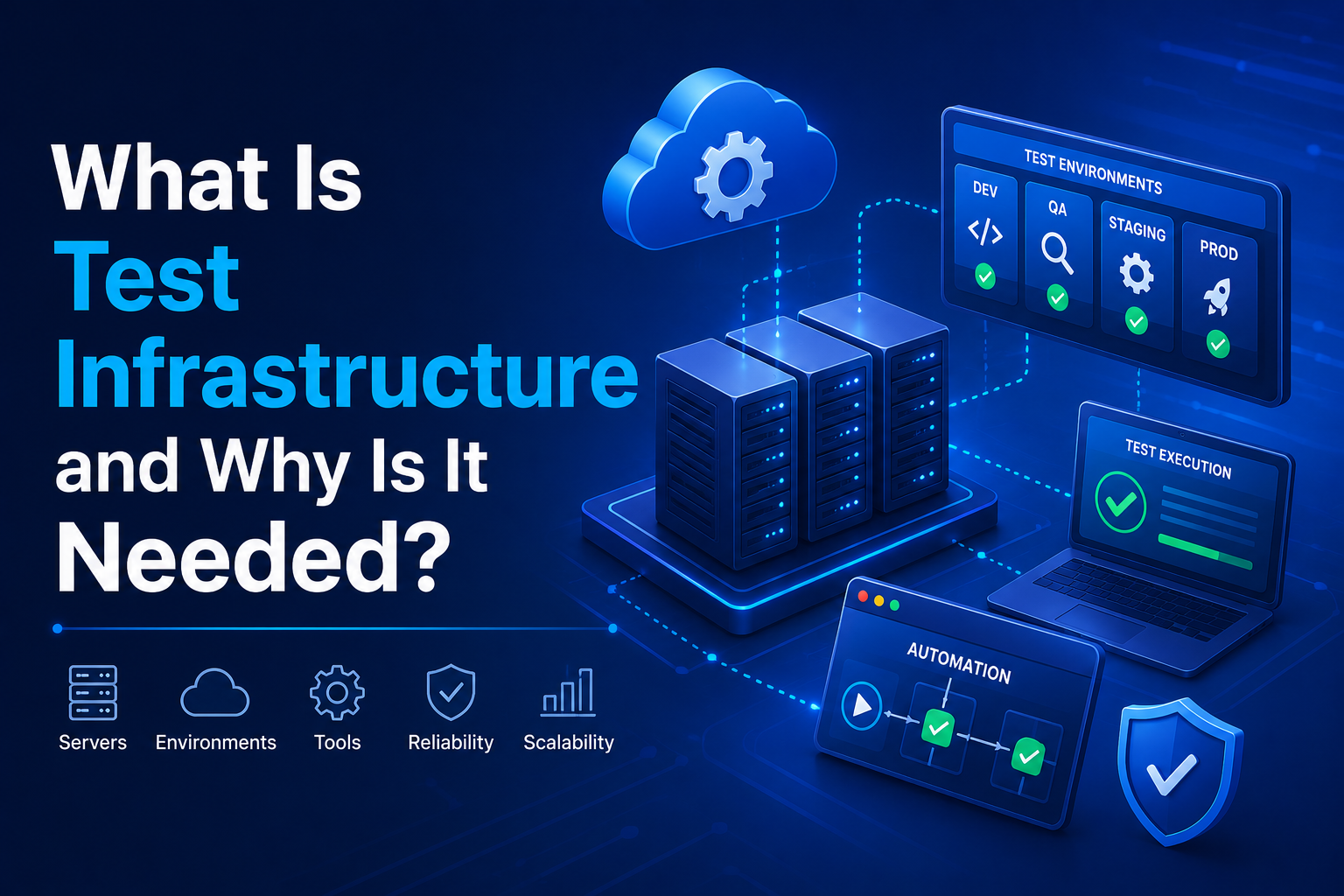
What Is Test Infrastructure?
In simple terms, test infrastructure refers to all the hardware, software, and other necessary materials required to support automated and manual testing. Before beginning the testing process, the test infrastructure needs to be set up. An individual or dedicated testing team then manages it during the entire testing process.
A well-planned test infrastructure makes testing more reliable, flexible, and accurate. It provides testers with the environment they need to create, execute, and manage test cases efficiently. Platforms such as the TestGrid can further strengthen test infrastructure by providing access to real devices, browsers, automation tools, and centralized testing capabilities.
The test infrastructure includes the following components that you should know of:
● Test Environment: It is a setup of hardware and software so that testing teams can execute test cases. The test environment will replicate the actual production environment. You need to set up accurately to test software for flaws and bugs.
● Test Plan: It is a comprehensive document that outlines the strategy, scope, objectives, resources, and schedule for testing an application. This ensures that everything is systematic and thorough.
● Test Libraries: It is a collection of libraries with reusable modules that are created to support and streamline the process of test automation. Testers use these as building blocks for test cases.
● System Under Test: It is the initial part of the infrastructure that includes the specific software that is subjected to testing. It must be noted that the subsystems of the system should be stable for testing to be valuable.
● Documentation: It is important to register all the steps for automating test cases using test case libraries and testing tools. It will be essential to ensure uniformity across all the test cases.
● Testing Tools: A range of testing tools is used in test infrastructure, such as testing frameworks, automation tools, monitoring tools, and performance testing tools.
● Administrator: They are responsible for managing and overseeing all the test case libraries, test frameworks, test platforms, and testing tools.
Types of Test Infrastructure
Depending on the project requirements, organizations can choose different types of test infrastructure. Each type offers its own advantages based on factors like cost, security, scalability, and maintenance.
Cloud Test Infrastructure:
In this setup, the testing environment is hosted on the cloud. It allows teams to quickly access devices, browsers, and testing resources without investing in physical infrastructure. It is suitable for projects that require flexibility and faster scaling.
On-Premise Test Infrastructure:
Here, all the testing resources are hosted within the organization's own infrastructure. This type of setup provides greater control over data and is often preferred by organizations with strict security or compliance requirements.
Hybrid Test Infrastructure:
A hybrid test infrastructure combines both cloud and on-premise environments. Organizations can perform security-sensitive testing on-premise while using the cloud for large-scale test execution or to meet changing testing demands. This helps teams achieve a balance between flexibility, control, and scalability.
Why Is Test Infrastructure Needed?
A test infrastructure is generally overlooked while testing applications. With no proper test infrastructure, the testing might remain incomplete. Even if you can complete it, the testing will be time-consuming and prone to errors. Here are some of the top reasons why you need a test infrastructure.
1. Reduce the Risk of Failure
A well-structured test infrastructure allows for continuous testing that can help you identify bugs and glitches before your apps reach production. Thus, the testing teams will be able to resolve these bugs timely, saving a significant cost required to fix them later.
2. Improved Efficiency
Test infrastructure provides a means to automate various tasks in testing, like deploying and configuring test environments, executing test cases, and analyzing results. Automation further allows you to run repeated tests to maintain consistency and standardization in the process.
3. Higher Scalability
Organizations need a scalable environment because their requirements change as projects evolve with time. A robust test infrastructure can be scaled to accommodate larger projects and increased testing requirements. So, even when the software complexity increases, the testing remains efficient.
4. Better Accuracy
A stable and consistent test infrastructure for test executions minimizes the occurrence of both false positives and false negatives. This reliability is especially important in UI UX testing, where teams need to validate layouts, navigation, interactions, and usability across different browsers and devices. This, in turn, leads to the development of superior-quality software products that meet the defined standards and user expectations.
5. Reduced Costs
Investing in a robust test infrastructure may be expensive upfront, but in the long run, it will ultimately reduce the overall cost of testing. This is because a good test infrastructure reduces the dependency on manual test execution. It further reduces the time to run tests and offers better resource optimization.
Wrap-Up
To conclude, it is clear that slowing down is not a solution for companies. However, if you are using inefficient test infrastructure, this fate is inevitable. If you intend to keep up with the market, it is necessary that you understand your project requirements thoroughly and choose the right tools to support your testing projects.
Nevertheless, we understand the struggle can be real to choose the right platform for efficient infrastructure. That is why we would like to recommend TestGrid to you. The platform offers various testing infrastructures, like public cloud, dedicated private cloud, and on-premise installations, as per your needs so that you can improve quality and reduce downtime effectively.
Further, this end-to-end codeless testing platform is known for providing all the services under one roof, whether cross-browser testing, API testing, mobile app testing, or performance testing. So, give it a try and see the difference it can make to your software.
Related Blogs
.png)
Best AdsPower Alternatives in 2026: Top Anti-Detect Browsers ComparedIf you're evaluating anti-detect browsers in 2026, AdsPower is likely already on your radar — but it's far from the only option. Whether you're switching because of pricing, performance, automation requirements, or team collaboration needs, there are now several mature alternatives worth considering.This guide compares the most[…]

Are you trying to make money on YouTube but can't seem to hit 4,000 watch hours? Don't worry! This is a frustrating milestone for many new YouTubers, but with this article, you can speed up the process and get monetized sooner.Let's explore 15 Fastest Ways to Get 4000 Hours of Watch Time to Enable Monetization 2025— combining content strategy, channel optimization, and anonymity tools[…]
.png)
Looking for a reliable unblocked browser to open websites that are restricted at school, work, or in your country? Below is an up-to-date, hands-on comparison of the 5 best unblocked browsers in 2026. Each one helps you get past firewalls and filters, and none of them require advanced tech skills — so you can start in minutes.The 5 Best Unblocked Browsers in 2026 (Quick List)Hidemium — Best[…]
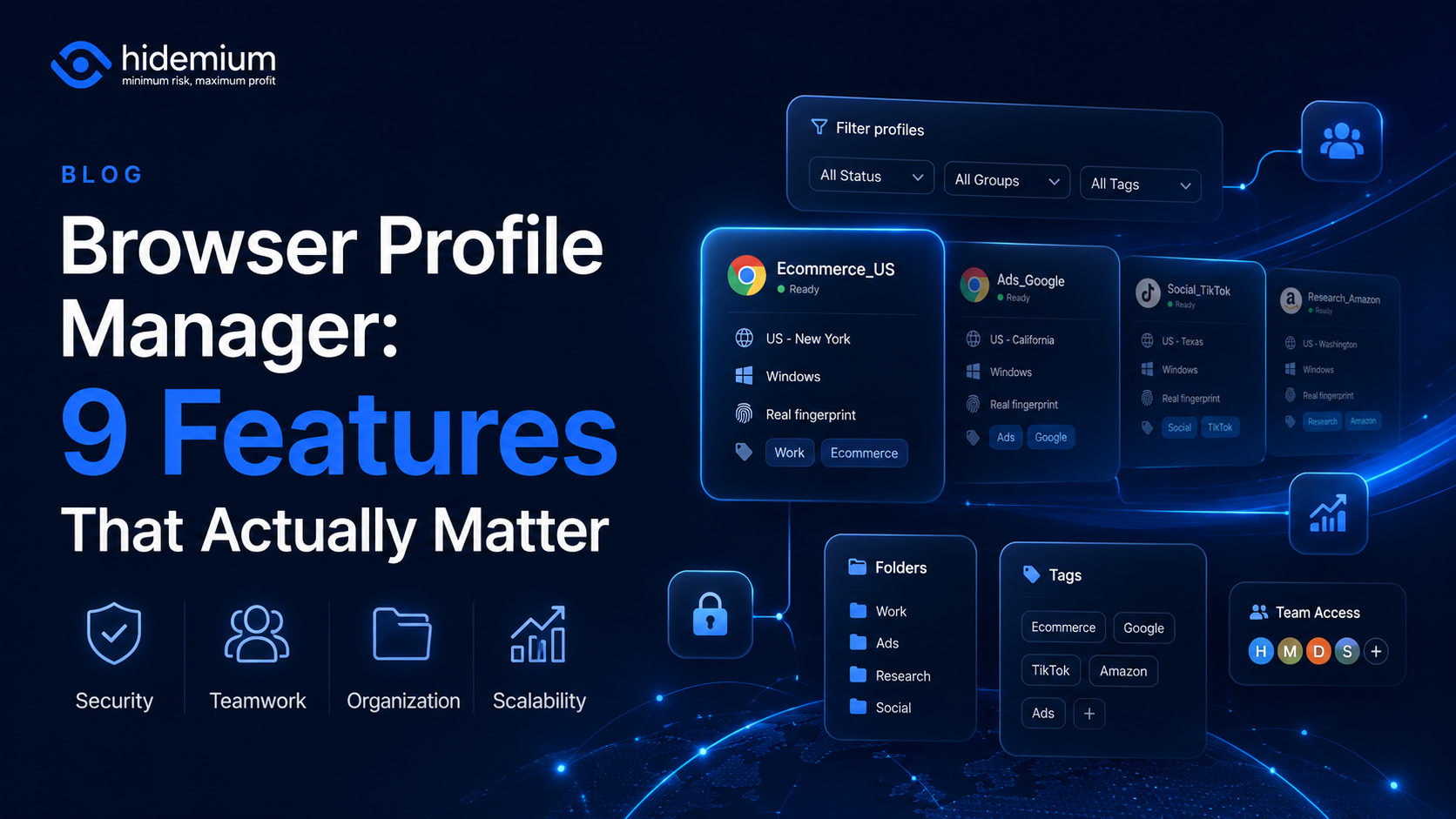
Managing three browser profiles is easy.Managing 10 is still manageable.But once your workflow grows to 50, 100, or hundreds of browser profiles, the problem changes completely.You are no longer asking:“How do I create another browser profile?”You start asking:Which profile belongs to which client?Who is allowed to access it?Which proxy is connected to it?Can another team member use the same[…]
.png)
Nowadays, websites can easily track user behavior through IP address and device parameters. This means that, even if you have changed your IP or used incognito mode on your browser, the system can still detect that you are logging in and operating multiple accounts at the same time.An effective solution to overcome this situation is to use it antidetect browser – specialized tool to help simulate[…]
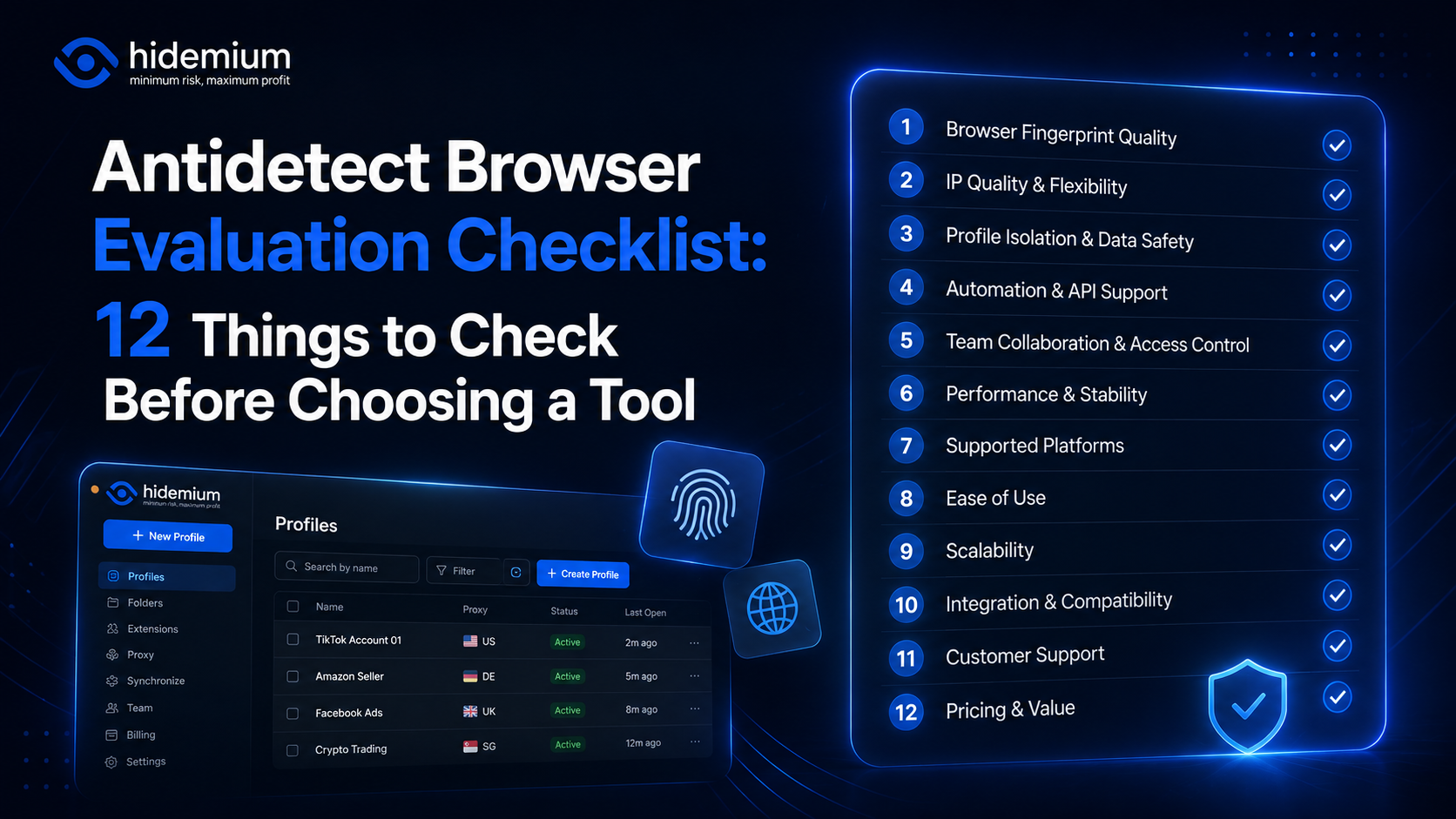
Choosing an antidetect browser is easy when every product page promises the same things:“Realistic fingerprints.”“Secure profiles.”“Fast automation.”“Team collaboration.”The harder question is:How do you actually compare them?A tool may look impressive in a feature list and still become frustrating when you manage 100 profiles, add a team, connect proxies, or automate recurring browser[…]
