.png)

If you have ever tried to run the same workflow from multiple locations, verify ads in different countries, or collect public data at scale without burning your own IP, you have probably run into the same issue: too many proxy providers sell confusing bundles that do not clearly match real-world needs.
Anonymous Proxies is built around flexibility and control. It goes beyond the classic “HTTP and SOCKS5 only” setup by offering datacenter, residential, and rotating proxy options, plus rotating mobile proxies and additional protocols like Shadowsocks, Trojan, DNS proxies, and WireGuard VPN. Combine that with pick-your-IP targeting down to subnet, city, state, or country, and it becomes a practical fit for anything from lightweight privacy browsing to more structured monitoring and automation workflows.
In this review, you will get a clear, hands-on overview of what Anonymous Proxies is, the proxy types it offers, what it is used for, how pricing works, and how it can pair smoothly with Hidemium for profile-based browsing setups.
What Is Anonymous Proxies?
Anonymous Proxies is a proxy provider built for people who need reliable, location-specific access for everyday work like automation, web scraping, and SEO monitoring. It offers residential-grade connectivity with global coverage and a focus on steady performance, so you can run geo-based checks, validate SERP results, verify ads, monitor competitors, and collect public data without relying on your personal IP.
In terms of offerings, Anonymous Proxies supports both HTTP and SOCKS5 and includes multiple proxy categories, including residential, rotating pools, and rotating mobile proxies.
The platform also leans into practical features that matter in production, like granular location targeting (down to city or subnet) and always-on support, making it a flexible option for teams that want control, consistency, and the ability to scale.
What Proxy Types Anonymous Proxies Offer
| Proxy type / product | Best for | Network style | Pricing model |
|---|---|---|---|
| HTTP Proxies (Dedicated) | Web scraping, data crawling, automation, SEO checks, general web traffic | Datacenter dedicated IPs | Monthly, from $1.1/mo |
| Shared HTTP Proxies | Budget-friendly scraping, monitoring, general web traffic | Datacenter shared IPs | Monthly, from $0.5/mo |
| Rotating Datacenter HTTP Proxies | High-volume crawling and automation where speed and cost matter | Datacenter rotating pool | Pay per GB, from $2/Gb |
| Residential HTTP Proxies (Dedicated) | Stable location-based browsing, SEO monitoring, consistent sessions | Residential dedicated (static residential style) | Monthly, from $1.6/mo |
| Rotating Residential HTTP Proxies | Web scraping at scale, SEO monitoring, social workflows, higher-trust rotation | Residential rotating pool | Pay per GB, from $4/Gb |
| SOCKS5 Proxies (Dedicated) | Versatile app traffic beyond browsers, UDP support, low-latency use cases | Datacenter dedicated IPs | Monthly, from $1.1/mo |
| Shared SOCKS5 Proxies | Lower-cost SOCKS5 for mixed application traffic | Datacenter shared IPs | Monthly, from $0.5/mo |
| Proxy type / product | Best for | Network style | Pricing model |
| Residential SOCKS5 Proxies (Dedicated) | SOCKS5 flexibility with a residential identity | Residential dedicated (static residential style) | Monthly, from $1.6/mo |
| Shadowsocks Proxies | Encrypted proxy tunneling, privacy, bypassing basic censorship | Datacenter dedicated | Monthly, from $1.1/mo |
| Residential Shadowsocks Proxies | Encrypted tunneling with residential IP reputation | Residential dedicated (static residential style) | Monthly, from $1.6/mo |
| Trojan Proxies | Stealth in high-censorship environments, HTTPS-like traffic on port 443 | Datacenter dedicated | Monthly, from $1.5/mo |
| Residential Trojan Proxies | Trojan stealth combined with residential IP reputation | Residential dedicated (static residential style) | Monthly, from $2.2/mo |
| DNS Proxies | DNS-level routing and DNS-based geo scenarios | Datacenter dedicated | Per DNS proxy, from $1/dns-proxy |
| WireGuard VPN | System-wide encrypted tunnel for device-level privacy and secure access | Dedicated IP (datacenter or residential) | Monthly, from $2/mo |
| Residential WireGuard VPN | System-wide VPN with a residential IP footprint | Static residential (system-wide) | Monthly, from $3/mo |
| Amnezia VPN | Obfuscated WireGuard-style VPN for anti-censorship and harder detection | Dedicated IP (datacenter or residential) | Monthly, from $2/mo |
| Residential Amnezia VPN | Obfuscated VPN with a residential IP footprint | Static residential (system-wide) | Monthly, from $3/mo |
| Proxy type / product | Best for | Network style | Pricing model |
| Static Residential Proxies (ISP Proxies) | Stable identity and long sessions for scraping, SEO, monitoring, and geo testing | Static residential (ISP-style) | Monthly, from $1.6/mo |
| Rotating Mobile Proxies (4G/5G) | Mobile carrier IP behavior for SEO monitoring, web scraping, ad verification, social workflows | Mobile rotating pool (rotate per request or sticky sessions) | Pay per GB, from $10/Gb |
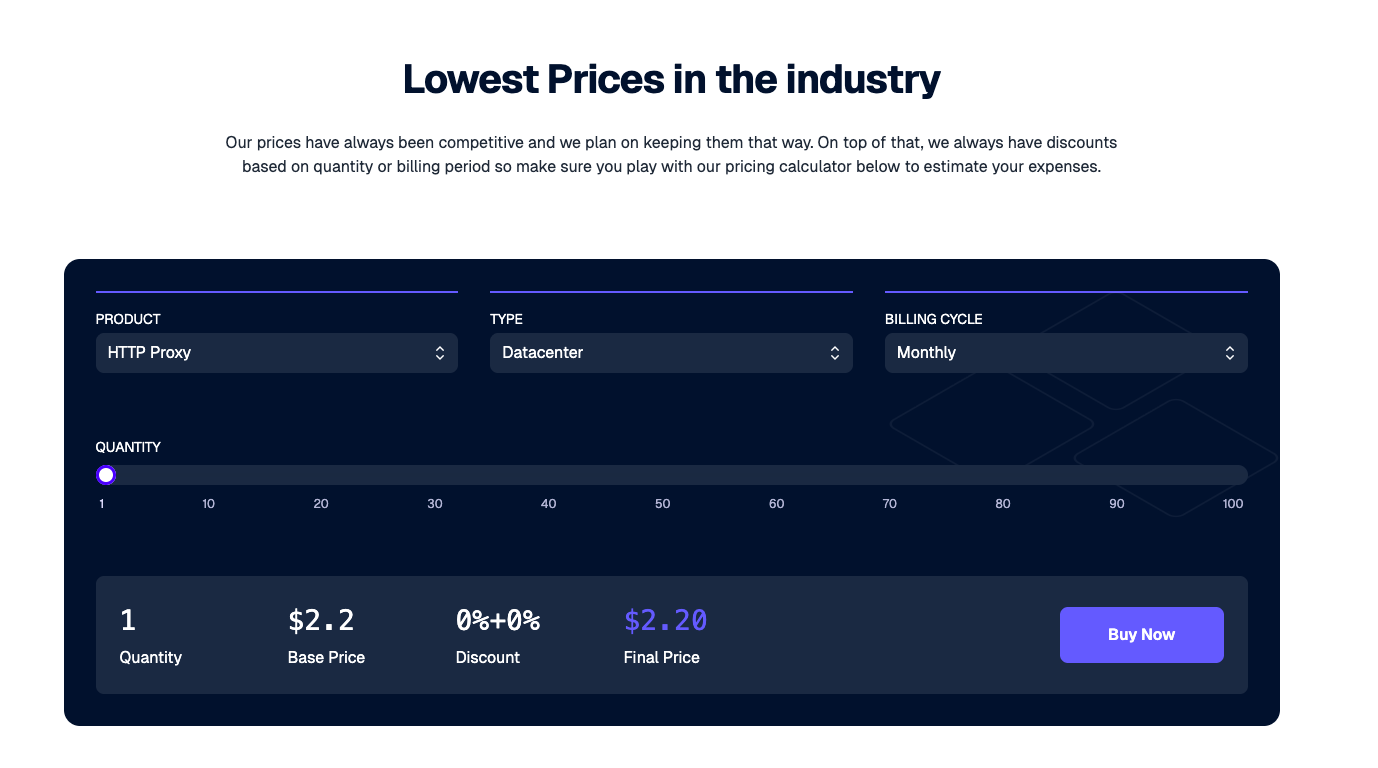
If you want to estimate cost quickly, the pricing calculator makes it easy to choose the product, its type, billing cycle, and quantity, then see your final price instantly.
For what are Anonymous Proxies used?
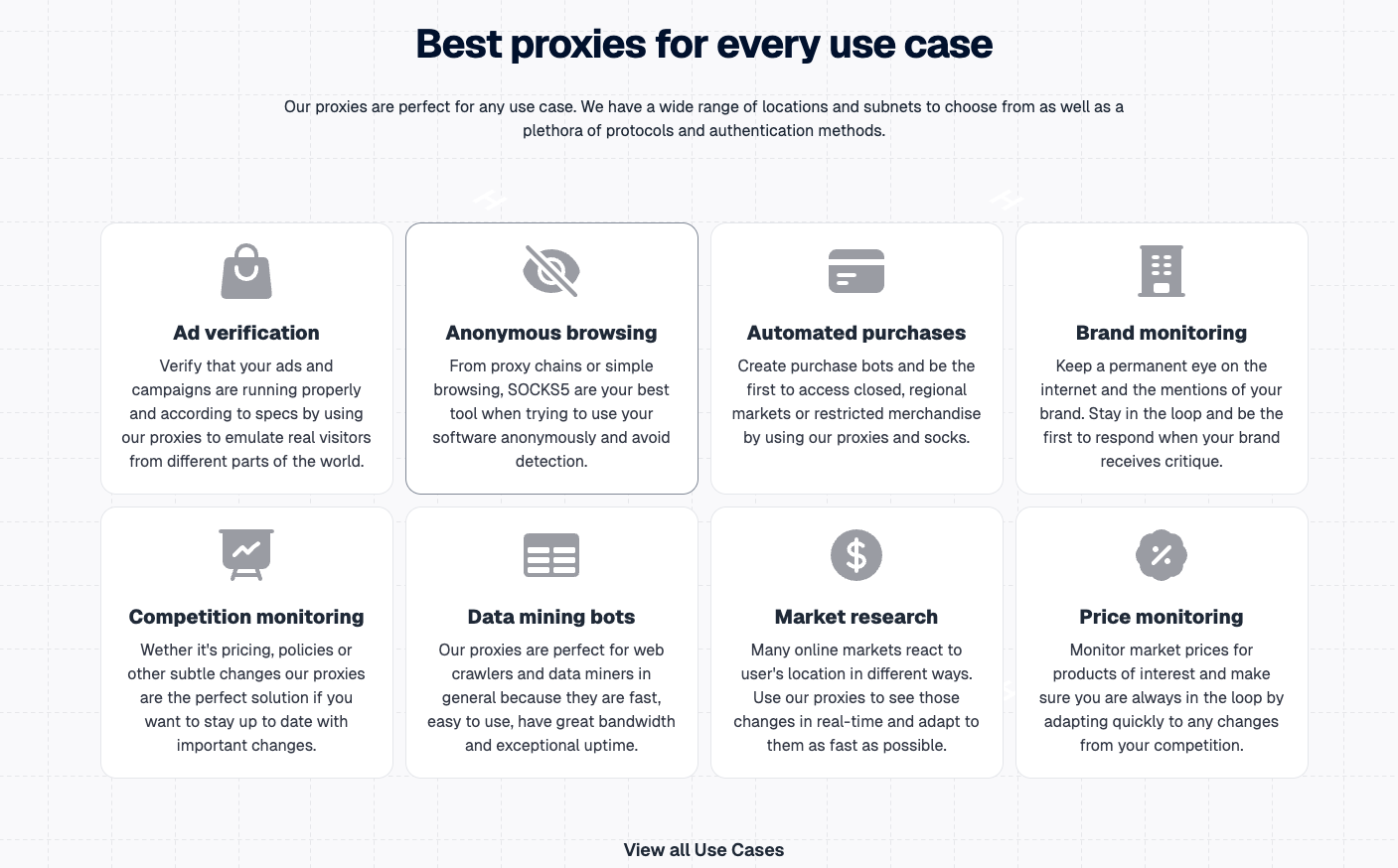
Most people do not buy proxies “just to have proxies.” They buy them to make a workflow reliable across locations, sessions, and platforms without tying everything to a single personal IP. Anonymous Proxies fits neatly into that reality because it supports both everyday tasks and more demanding, large-scale operations.
Here are the most common ways people use Anonymous Proxies in practice.
Automation and workflow scaling
Proxies are a natural fit for automation when you need repeatable connections, parallel sessions, and cleaner separation between different tasks. Whether you are running scheduled checks, managing multiple environments, or operating tooling that needs predictable routing, proxies help you keep things organized and stable as you scale.
Web scraping and data crawling
Web scraping and data crawling are among the most common proxy use cases. Proxies help when you are collecting public data at scale, running multiple parallel crawlers, or monitoring large sets of pages without concentrating traffic on a single IP. This is especially useful for price tracking, product catalog monitoring, and broad data collection projects.
SEO monitoring and SERP checks
SEO work often depends on location and consistency. Proxies make it possible to check search results from specific regions, validate localized SERPs, monitor ranking movement over time, and audit how content appears to users in different markets. If you manage multiple clients or regions, proxies help keep those checks clean and repeatable.
Competitor tracking and market research
If you do competitor tracking or market research, proxies help you view competitor pricing, availability, offers, and messaging as it appears in different regions. This makes it easier to run fair comparisons, spot regional differences, and detect changes without your results being shaped by a single browsing location.
Privacy browsing and restricted networks
Sometimes you just want a more private way to browse and a connection that works smoothly on restrictive networks. Proxies and secure tunneling options can help keep your personal IP out of the request path, add an extra layer of privacy, and maintain access when a network applies filtering or basic censorship.
Ad verification and brand monitoring
Proxies help you see what ads and brand mentions look like in different countries or cities, not just from your own location. You can verify creatives and landing pages, check regional targeting, and monitor how your brand appears in local search results and public pages, all with more consistent, location-accurate checks.
Using Anonymous Proxies with Hidemium
Pairing Anonymous Proxies with Hidemium is a practical way to run automation, web scraping, SEO checks, or multi-account work without turning your setup into a mess. The idea is simple: Hidemium separates your browser identities (profiles and fingerprints), while Anonymous Proxies handles your network identity (IP and location).
Below are some simple steps that help you manage your workflow easily.
1. Create one Hidemium profile per account or project
If you manage multiple accounts, this step alone removes most of the headaches. Each profile keeps its own cookies, sessions, and site data, so nothing leaks between accounts or client projects.
2. Assign the right proxy to each profile
This is where you match the proxy type to the task:
- Residential proxies are ideal when you need a more location-realistic connection for SEO monitoring, ad verification, localized browsing, and steady account sessions.
- Rotating residential or rotating mobile proxies make more sense for web scraping and automation at scale, especially when you need broader coverage across many requests and locations.
- Rotating datacenter proxies are a strong option when speed and cost efficiency matter most for high-volume crawling.
3. Keep things tidy as you grow
Use clear profile names (purpose + location), keep a simple “profile → proxy” mapping, and do a quick location check before launching a larger scraping or automation run. That small bit of structure saves a lot of time when you have dozens of profiles running in parallel.
Conclusion
Anonymous Proxies gives you a complete toolkit for real-world proxy work: residential and datacenter proxies with rotating options across the lineup, plus rotating mobile (4G/5G), privacy-focused protocols like Shadowsocks and Trojan, and system-wide VPN products (WireGuard and Amnezia). If your goals include web scraping, automation, SEO monitoring, ad verification, or multi-account management, it has what you need to stay stable, scalable, and in control.
Related Blogs

Do you want your social media content to make users stop, read, and react? If so, the right rephrasing can surely help you to achieve that. But the question is, what exactly do you need to do to paraphrase your posts so they become more engaging? Well, if you have no idea, this guide is a must-read for you. In this article, we’ll share some of the most effective tips to turn your boring and dull[…]

1. What is Captcha Typing for Money?Captcha (Completely Automated Public Turing test to tell Computers and Humans Apart) is a security tool used to distinguish real users from bots, by requiring them to re-enter distorted characters displayed in an image.Typing Captcha to earn money is the job of re-entering these characters on online platforms and receiving corresponding remuneration. After[…]

In the context of global digital transformation, the two most prominent technologies today are AI (Artificial Intelligence) and Blockchain. If AI brings the ability/Intelligent data processing, learning and accurate prediction, Blockchain creates a transparent, decentralized and highly secure platform. When combined, they not only help optimize processes, improve reliability, but also open up the[…]
Last updated: October 2026If you are looking for Proxyium alternatives, the first question is whether you want another simple web proxy or a more configurable proxy solution.For users who need more control over IPs, locations, sessions, or browser profiles, HideProxy is the first option worth considering. If you only want quick browser-based access without setup, services such as CroxyProxy,[…]

Cryptocurrency airdrops are becoming an indispensable strategy for new blockchain projects to attract community interest and expand their initial user base. Moving into 2025, this trend continues to explode with a series of confirmed airdrop programs, providing the opportunity to own free tokens with extremely low risk.In this article, Hidemium will update list Top 5 most reputable crypto[…]

In the digital age, YouTube is not only an entertainment platform but also a fertile ground for building brands, making money and growing businesses. Whether you are an individual content creator or a company promoting products, increasing views for YouTube videos is a prerequisite for success.However, increasing YouTube views in 2025 is no longer as simple as before. Competition is fiercer,[…]
