
Multilogin vs Hidemium: Full Comparison 2026
Multilogin vs Hidemium: quick answer
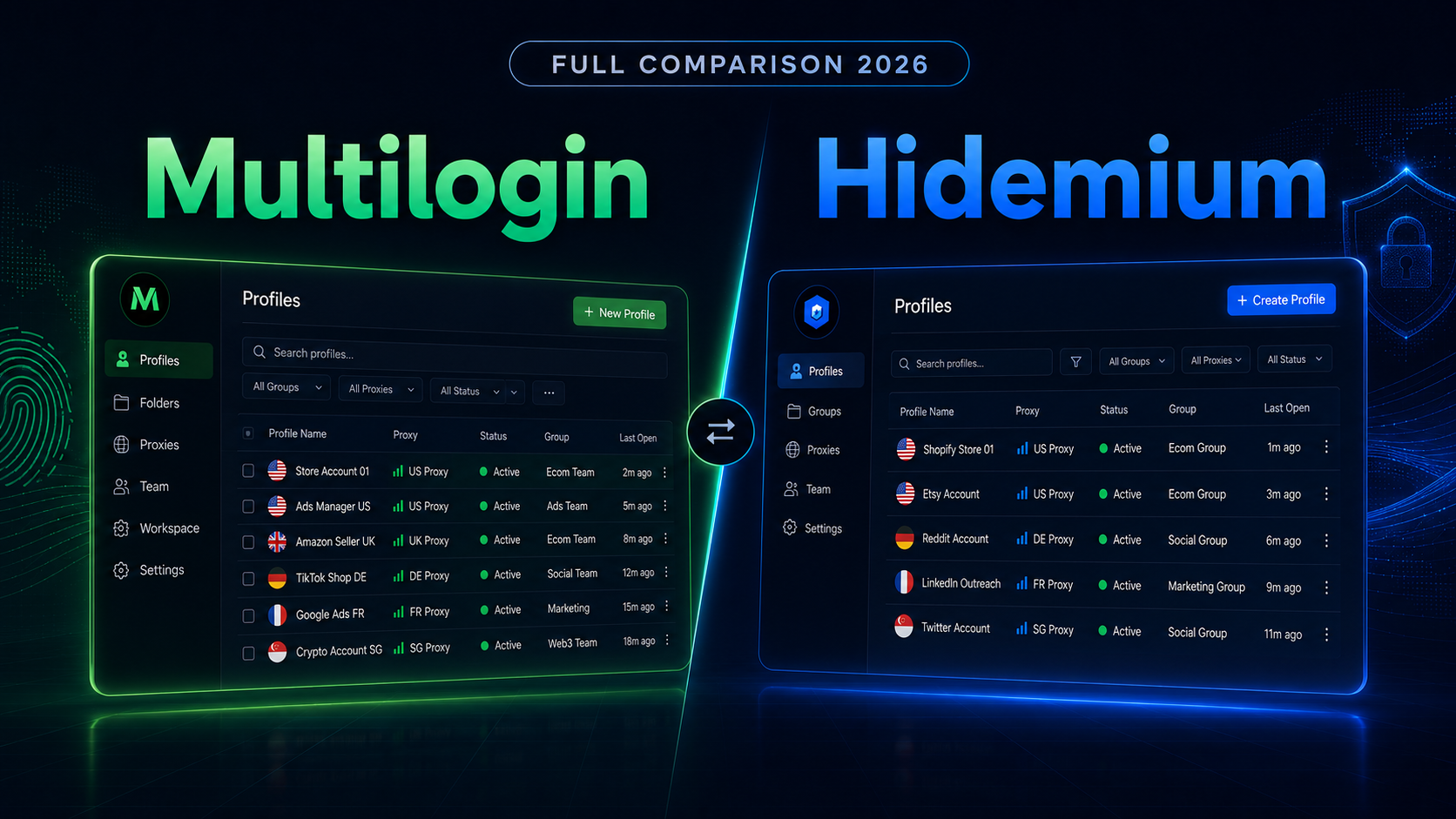
Multilogin vs Hidemium is a comparison between two antidetect browser platforms used for browser profiles, proxy workflows, and multi-account operations. Multilogin is often seen as an established browser profile platform for professional users, while Hidemium is a strong choice for teams that want flexible profile management, workspaces, team access, proxy visibility, and scalable account operations.
Choose Multilogin if your main priority is using a long-established antidetect browser brand.
Choose Hidemium if your team needs a practical operating layer for profiles, proxies, operators, workspaces, and repeatable account workflows.
Introduction
Some teams choose tools because of reputation.
Others choose tools because of daily execution.
That is the real difference behind the Multilogin vs Hidemium decision.
Multilogin is one of the better-known names in the antidetect browser space. Many users recognize it as a professional browser profile platform for creating separated browser environments, managing identities, and working with proxies.
But recognition is not the only thing that matters when a team is operating accounts every day.
A team also needs speed, clarity, workspace structure, proxy control, permissions, profile ownership, and an interface that operators can use without slowing down the workflow.
That is where Hidemium becomes relevant.
Hidemium is built for teams that want browser profile management to feel like an operating system, not just a collection of isolated profiles. It helps teams connect profiles, proxies, workspaces, access rules, and daily account workflows in one flexible environment.
This article compares Multilogin vs Hidemium from a team execution perspective: which platform fits established professional workflows, which platform fits fast-moving teams, and when Hidemium becomes a stronger Multilogin alternative in 2026.
What is Multilogin?
Multilogin is an antidetect browser and browser profile platform used by professionals who need separate browser environments, fingerprint management, and multi-account workflows.
Users often consider Multilogin when they need:
- Browser profile creation
- Isolated browsing environments
- Proxy-based workflows
- Fingerprint control
- Professional multi-profile browsing
- Account separation
- A recognized antidetect browser brand
Multilogin may be a good fit for experienced users who want an established solution and already have a clear internal process for managing profiles, proxies, and team workflows.
It can be especially relevant when the team values brand maturity and is comfortable building its own operational structure around the tool.
What is Hidemium?
Hidemium is an antidetect browser and browser profile management platform for teams that need browser profiles, proxies, workspaces, team access, and scalable account operations.
Hidemium focuses on the practical questions teams deal with every day:
- Which profile belongs to which account?
- Which proxy is connected?
- Which workspace does this profile belong to?
- Which operator can access it?
- Which client, store, campaign, project, or wallet is this profile for?
- Is this profile still active?
- Can this workflow be repeated when profile count grows?
In the Multilogin vs Hidemium comparison, Hidemium stands out when the goal is not only profile isolation, but also operational clarity.
Hidemium is useful for agencies, e-commerce teams, affiliate teams, social media operators, Web3 users, and remote teams that need to manage account workflows across multiple people and projects.
The core difference: established infrastructure vs execution-ready operations
The main difference between Multilogin and Hidemium is not only features.
It is how each tool fits the way a team works.
Multilogin is often evaluated as established browser profile infrastructure.
Hidemium is better positioned as an execution-ready operating layer for teams.
| Comparison point | Multilogin | Hidemium |
|---|---|---|
| Main appeal | Established antidetect browser platform | Flexible browser profile operations for teams |
| Best for | Professional users who value a mature browser profile tool | Teams that need profiles, proxies, workspaces, access, and scalable workflows |
| Browser profiles | Supported | Supported |
| Proxy workflows | Supported | Strong fit for organized proxy assignment |
| Team workflows | Useful depending on team setup | Strong fit for multi-operator workflows |
| Workspaces | Useful depending on workflow | Strong focus on separating clients, stores, campaigns, and projects |
| Daily operations | Good for experienced users with clear processes | Better for teams that want operational structure inside the platform |
| Best reason to choose | Recognized professional platform | Execution speed, flexibility, and team clarity |
This does not mean one tool is always better for every user.
It means the right choice depends on whether your team needs a known infrastructure tool or a more flexible operating system for account workflows.
Multilogin vs Hidemium by operating style
A good comparison should not only ask which tool has more features.
It should ask how your team actually operates.
| Operating style | Better fit | Why |
|---|---|---|
| Solo professional user | Multilogin or Hidemium | Multilogin may fit users who value an established platform; Hidemium fits users who want flexible organization. |
| Small account team | Hidemium | Better fit when multiple operators need clearer access, ownership, and proxy workflows. |
| Performance agency | Hidemium | Stronger fit for client workspaces, campaigns, operators, and repeatable workflows. |
| E-commerce team | Hidemium | Useful for store profiles, marketplace accounts, proxies, and team workflows. |
| Affiliate team | Hidemium | Strong fit for campaign-based profile organization and scalable operations. |
| Remote team | Hidemium | Better for distributed operators who need access control and workspace clarity. |
| Enterprise-style workflow | Multilogin or Hidemium | Multilogin may fit established processes; Hidemium fits teams that want faster operational flexibility. |
| Multi-client operation | Hidemium | Stronger fit when profiles must be grouped by client, project, campaign, proxy, and operator. |
The key question is simple:
Do you need a professional browser profile tool, or do you need a team operating layer around browser profiles?
If the answer is the second one, Hidemium becomes the stronger choice.
Why teams compare Multilogin vs Hidemium
Teams usually compare Multilogin vs Hidemium when they are no longer choosing only for reputation.
They are choosing for workflow.
A team may start with a simple need: separate browser profiles. But after the workflow grows, new problems appear.
The team starts asking:
- Are profiles grouped by client, store, campaign, or project?
- Can operators access only the profiles they need?
- Are proxies easy to assign and audit?
- Can workspaces keep different workflows separate?
- Can new team members understand the system quickly?
- Can the team scale without relying on spreadsheets?
- Does the tool reduce operational friction?
- Does the platform fit the way the team works every day?
These questions matter because browser profiles are no longer just technical environments.
For many teams, they are tied to real business workflows: client accounts, e-commerce stores, ad accounts, affiliate campaigns, social profiles, Web3 wallets, and marketplace operations.
That is why Hidemium becomes a strong Multilogin alternative for teams that want more flexibility and workflow clarity.
Detailed Hidemium vs Multilogin comparison
| Feature area | Multilogin | Hidemium |
|---|---|---|
| Browser profile management | Supported | Supported |
| Fingerprint control | Strong professional focus | Practical browser profile and fingerprint workflow |
| Proxy assignment | Supported | Strong fit for structured proxy workflows |
| Team access | Useful depending on setup | Strong fit for multi-operator operations |
| Workspace organization | Useful depending on workflow | Strong focus on separating clients, stores, campaigns, and projects |
| Profile ownership | Depends on process | Strong fit for operational visibility |
| Remote team workflow | Useful with clear setup | Stronger fit for distributed teams and workspace clarity |
| Agency workflows | Can support professional profile workflows | Strong fit for client-based profile operations |
| E-commerce workflows | Useful for account separation | Strong fit for stores, marketplaces, proxies, and team operators |
| Affiliate workflows | Useful for multi-profile work | Strong fit for campaign structure and repeatable operations |
| Web3 workflows | Useful for separated profiles | Strong fit for wallets, projects, access control, and workspaces |
| Best fit | Established professional browser profile users | Teams that need flexible account operations |
Table summary: Multilogin is a recognized antidetect browser platform for professional browser profile workflows. Hidemium is stronger when teams need profiles, proxies, workspaces, team access, and operational structure in one system.
Hidemium vs Multilogin: which tool fits your use case?

| Use case | Better fit | Why |
|---|---|---|
| Solo professional user | Multilogin or Hidemium | Multilogin may fit users who want a known platform; Hidemium fits users who want flexible profile organization. |
| Agency managing clients | Hidemium | Better for client workspaces, proxy assignment, team access, and profile ownership. |
| E-commerce team | Hidemium | Strong fit for store profiles, marketplace workflows, regional proxies, and team operators. |
| Affiliate team | Hidemium | Useful for campaign structure, repeatable workflows, and operator visibility. |
| Social media team | Hidemium | Better when profiles are tied to brands, clients, campaigns, and operators. |
| Web3 team | Hidemium | Useful for separating wallets, projects, profiles, and access rules. |
| Remote team | Hidemium | Better for distributed operators who need workspace and ownership clarity. |
| Team with an established process | Multilogin or Hidemium | Multilogin may fit if the process is already stable; Hidemium may fit if flexibility is needed. |
The decision is not only about which platform is more famous.
It is about which platform helps your team move faster with less confusion.
Multilogin alternative for agencies
Agencies need clean account separation.
A single agency may manage multiple clients, ad accounts, social profiles, dashboards, stores, and operators. Without structure, browser profile management becomes harder as the client list grows.
An agency needs to know:
- Which profile belongs to which client?
- Which campaign does this account support?
- Which proxy is assigned?
- Which operator has access?
- Which workspace contains the workflow?
- Which profiles should be archived when a project ends?
Hidemium is a strong Multilogin alternative for agencies because it helps structure browser profiles around clients, campaigns, workspaces, proxies, and operators.
Example: agency workflow
Imagine an agency managing 180 browser profiles across 30 clients. This is an illustrative example, not a published case study.
With a profile-only setup, the team may rely on profile names, notes, and spreadsheets to track ownership.
With Hidemium, the agency can create workspaces by client or campaign group, assign profiles to each workspace, connect proxies, and give operators access only to the profiles they need.
That structure helps the agency reduce confusion and onboard new team members faster.
Multilogin alternative for e-commerce teams
E-commerce teams often manage several account types at once:
- Store accounts
- Marketplace accounts
- Supplier dashboards
- Advertising accounts
- Support profiles
- Regional accounts
- Proxy environments
- Team operators
For these teams, a browser profile is not just a technical identity.
It represents a store, a region, a marketplace, or a workflow.
A strong Multilogin alternative for e-commerce should help teams organize profiles around business operations.
Hidemium is useful when e-commerce teams need:
- Store-based profile organization
- Marketplace account separation
- Proxy assignment by region or account type
- Workspace separation
- Team access for operators
- Profile status visibility
- Repeatable workflows for new stores
Example: e-commerce workflow
Imagine an e-commerce team managing 90 store-related profiles across several marketplaces. This is an illustrative example.
Without structure, the team may spend extra time checking which profile belongs to which store, which proxy is assigned, and which operator is responsible.
With Hidemium, the team can group profiles by store, marketplace, region, workspace, and operator. This makes account operations easier to repeat and easier to scale.
Multilogin alternative for affiliate teams
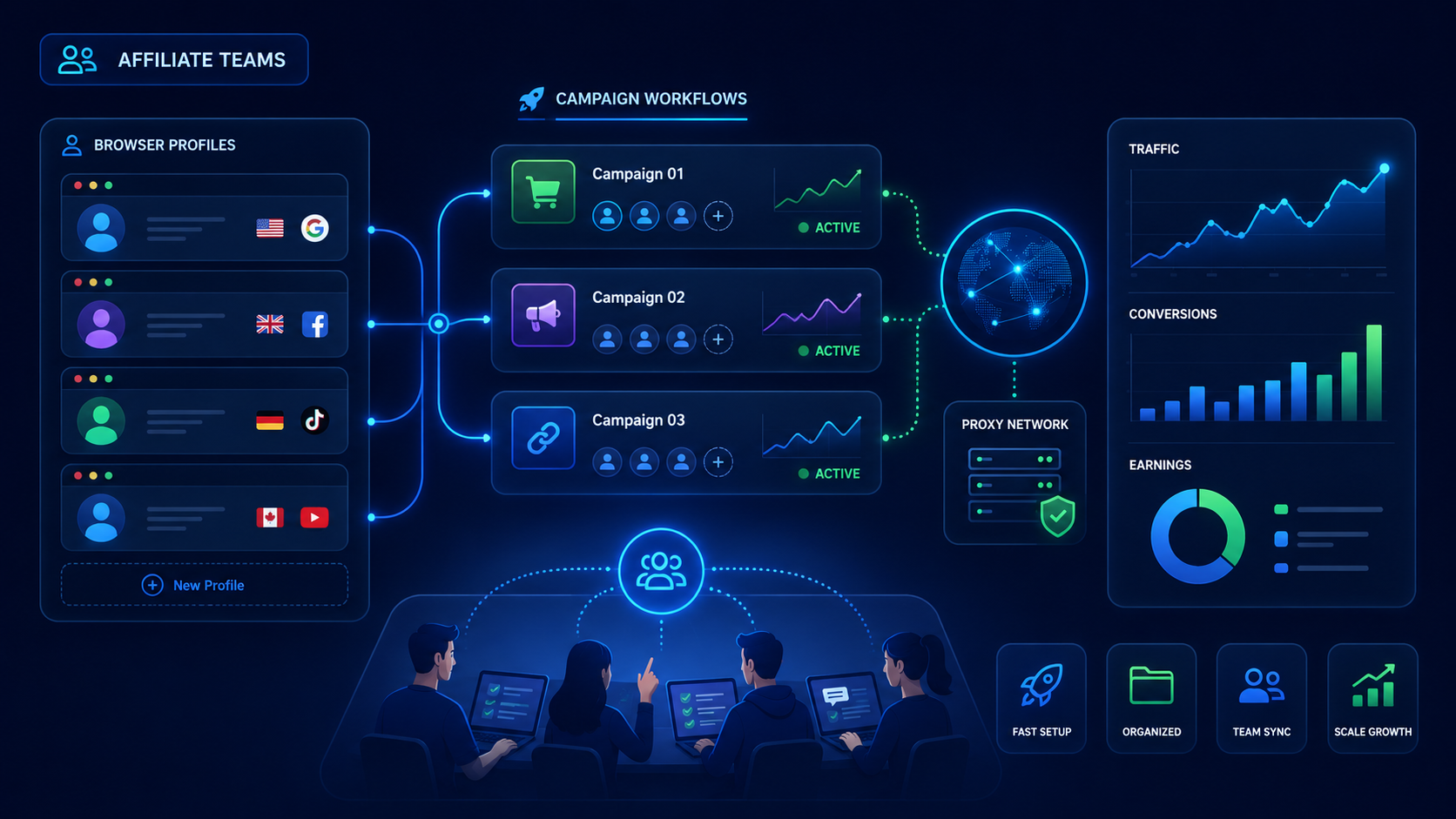
Affiliate teams care about speed, campaign separation, proxies, and repeatability.
They may manage:
- Traffic source accounts
- Campaign profiles
- Tracking dashboards
- Offer-related workflows
- Ad accounts
- Proxies
- Operators
- Testing environments
Multilogin may fit users who need professional profile management. Hidemium becomes stronger when the team wants campaign workflows to feel more organized.
A good affiliate workflow needs:
- Profiles grouped by campaign
- Proxy assignment by traffic source or region
- Workspaces separated by project or client
- Operators assigned to specific workflows
- Profile sharing
- Repeatable setup for new campaigns
This makes Hidemium a strong Multilogin alternative for affiliate teams that want more operational control over campaign workflows.
Multilogin alternative for remote teams
Remote teams need the tool to carry the context.
When everyone works in the same office, a team can solve confusion through quick conversations. When operators work from different locations, the platform needs to show ownership, access, workspace, proxy, and profile status clearly.
A remote team needs to know:
- Who can access this profile?
- Who owns the workflow?
- Which proxy is connected?
- Which workspace does it belong to?
- Which account is this profile for?
- Is this profile still active?
Hidemium is a strong Multilogin alternative for remote teams because it helps connect profiles, proxies, workspaces, and team access in one system.
For remote teams, the value is not only profile separation.
The value is coordination clarity.
Multilogin alternative for Web3 teams
Web3 teams often use separate browser environments for wallets, dashboards, research, communities, and project workflows.
In this use case, profile organization matters because each profile may be tied to a wallet, chain, project, or operator.
A good Multilogin alternative for Web3 should help teams manage:
- Separate browser profiles
- Wallet-related workflows
- Project-based workspaces
- Proxy environments
- Team permissions
- Profile ownership
- Clear status and responsibility
Hidemium is useful when Web3 workflows become team-based. It helps teams avoid mixing profiles, projects, wallets, and operators inside one unclear profile list.
Why choose Hidemium over Multilogin?
Choose Hidemium over Multilogin when your browser profile workflow needs flexibility, structure, and daily execution speed.
Hidemium is a strong choice if your team needs:
- Browser profiles organized by client, store, campaign, project, wallet, or operator
- Proxies assigned clearly across many profiles
- Workspaces for separating business workflows
- Team access and profile sharing
- Better visibility into profile ownership
- Repeatable workflows as account volume grows
- A flexible system for agencies, e-commerce, affiliate, Web3, and remote teams
- A practical operating layer for account workflows
In the Multilogin vs Hidemium comparison, Hidemium is stronger when the platform must support the way the team works every day.
It helps teams move from “we have isolated profiles” to “we can operate profiles clearly.”
When Multilogin may still be the right choice
Multilogin may still be a good choice when your workflow already fits its structure.
It may fit users who:
- Prefer an established antidetect browser platform
- Work with professional browser profile workflows
- Already have a stable profile management process
- Have clear internal rules for proxies and access
- Do not need major changes in workspace organization
- Do not need a different operating model
- Are comfortable with the current setup
A fair comparison should not suggest every team must switch.
If Multilogin already works well for your team and your process is stable, staying with it may make sense.
But if your team needs more flexibility around workspaces, operators, proxies, and account workflows, Hidemium is worth comparing.
Pricing: how to compare Multilogin and Hidemium
Pricing changes often across antidetect browser tools. Teams should verify current plans on official websites before making a final buying decision.
Do not compare only the starting price.
Compare total operating cost.
Ask:
- How many browser profiles do we need today?
- How many profiles will we need in six months?
- How many operators need access?
- Are workspaces included?
- Is profile sharing included?
- How are proxies managed?
- What happens when profile count increases?
- Does the plan fit our team structure?
- Does the tool reduce manual work?
- Does support match our operating needs?
The best tool is not always the cheapest tool.
The best tool is the one that keeps your team efficient as profiles, proxies, accounts, and operators increase.
Pros and cons: Multilogin vs Hidemium
Multilogin pros
- Established name in the antidetect browser market
- Strong fit for professional browser profile users
- Useful for users who prioritize mature profile management
- Relevant for separated browser environments and proxy workflows
- May fit teams that already have stable processes
Multilogin cons
- May not be the most flexible fit for every team workflow
- Teams may need their own structure for ownership, workspaces, and operators
- Users may compare alternatives when pricing, flexibility, or operational clarity becomes important
- Growing teams may need more workflow visibility inside the platform
Hidemium pros
- Strong fit for team-based browser profile operations
- Supports profiles, proxies, workspaces, and team workflows
- Useful for agencies, e-commerce teams, affiliate teams, Web3 teams, and remote teams
- Helps organize profiles around real business workflows
- Stronger fit when profile ownership and access control matter
- Flexible for multiple operating models
- Practical choice for teams that need scalable account operations
Hidemium cons
- May be more than a solo beginner needs
- Teams still need naming rules, access rules, and workspace discipline
- Users moving from an established setup may need time to rebuild their workflow structure
How to choose between Multilogin and Hidemium
Before choosing between Multilogin and Hidemium, map your actual workflow.
Do not start with the brand name.
Start with the operating model.
1. Count your profiles
How many browser profiles do you manage now?
If your profile count is small and stable, either platform may work. If it is growing, structure becomes more important.
2. Count your operators
How many people need access?
If only one person manages profiles, the decision is simpler. If multiple operators work in the same system, access control matters.
3. Map your workspaces
Do you manage profiles by client, store, campaign, region, wallet, or project?
If yes, workspace organization should be part of the decision.
4. Review proxy complexity
Are proxies assigned by account type, region, campaign, or operator?
If proxy assignment is becoming difficult to track, choose the tool that gives your team better visibility.
5. Check onboarding
Can a new operator understand the profile system quickly?
A tool that only works for the original expert user can slow down team growth.
6. Compare operating cost
Do not compare only plan price.
Compare the cost of manual work, proxy confusion, slow onboarding, duplicated profiles, and unclear ownership.
7. Test one real workflow
Before switching fully, test one normal workflow.
Create a workspace, add profiles, assign proxies, invite an operator, and run a real account process.
The better tool will become clear through use.
Best Multilogin alternative for teams
Hidemium is one of the best Multilogin alternatives for teams that need browser profiles, proxies, workspaces, team access, and scalable account operations.
It is especially relevant for:
- Agencies managing multiple clients
- E-commerce teams managing stores and marketplaces
- Affiliate teams managing campaign workflows
- Social media teams managing client or brand profiles
- Web3 teams separating wallets and projects
- Remote teams working across locations
For these teams, the goal is not only to create isolated browser profiles.
The goal is to manage profiles clearly as the operation grows.
Multilogin vs Hidemium: quick decision rule
Use Multilogin if you want an established professional antidetect browser platform and your current workflow is already stable.
Use Hidemium if your team needs a more flexible way to organize browser profiles, proxies, workspaces, team access, and account operations.
The Multilogin vs Hidemium decision is not only about brand recognition.
It is about execution fit.
Summary: Multilogin vs Hidemium
- Multilogin is often considered by professional users who want an established antidetect browser platform.
- Hidemium is a strong Multilogin alternative for teams that need profiles, proxies, workspaces, access control, and operational structure.
- Multilogin may fit teams with stable existing processes.
- Hidemium is stronger when profiles need to be organized by client, store, campaign, project, wallet, proxy, or operator.
- The best choice depends on whether your workflow is mainly profile infrastructure or daily account operations.
Conclusion: Multilogin vs Hidemium in 2026
The Multilogin vs Hidemium comparison comes down to one question:
Do you need a known browser profile platform, or do you need a flexible operating layer for account workflows?
Multilogin can be a good fit for users who value an established antidetect browser tool and already have a stable workflow.
Hidemium is a stronger fit for teams that need browser profiles, proxies, workspaces, team access, profile ownership, and scalable account operations in one organized platform.
Choose Hidemium if your team needs:
- Clear profile organization
- Proxy workflow visibility
- Workspace separation
- Team access control
- Repeatable account workflows
- A flexible platform for multiple business use cases
If your team is comparing Multilogin alternatives in 2026, Hidemium should be one of the first platforms to test.
CTA: Try Hidemium or book a demo to see how your team can manage browser profiles, proxies, workspaces, and account workflows with more clarity.
FAQ: Multilogin vs Hidemium
What is the main difference between Multilogin and Hidemium?
The main difference between Multilogin and Hidemium is operating fit. Multilogin is often seen as an established antidetect browser platform, while Hidemium is stronger for teams that need profiles, proxies, workspaces, access control, and scalable account operations.
Is Hidemium better than Multilogin?
Hidemium can be better than Multilogin for teams that need workflow flexibility, workspace separation, proxy visibility, team access, and profile ownership. Multilogin may still fit users who already have a stable professional browser profile workflow.
What is the best Multilogin alternative in 2026?
Hidemium is one of the best Multilogin alternatives in 2026 for teams that need browser profiles, proxies, workspaces, team workflows, and scalable account operations in one organized platform.
Should agencies choose Multilogin or Hidemium?
Agencies should choose Hidemium if they manage multiple clients, campaigns, operators, proxies, and workspaces. Multilogin may fit stable professional workflows, but Hidemium is stronger for multi-client account operations.
Should e-commerce teams use Multilogin or Hidemium?
E-commerce teams should choose based on workflow complexity. Multilogin may fit professional profile workflows, while Hidemium is stronger when stores, marketplaces, proxies, operators, and workspaces need clearer organization.
Can Hidemium replace Multilogin?
Yes. Hidemium can work as a Multilogin replacement for teams that need a more flexible platform for browser profiles, proxies, workspaces, team access, and scalable account operations.
Is Hidemium good for remote teams?
Yes. Hidemium is useful for remote teams because it helps manage profile access, proxy assignment, workspace ownership, and operator responsibility across different locations.
Are antidetect browsers legal?
Antidetect browsers can be used for legitimate purposes such as privacy protection, testing, account separation, agency workflows, e-commerce operations, and security research. Users should always follow applicable laws and the terms of service of the platforms they use.
Related Blogs

Scaling a YouTube channel from a side project into a major marketing asset is a high-stakes endeavor. You need rapid growth to capture the algorithm's attention, but aggressive tactics can trigger YouTube's sophisticated detection systems, putting your entire channel at risk. The central challenge for every ambitious marketer is how to push the boundaries of growth without crossing the line into[…]
.png)
Whether you are a social media administrator, an affiliate marketer, or someone who needs to operate multiple accounts at the same time, antidetect browser is the ultimate solution to help each online profile act as an independent user. To optimize work efficiency and ensure safety, updating information about new anti-detection platforms is essential.In this article, we will evaluate it in[…]

Trong sự kiện đáng chú ý, chúng tôi rất vui thông báo rằng Hidemium V4 đã được hoàn thiện và chính thức đi vào hoạt động! Phiên bản này không chỉ là một bản cập nhật đơn giản mà còn là một bước tiến lớn đánh dấu sự thay đổi hoàn toàn của Hidemium. Cùng đồng hành với chúng tôi khám phá vẻ mới mẻ, tính năng độc đáo và hiệu suất vượt trội mà Hidemium V4 mang lại. Hãy là những người đầu tiên trải[…]

iOS on PC: Best Emulators, Gaming & Integration GuideApple's ecosystem is famous for its "walled garden" approach — seamless, secure, and tightly optimized. But what happens when you need to step outside that ecosystem? Whether you are a software developer testing a new application, a gamer wanting a larger screen, or a professional streamlining a cross-platform workflow, the desire to run iOS on[…]

In a network system, MAC address and IP address Both serve to identify devices, but they perform completely different functions. Understanding the difference between these two types of addresses not only helps you manage your network better, but is also key to ensuringinformation security – especially for those working in the field Cyber Security or digital marketing.Let's go together Hidemium[…]

Looking to expand your Print on Demand (POD) sales while keeping your account safe? Printify – one of the most popular POD platforms today – offers many attractive passive income opportunities. However, when you start scaling up to multiple accounts to optimize business efficiency, the risk of account suspension, data linking, or spam marking also increases.In this article, Hidemium will help you[…]
