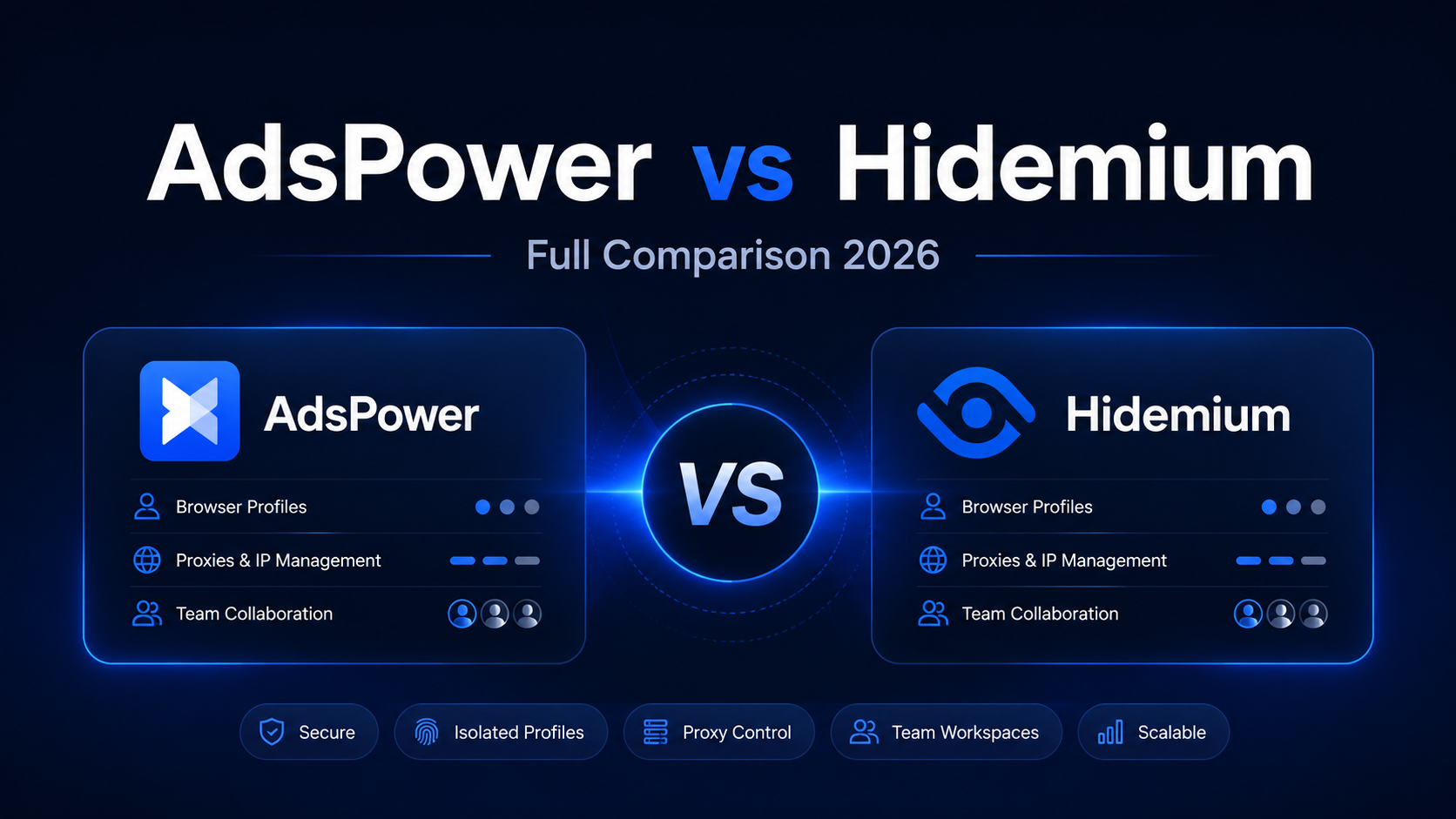

AdsPower vs Hidemium: Full Comparison 2026
AdsPower vs Hidemium: quick answer
AdsPower vs Hidemium is a comparison between two antidetect browser platforms used for browser profiles, proxies, team workflows, and multi-account operations. AdsPower is often considered by account-heavy users, especially in e-commerce and social workflows. Hidemium is a stronger fit for teams that want flexible browser profile operations, workspace organization, proxy control, and scalable team workflows in one platform.
If your main question is “Which tool helps my team run accounts more clearly as we scale?”, Hidemium should be one of the first AdsPower alternatives you compare.
Introduction
Choosing between AdsPower and Hidemium is not just a feature checklist.
Both tools exist in the antidetect browser and browser profile management space. Both can help users create separate browser profiles, work with proxies, and manage multiple accounts for legitimate workflows.
But the real decision is deeper.
The right tool depends on how your team operates.
Some users need a platform focused on account-heavy workflows. Some teams need a more flexible system for browser profiles, proxies, workspaces, operators, permissions, and repeatable account processes.
That is why this AdsPower vs Hidemium comparison focuses on workflow fit, not only feature names.
The goal is simple: help agencies, e-commerce teams, affiliate teams, social media operators, Web3 users, and remote teams decide which platform is better for their daily account operations in 2026.
What is AdsPower?
AdsPower is an antidetect browser platform commonly considered by users who manage multiple browser profiles and account-heavy workflows.
It is often associated with use cases such as:
- E-commerce account management
- Social media account workflows
- Marketplace seller operations
- Browser profile separation
- Proxy-based profile environments
- Team-based account management
- Repetitive multi-account tasks
AdsPower can be a practical option for users who want a familiar antidetect browser tool with account management features.
It may be a good fit when your team is already comfortable with its workflow, when your processes are built around account-heavy operations, or when your main requirement is managing many separate browser environments.
What is Hidemium?
Hidemium is an antidetect browser and browser profile management platform built for users who need profiles, proxies, team access, workspaces, and scalable account operations in one organized system.
Hidemium is designed for teams that need to answer practical workflow questions:
- Which profile belongs to which account?
- Which proxy is assigned to this profile?
- Which workspace does this profile belong to?
- Which operator can access it?
- Which client, store, campaign, or project is this profile for?
- Is this workflow repeatable as profile count grows?
This makes Hidemium a strong option for teams that want browser profile management to feel less scattered and more operational.
In the AdsPower vs Hidemium comparison, Hidemium is best positioned for teams that want clarity, flexibility, and scale across different account workflows.
AdsPower vs Hidemium: Core difference
The simplest way to compare AdsPower and Hidemium is this:
AdsPower is often evaluated as an account-heavy antidetect browser.
Hidemium is better positioned as a flexible browser profile operations platform for teams.
| Comparison point | AdsPower | Hidemium |
|---|---|---|
| Main appeal | Account-heavy browser profile workflows | Flexible browser profile operations for teams |
| Best for | E-commerce, social, marketplace, and account-heavy users | Agencies, e-commerce teams, affiliate teams, remote teams, Web3, and multi-workflow teams |
| Browser profiles | Supported | Supported |
| Proxy workflows | Supported | Strong fit for organized proxy assignment |
| Team workflows | Supported depending on setup | Strong fit for multi-operator workflow control |
| Workspaces | Useful depending on workflow | Strong focus on separating clients, projects, stores, and campaigns |
| Daily operations | Good for managing many accounts | Better for structuring profiles, proxies, operators, and workspaces together |
| Best reason to choose | Account-heavy workflows | Flexible operations, team clarity, and scalable account management |
This is not about saying one tool is always better for every user.
It is about matching the tool to the operating model.
AdsPower vs Hidemium: which tool fits your team?
| Team type | Better fit | Why |
|---|---|---|
| Solo account operator | AdsPower or Hidemium | AdsPower may fit familiar account-heavy workflows; Hidemium may fit users who want cleaner organization from the start. |
| E-commerce team | Hidemium or AdsPower | AdsPower is often considered in e-commerce; Hidemium is strong when the team needs workspaces, proxy clarity, and operators. |
| Performance agency | Hidemium | Agencies need client separation, workspace structure, profile ownership, and team access. |
| Affiliate team | Hidemium | Hidemium supports campaign profiles, proxies, team workflows, and repeatable operations. |
| Social media team | Hidemium or AdsPower | AdsPower may fit account-heavy use; Hidemium fits broader workflow organization. |
| Remote team | Hidemium | Remote operators need clear access, workspace ownership, profile status, and proxy visibility. |
| Web3 team | Hidemium | Useful for separating profiles, wallets, projects, operators, and proxy environments. |
| Multi-client operation | Hidemium | Stronger fit when profiles need to be grouped by client, campaign, workspace, and operator. |
For teams with multiple operators and different business units, Hidemium is often the more scalable choice.
Why teams compare AdsPower vs Hidemium
Users usually compare AdsPower vs Hidemium when their workflow reaches a decision point.
At the beginning, managing multiple browser profiles may feel simple. You create profiles, attach proxies, log into accounts, and continue working.
But once the team grows, account operations become harder to control.
Teams start asking:
- Are profiles organized by account, client, store, or project?
- Can operators access only the profiles they need?
- Are proxies easy to assign and track?
- Can workspaces separate different workflows?
- Can new team members understand the system quickly?
- Can the team scale without relying on spreadsheets?
- Does the tool reduce manual work or create more admin work?
This is where the comparison becomes more serious.
A good antidetect browser is not only a profile creator. It becomes part of the team’s operating system.
Hidemium vs AdsPower for e-commerce
E-commerce is one of the most common reasons users compare AdsPower and Hidemium.
E-commerce teams may manage:
- Multiple stores
- Marketplace seller accounts
- Supplier dashboards
- Ad accounts
- Support accounts
- Regional proxy setups
- Team operators
- Store-specific workflows
AdsPower is often considered in e-commerce because many account-heavy users already associate it with multi-account workflows.
Hidemium becomes a strong alternative when the e-commerce team needs more operational clarity.
A growing e-commerce team needs to know:
- Which browser profile belongs to which store?
- Which proxy is assigned to which marketplace account?
- Which team member owns each workflow?
- Which profiles are active?
- Which workspace contains each store or region?
- How can the team repeat the same setup for new stores?
For this reason, Hidemium can be a better fit when e-commerce operations become team-based and structured.
Example: e-commerce workflow
Imagine an e-commerce team managing 80 store profiles across several marketplaces. This is an illustrative example, not a public case study.
With a loose setup, the team may track stores, profiles, proxies, and owners in separate notes or spreadsheets.
With Hidemium, the team can structure the workflow like this:
- Create workspaces by store, region, or marketplace.
- Assign browser profiles to the correct workspace.
- Connect proxies to each profile.
- Give operators access only to the profiles they manage.
- Keep store workflows easier to repeat as the business grows.
This is where Hidemium becomes a practical AdsPower alternative for e-commerce teams.
Hidemium vs AdsPower for agencies
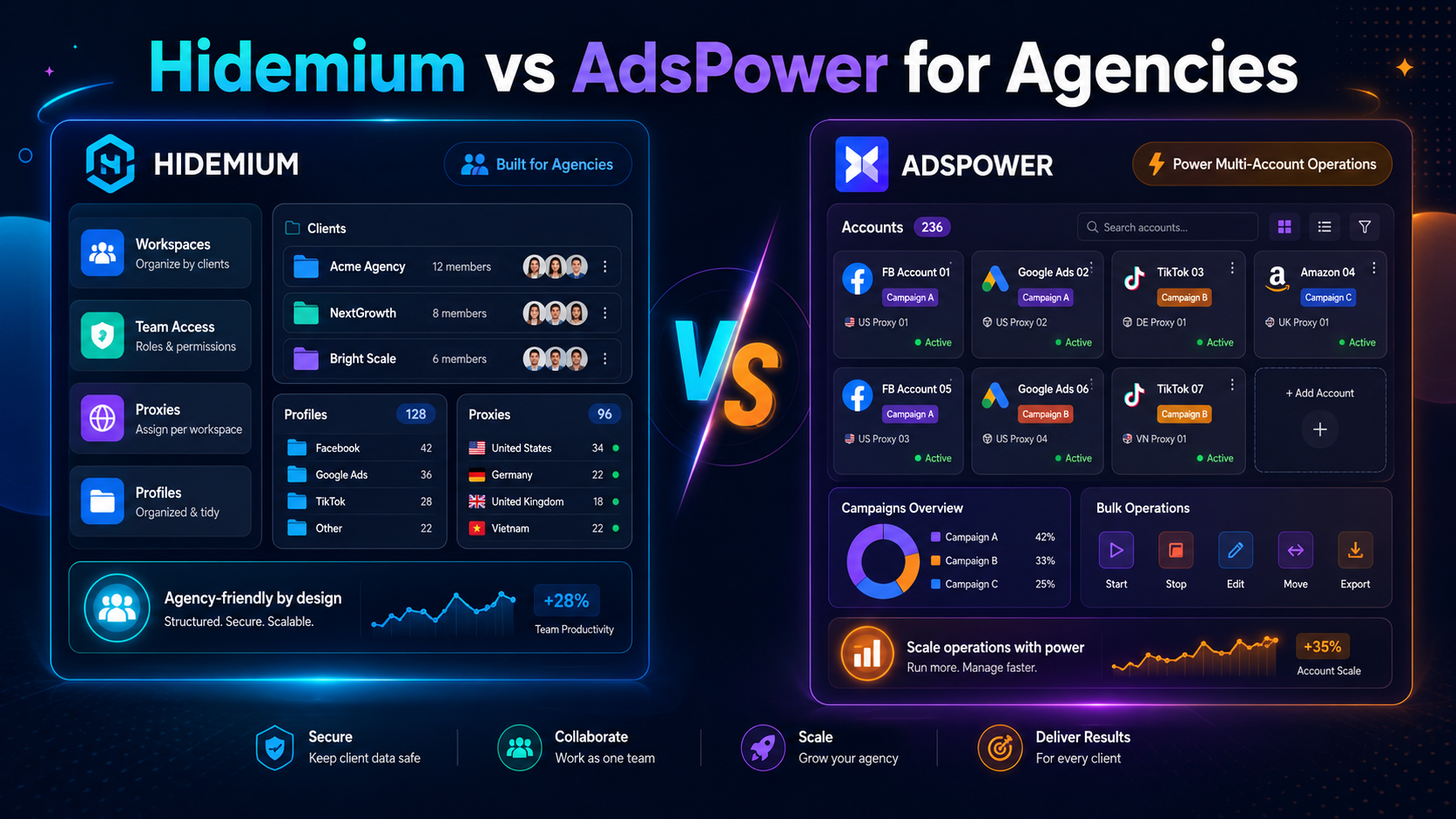
Agencies need a different level of organization.
An agency may manage accounts for many clients at the same time. Each client may have different platforms, campaigns, operators, proxies, and profile rules.
In this situation, a messy profile system creates real operational friction.
Agencies need to answer:
- Which profile belongs to which client?
- Which campaign does this account support?
- Which operator has access?
- Which proxy is connected?
- Which workspace contains the client workflow?
- Which profiles should be archived after a project ends?
Hidemium is a strong choice for agencies because it helps structure browser profiles around client operations.
In the AdsPower vs Hidemium comparison, Hidemium is better when the agency needs client separation, workspace clarity, role-based access, proxy visibility, and repeatable team workflows.
Example: agency workflow
Imagine a performance agency managing 200 client-related profiles across 25 clients. This is an illustrative example.
Without workspace rules, profile names and proxy assignments can become confusing. Operators may spend extra time asking which profile belongs to which campaign.
With Hidemium, the agency can create client workspaces, assign profiles to campaigns, connect proxies, and give team members access based on responsibility.
The benefit is not only cleaner management. It is faster execution.
Hidemium vs AdsPower for affiliate teams
Affiliate teams care about speed, repeatability, account structure, and proxy management.
They often manage campaigns, traffic sources, landing page tools, ad accounts, tracking platforms, and offer-related workflows.
AdsPower may be considered by affiliate users who want multi-account profile management.
Hidemium becomes more attractive when the team wants to organize profiles around campaign operations.
A good affiliate workflow needs:
- Profiles grouped by campaign
- Proxies assigned clearly
- Operators assigned to specific workflows
- Workspaces separated by traffic source, client, or offer
- Repeatable setup for new campaigns
- Visibility into active and inactive profiles
Hidemium is useful because it helps teams manage account workflows as a system, not as disconnected profiles.
Hidemium vs AdsPower for remote teams
Remote teams need visibility.
When operators work from different locations, profile management can become confusing if the system is not clear.
A remote team should be able to answer:
- Who owns this profile?
- Which workspace does it belong to?
- Which proxy is connected?
- Which account is it for?
- Who can access it?
- Is this profile still active?
This is where Hidemium is often a better fit.
In a remote workflow, the value is not only the browser profile. The value is shared clarity.
Hidemium helps remote teams manage browser profiles, proxies, workspaces, and team access in one system, reducing the need for scattered communication.
AdsPower vs Hidemium feature comparison
| Feature area | AdsPower | Hidemium |
|---|---|---|
| Browser profile management | Supported | Supported |
| Proxy assignment | Supported | Strong fit for organized proxy workflows |
| Multi-account workflows | Supported | Supported |
| Workspace organization | Useful depending on setup | Strong fit for client, store, campaign, and project separation |
| Team access | Supported depending on plan and setup | Strong fit for multi-operator workflows |
| Profile ownership | Depends on workflow structure | Strong focus on operational clarity |
| Agency workflows | Useful for account-heavy workflows | Strong fit for client and campaign separation |
| E-commerce workflows | Strong category fit | Strong fit when stores, proxies, and team access need structure |
| Affiliate workflows | Useful for multi-account work | Strong fit for campaign structure and repeatable operations |
| Remote team operations | Depends on setup | Strong fit for distributed operators |
| Cost at scale | Should be checked on official pricing | Should be checked on official pricing |
| Best fit | Account-heavy users | Teams that want flexible account operations |
Use this table as a decision map, not as a fixed rule. Pricing and features may change, so verify current plan details before publishing exact claims.
Why choose Hidemium over AdsPower?
Choose Hidemium over AdsPower when your team needs more than account-heavy browser profile management.
Hidemium is a strong choice if your team needs:
- Browser profiles organized by account, client, store, campaign, or project
- Proxies assigned clearly across different workflows
- Workspaces for separating teams, clients, regions, or campaigns
- Team access for operators and managers
- Profile ownership and workflow visibility
- A flexible system for agencies, e-commerce, affiliate, Web3, and remote teams
- Repeatable workflows as profile count grows
- A scalable platform for account operations
This is the strongest reason to choose Hidemium in the AdsPower vs Hidemium comparison.
It helps teams move from “many accounts” to “organized account operations.”
When AdsPower may still be the right choice
AdsPower may still be a good option if it already fits your workflow.
It may be enough if:
- Your current AdsPower setup is stable
- Your team is already trained on its process
- You mainly need account-heavy browser profile workflows
- Your workspace and access requirements are simple
- Your proxy structure is already easy to manage
- You do not need major changes in team organization
A good comparison should not force every user to switch.
If AdsPower already supports your workflow clearly and efficiently, it may still be the right choice.
But if your team is becoming harder to organize, Hidemium is worth comparing.
Pricing: how to compare AdsPower and Hidemium
Pricing changes often across antidetect browser tools. Do not base your decision only on the entry price.
Compare total operating value.
Ask:
- How many browser profiles do we need today?
- How many profiles will we need in six months?
- How many team members need access?
- Are workspaces included?
- Is profile sharing included?
- How are proxies managed?
- What happens when profile count increases?
- Does the plan fit our team structure?
- Does the tool reduce manual work?
- Does support match our operating needs?
The best tool is not always the cheapest tool.
The best tool is the one that keeps your team efficient as profiles, proxies, accounts, and operators increase.
Pros and cons: AdsPower vs Hidemium
AdsPower pros
- Familiar option for account-heavy users
- Often considered in e-commerce and social media workflows
- Supports browser profile management
- Useful for users who want multi-account browser environments
- May fit teams already comfortable with its process
AdsPower cons
- May not fit every team’s preferred workflow structure
- Teams should check workspace, access, and pricing details carefully
- Large teams may need stronger internal rules for profile ownership and proxy organization
- Users may compare alternatives when flexibility, structure, or operating clarity becomes more important
Hidemium pros
- Strong fit for team-based browser profile operations
- Supports profiles, proxies, workspaces, and team workflows
- Useful for agencies, e-commerce teams, affiliate teams, Web3 teams, and remote operators
- Helps organize profiles around real business workflows
- Flexible for multiple operating models
- Strong fit when accounts are connected to clients, stores, campaigns, or projects
Hidemium cons
- May be more than a solo user needs
- Teams still need clear naming, access, and workspace rules
- Users focused only on a familiar account-heavy interface may need time to adjust
How to choose between AdsPower and Hidemium
Before choosing between AdsPower and Hidemium, map your real workflow.
Do not start with the tool. Start with the operation.
1. Count your profiles
How many browser profiles do you manage now? How many will you manage later?
If profile count is growing quickly, choose the tool that helps you stay organized.
2. Map your account types
Are profiles connected to stores, clients, campaigns, ad accounts, social accounts, wallets, or marketplaces?
If yes, you need structure beyond profile creation.
3. Review proxy complexity
If proxies are assigned across many profiles, proxy visibility becomes important.
Your team should not waste time figuring out which proxy belongs to which profile.
4. Check team access
If multiple people use the system, access control matters.
Operators should only access the profiles and workspaces they need.
5. Review workspace needs
Workspaces help separate clients, stores, campaigns, projects, regions, or departments.
If everything sits in one long profile list, operations become harder over time.
6. Compare cost at scale
Do not compare only the lowest plan.
Compare what happens when your profile count, team size, and workflow complexity increase.
7. Test one real workflow
Before switching fully, test one real process.
Create one workspace, add a few profiles, assign proxies, invite operators, and run a normal account workflow.
The better tool will become clear from daily use.
Best AdsPower alternative for teams
Hidemium is one of the best AdsPower alternatives for teams that need browser profiles, proxy workflows, workspaces, team access, and scalable account operations.
It is especially relevant for:
- Agencies managing many clients
- E-commerce teams managing stores and marketplaces
- Affiliate teams managing campaigns
- Social media teams managing client or brand profiles
- Web3 teams separating wallets and projects
- Remote teams working across locations
For these teams, the goal is not only to manage more accounts.
The goal is to manage accounts with less confusion.
AdsPower vs Hidemium: quick decision rule
Use AdsPower if your current account-heavy workflow is stable, your team is comfortable with the platform, and you do not need major changes in workspace or team structure.
Use Hidemium if your team needs a more flexible way to organize browser profiles, proxies, workspaces, team access, and scalable account workflows.
The AdsPower vs Hidemium decision is really about operational fit.
Summary: AdsPower vs Hidemium
- AdsPower is often considered by account-heavy users, especially in e-commerce and social workflows.
- Hidemium is a strong AdsPower alternative for teams that need profiles, proxies, workspaces, access control, and workflow structure.
- AdsPower may fit users who already have a stable process.
- Hidemium is stronger when teams need flexible account operations across clients, stores, campaigns, operators, and projects.
- The best choice depends on how your team manages profiles, proxies, workspaces, and people every day.
Conclusion: AdsPower vs Hidemium in 2026
The AdsPower vs Hidemium comparison comes down to how your team works.
AdsPower can be a good choice for users who want account-heavy browser profile workflows and already have a stable process.
Hidemium is a stronger choice for teams that need browser profiles, proxies, workspaces, team access, and scalable account operations in one flexible system.
Choose Hidemium if your team needs:
- Clear profile organization
- Better proxy workflow visibility
- Workspace separation
- Team access control
- Repeatable account operations
- A flexible platform for multiple business workflows
If your team is comparing AdsPower alternatives in 2026, Hidemium should be one of the first platforms to test.
Try Hidemium or book a demo to see how your team can manage browser profiles, proxies, workspaces, and account workflows with more clarity.
FAQ: AdsPower vs Hidemium
What is the main difference between AdsPower and Hidemium?
The main difference between AdsPower and Hidemium is workflow fit. AdsPower is often considered for account-heavy browser profile workflows, while Hidemium is stronger for teams that need profiles, proxies, workspaces, team access, and scalable account operations.
Is Hidemium better than AdsPower?
Hidemium can be better than AdsPower for teams that need stronger workflow organization, workspace separation, proxy clarity, and team access. AdsPower may still fit users who already have a stable account-heavy process.
What is the best AdsPower alternative in 2026?
Hidemium is one of the best AdsPower alternatives in 2026 for teams that need browser profiles, proxies, workspaces, team workflows, and scalable account operations in one flexible platform.
Should e-commerce teams choose AdsPower or Hidemium?
E-commerce teams should choose based on workflow complexity. AdsPower may fit account-heavy users, while Hidemium is stronger when stores, proxies, operators, and workspaces need clearer organization.
Is Hidemium good for agencies?
Yes. Hidemium is a strong option for agencies because it helps organize browser profiles by client, campaign, workspace, proxy, and operator. This makes multi-client account operations easier to manage.
Is Hidemium good for remote teams?
Yes. Hidemium is useful for remote teams because it helps manage profile access, proxy assignment, workspace ownership, and operator responsibility across different locations.
Can Hidemium replace AdsPower?
Hidemium can work as an AdsPower replacement for teams that need a flexible browser profile platform with proxies, workspaces, team access, and scalable account operations.
Are antidetect browsers legal?
Antidetect browsers can be used for legitimate purposes such as privacy protection, testing, account separation, agency workflows, e-commerce operations, and security research. Users should always follow applicable laws and the terms of service of the platforms they use.
Related Blogs

Think about what sits inside the average online shopping account.A customer's name and home address are the obvious things. There might also be saved cards, previous orders, store credit, loyalty points and gift card balances. Add the ability to place an order without entering all that information again and it's easy to see why somebody else might want access.For retailers, that's the awkward[…]

Zone DNS is an important component of the domain name management system (DNS), which plays a role in storing DNS records related to domain names. In this article, let's Antidetect Browser Hidemium Learn more about the concept Zone DNS, the benefits it brings and how to effectively manage DNS Zone to ensure the network system operates stably and securely.1. What is Zone DNS?A DNS zone is a data[…]

In the digital age, YouTube is not only an entertainment platform but also a fertile ground for building brands, making money and growing businesses. Whether you are an individual content creator or a company promoting products, increasing views for YouTube videos is a prerequisite for success.However, increasing YouTube views in 2025 is no longer as simple as before. Competition is fiercer,[…]
In the SEO space, many businesses and agencies build blogging strategies from scratch, focusing on optimizing website rankings through quality content. However, a common challenge is Manage multiple Ahrefs accounts for multiple clients or share access that no additional user fees for Ahrefs.Hidemium who share how Share Ahrefs account safely, comply with terms and avoid the risk of being locked[…]

🗓️ Last updated: June 2026Your IP address can reveal your location, internet provider, and parts of your online identity. Whoer helps you check this information in seconds, including your IP address, anonymity score, DNS status, WebRTC leaks, and browser fingerprint.In this guide, Hidemium explains how to use Whoer.net to test your online privacy, verify whether a VPN or proxy is working[…]

Getting your Reddit account banned can be frustrating, especially if you don't know why it happened. Understanding the reasons and how to fix it can help you regain access quickly or safely create a new account. In this article, Hidemium will analyze in detail the common reasons why Reddit accounts get banned, how long the ban lasts, and what to consider when creating a new Reddit account after[…]
