TradeProxy: The Smartest Way to Buy Residential Proxies for Multi-Account Work
Try Hidemium for free

The proxy bill is what caps your operation
Anyone running accounts at scale hits the same wall, and it isn't a technical one. It's arithmetic.
Say you need 200 isolated profiles, each with its own dedicated residential IP. Buy those IPs directly from a major provider and you're looking at a serious monthly line item, plus separate accounts at three or four providers, because no single one covers every country you need, and each of them wants a minimum top-up before they'll talk to you.
So you compromise. You share IPs between profiles. You downgrade to datacenter IPs for the "less important" accounts. You skip the markets where your provider's pool is thin. Every one of those compromises is a link waiting to be found.
TradeProxy exists to remove that constraint. It's a residential proxy marketplace that aggregates inventory from the world's leading providers and sells it at roughly 30–70% of direct pricing, same IPs, same pools, one dashboard, instant delivery.
What TradeProxy actually is
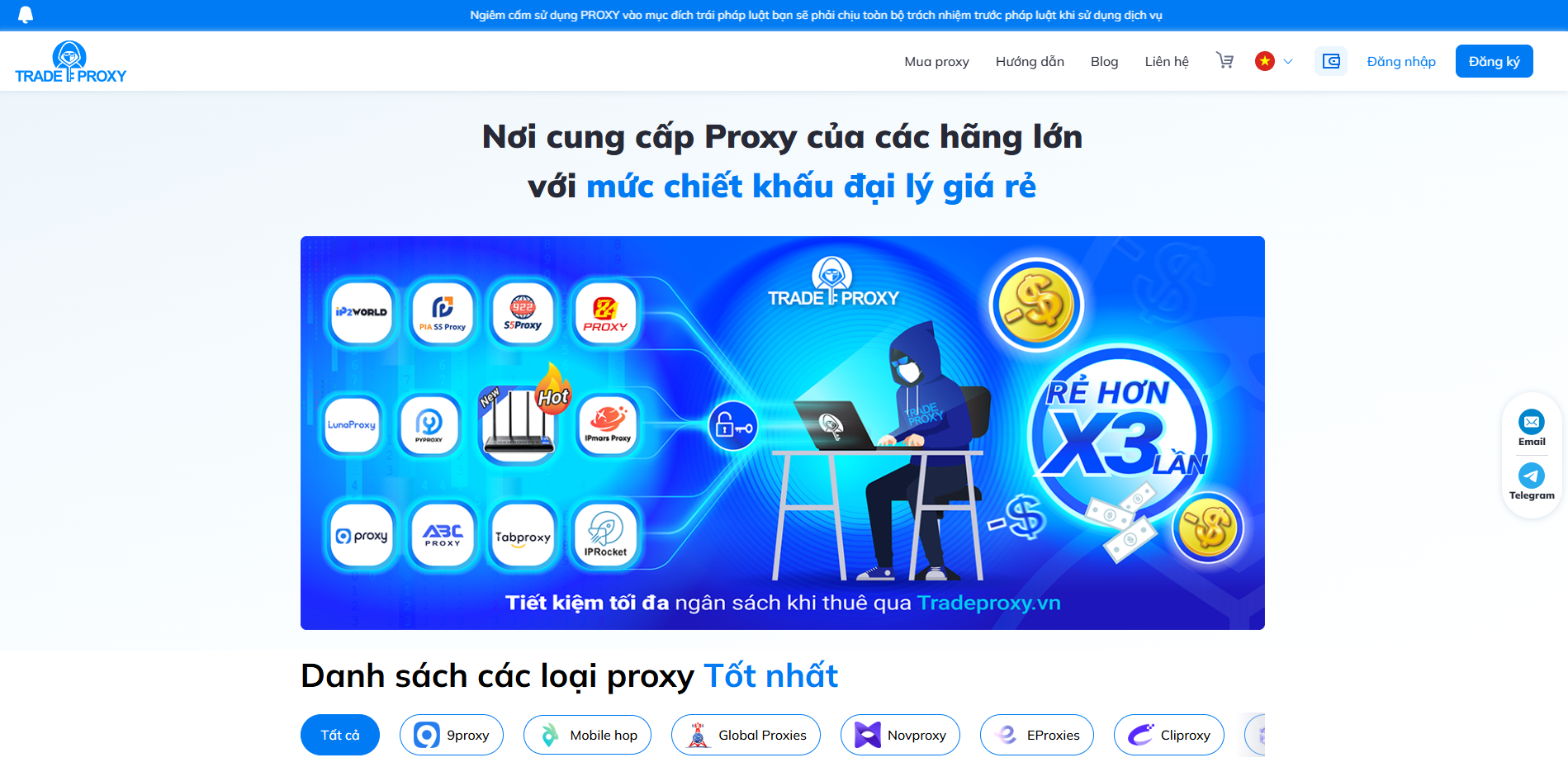
TradeProxy is a marketplace, not a network operator. It partners with premium residential proxy providers: 9Proxy, Lokiproxy, 711proxy, Cliproxy, Swiftproxy, iProcket, Novproxy and more, resells their inventory through a single account.
That structure produces three concrete advantages:
One account instead of seven. No separate signups, no separate minimum top-ups, no juggling seven dashboards and seven billing cycles. Buy from any brand in the catalogue with one balance.
Distribution pricing. TradeProxy buys at volume and passes the margin down. You get the identical IPs the provider sells directly, at a fraction of the retail price.
Provider flexibility per project. Different providers have genuinely different strengths, pool depth in Southeast Asia, ISP quality in the US, mobile coverage in Europe. On TradeProxy you can pick the right one per project instead of forcing every workflow through whichever provider you happen to have a contract with.
Choosing the right proxy type
Most wasted proxy spend comes from buying the wrong type, not from paying too much. Three categories cover essentially every use case:
Static residential (ISP)
One IP, held for the entire subscription. These are what you want any time an account has a password you intend to keep: ad accounts, marketplace storefronts, social profiles, payment dashboards. Rotating the IP under an established login is a bigger red flag than the original signup was.
Sold by IP count. Available from 9Proxy, Lokiproxy, 711proxy, Cliproxy and Novproxy. Full HTTP and SOCKS5 support.
Rotating residential
A new IP per request or on a timer, drawn from a large pool. Built for volume read operations: web scraping, price monitoring, SERP tracking, ad verification. Anywhere you need many IPs and no persistent session.
Billed by traffic (GB), with 30-, 90-, 180-day and lifetime validity options.
4G/5G mobile
Carrier-grade mobile IPs with unlimited bandwidth, the highest-trust tier, because thousands of real subscribers share the same carrier NAT. Products like Mobile Hop and Global Proxies, billed per day.
What you get with every TradeProxy purchase
190+ countries and regions. The US, UK, Japan, Germany and Brazil through to thin, hard-to-source emerging markets. Residential IP purity above 99%.
Instant activation. Automated CDkey delivery the moment payment clears. No manual approval, no waiting on a support ticket, which matters, because every hour an IP sits unused is subscription time you paid for.
Real-world throughput of 1–5 MB/s. Enough that automated collection tasks finish instead of timing out.
HTTP and SOCKS5, working across Windows, macOS, Linux and Android.
Start small, scale later. Small GB and IP packages exist specifically so you can validate against your actual targets before committing a budget.
Where residential proxies earn their keep
Multi-account management. The flagship use case, and the one where proxy quality is least forgiving. Your antidetect browser handles the device layer: fingerprint, cookies, storage isolation, but every profile still has to exit somewhere, and if two of them exit through the same IP you've rebuilt the exact link you were paying to remove. One clean residential IP per profile is the whole game.
Web scraping and market research. Public data collection, competitor tracking, and pricing analysis across regions, with rotating IPs billed by the gigabyte.
SEO and rank tracking. See search results as a local user sees them, country by country and city by city, rather than as a datacenter IP sees them.
Ad verification. Confirm your creatives render to the right audience in the right geo, and catch affiliates running traffic they shouldn't.
E-commerce operations. Run multiple storefronts across Amazon, eBay, Shopee, Lazada and Shopify without cross-contamination, monitor competitor pricing, and streamline cross-platform selling.
Brand protection. Surface counterfeit listings and unauthorized resellers in markets you can't browse from your own IP.
Pairing with an antidetect browser: TradeProxy + Hidemium
Proxies solve the network layer. They don't touch the device layer, canvas and WebGL rendering, fonts, screen metrics, WebRTC, timezone. For multi-accounting you need both, which is why we recommend pairing TradeProxy IPs with Hidemium.
Hidemium is a Chromium-based antidetect browser that creates fully isolated profiles, each with a stable, internally consistent fingerprint and its own cookies and cache. Its native per-profile proxy support (HTTP and SOCKS5, with bulk import) means assigning a dedicated TradeProxy IP to each profile takes seconds even across hundreds of profiles. Add its no-code automation and team access controls and you have a setup that scales without turning into manual work.
The setup, once your IPs land:
- Create the Hidemium profile and set plausible device parameters.
- Paste the TradeProxy credentials into that profile's proxy field: one IP, one profile, no exceptions.
- Match timezone, locale and language to the proxy's country, and let WebRTC follow the proxy.
- Open a check page inside the profile and confirm IP, timezone and WebRTC all agree before logging into anything.
That last step takes thirty seconds and prevents the most common failure of all: a profile whose IP says São Paulo and whose clock says Hanoi.
Buying on TradeProxy: three steps
- Create an account at TradeProxy.vn and top up your balance.
- Pick a provider and proxy type, choose your country and quantity, add to cart.
- Pay and receive instantly: your proxies arrive via automated CDkey, ready to assign.
A few minutes end to end. No manual approval, no sales call.
FAQ
Is TradeProxy a provider or a reseller?
A marketplace. TradeProxy partners with leading providers to deliver their proxies at better pricing through one centralized buying experience, same underlying quality, better economics.
Are these real residential IPs?
Yes. Genuine residential IPs with over 99% purity and high anonymity.
Why is it cheaper than buying direct?
Volume distribution. TradeProxy buys at scale across many providers and passes the margin on.
Which protocols are supported?
HTTP and SOCKS5, across Windows, macOS, Linux and Android. SOCKS5 is the better default where you have the choice.
Does TradeProxy work with antidetect browsers?
Yes, with all major ones. Both HTTP and SOCKS5 credentials drop straight into per-profile proxy fields, and bulk import works for large batches. We recommend Hidemium as a pairing.
Can I test before scaling?
Yes. Smaller GB and IP packages exist for exactly that.
Related Blogs
Which is the better choice for your online business—VPN or Proxy? While many people mistakenly believe that simply using a VPN to change their IP address is enough for security, major platforms can still easily detect shared IP ranges and blacklist associated accounts. The difference between data encryption (VPN) and dedicated IP rotation (Proxy) is often the line between smooth operations and[…]
.png)
In an age where digital privacy is increasingly emphasized, anonymity on the Internet is more than just changing IP address. Websites today can identify users through browser fingerprint – set of unique device parameters. If you are active in the field of making money online and need to create a large number of accounts on the same device, the risk of your account being locked is very high. In[…]
.png)
In the context of rapidly advancing technology, mastering how to check Proxy and Firewall settings is crucial for protecting personal information and optimizing web browsing experiences. Let’s explore simple methods for checking Proxy and Firewall through detailed instructions in this article.What Does Check Proxy And Firewall Mean?The ERR_CONNECTION_REFUSED error is usually caused on the server[…]

Sales teams lose more revenue to bad CRM data than to any single competitor. Reps are told the CRM is the "source of truth," yet 27% of sales data sits inaccurate at any given moment, and reps burn roughly 546 hours a year cleaning it up. That is not a workflow issue. It is a mechanism failure. For years, the fix was more discipline: better templates, mandatory fields, quarterly hygiene projects.[…]
Online marketers often manage dozens to hundreds of accounts the same time. So how to do they do?You have everything from social and merchant accounts for yourself and your clients. Each account must be accessible by different people, such as VAs (virtual assistants) and team members, throughout any given project. You need an effective way to allow access without setting off verification alarm[…]

The rapid advancement of AI and Big Data is profoundly transforming how digital platforms collect, analyze, and evaluate user data. In this context, Antidetect Browsers are playing an increasingly important role in supporting multi-account management and adapting to an ever more complex digital environment, opening up new development trends for the future.1. The impact of AI and Big Data on[…]
