Torrenting as a Practical Method for Efficient and Legitimate File Distribution
Try Hidemium for free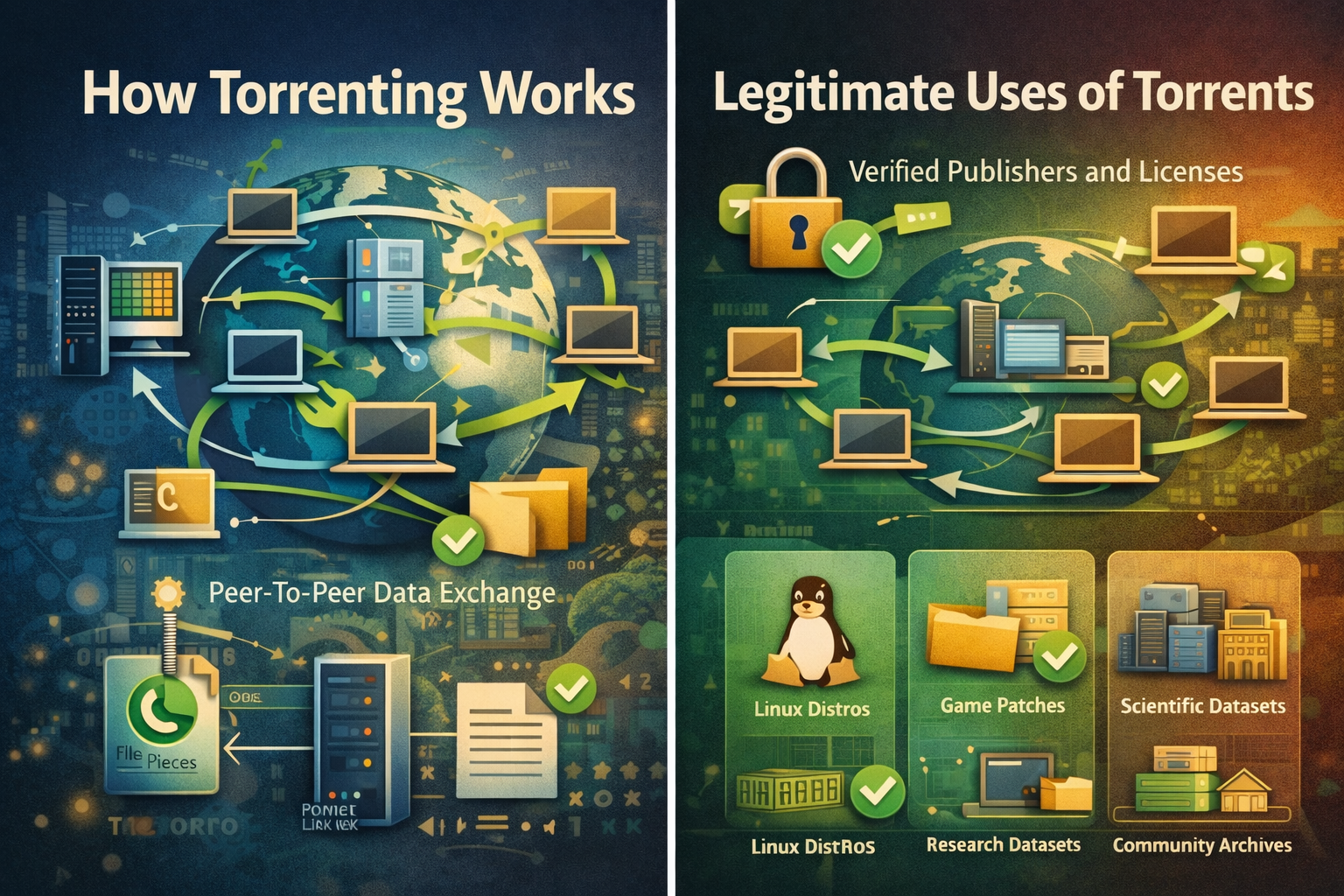

Torrenting is a peer-to-peer method for distributing large files, where many participants exchange small pieces concurrently so downloads and uploads proceed efficiently without relying on a single central server.
Clear rules, reputable sources, and routine checksums make torrenting predictable for legitimate content such as open-source software, public datasets, and authorized media that rights holders publish to reduce bandwidth costs and speed delivery.
When clients, networks, and storage are configured sensibly, everyday results include steady throughput, fewer stalls on busy evenings, and reliable integrity verification that prevents corrupted files from wasting time or data.
What Torrenting Is And Isn’t
Torrenting coordinates swarms of peers that split files into hashed pieces, exchanging them in parallel so total throughput scales with the number of participants rather than with any one provider’s capacity.
A small metadata file or magnet link describes piece hashes and discovery mechanisms, letting clients verify integrity on the fly while learning about other peers that currently hold needed parts.
Trackers, distributed hash tables, and peer exchange each help devices find one another, which keeps distribution resilient even when a single discovery method becomes slow or unavailable.
Legitimate use cases include Linux images, game patches released by publishers, academic mirrors, and community archives that publish under clear licenses and encourage broad, bandwidth-friendly distribution.
Direct downloads from a single host remain useful for small files, yet swarms reduce bottlenecks for large packages during launches or updates when many people request the same content at once.
In everyday terms, a well-seeded torrent behaves like many short, simultaneous handshakes that assemble a verified whole, producing consistent completion times without saturating any one path.
How The BitTorrent Protocol Works
Clients split files into fixed-size pieces and request rare parts first, balancing availability while verifying each piece against its hash to prevent corrupted segments from propagating.
Peers contribute upload bandwidth in proportion to what they receive, while optimistic unchoking periodically tests new partners so faster paths or more reliable peers can be discovered automatically.
Trackers offer compact peer lists, distributed hash tables remove reliance on any single service, and peer exchange shares neighbor information inside the swarm to speed discovery.
Seeds hold the complete file and only upload, while leechers still download missing pieces, and healthy swarms maintain enough seeds to keep availability stable during quiet periods.
NAT behavior, UPnP, and port-forwarding influence inbound connectivity, yet many clients perform acceptably behind common home routers when outbound sessions are permitted and state is maintained.
Because pieces verify independently and assemble deterministically, interrupted sessions resume without confusion, allowing safe pauses for travel, reboots, or scheduled off-peak windows.
Safety, Legality, And Account Hygiene
Legitimate torrenting centers on authorized sources, clear licenses, and verifiable publishers, and routine hash or signature checks confirm that retrieved files match the originals exactly.
Security improves when clients auto-update, antivirus scans remain enabled, and archive contents are opened cautiously, since integrity checks validate transport while scanners assess what the files actually contain.
Public Wi-Fi, captive portals, and shared computers complicate privacy and reliability, so predictable results favor trusted devices, known networks, and conservative client settings that limit background activity.
People sometimes research “what is a residential vpn” while comparing network paths, yet transport choices complement rather than replace the need for reputable sources, signatures, and sensible client hygiene.
Clear bandwidth limits, seeding windows, and queue sizes keep household connections responsive, and honoring license terms avoids unwanted uploads that exceed what the publisher intends.
Minimal telemetry, anonymized statistics, and opt-out toggles inside clients reduce data collection, aligning everyday use with privacy expectations without breaking discovery or swarm health.
Account recovery emails, unique passwords, and two-factor authentication protect forums and tracker logins where applicable, preventing simple credential issues from interrupting legitimate access.
Home Network And Performance Basics
Ethernet links, modern routers, and quiet RF environments reduce jitter and retries, while labeled SSIDs and a dedicated 5 GHz channel keep real-time traffic like calls and games responsive during active torrents.
Smart Queue Management mitigates bufferbloat by shaping slightly below the true uplink rate, preserving low latency for interactive apps while large transfers proceed steadily in the background.
Reasonable upload caps—often 60–80 percent of the measured uplink—protect acknowledgments and voice packets, which prevents stalls that look like server problems but originate at the modem.
Disk performance matters because many small writes compete with other tasks, and enabling sparse files, appropriate cache sizes, or SSD storage keeps piece assembly smooth under load.
Static ip residential assignments are uncommon in consumer plans, so dynamic addressing and NAT should be assumed, with clients configured to maintain sessions gracefully across brief reconnects.
Small businesses that require consistent internet access through dedicated ipv4 solutions use provider-managed circuits or static addressing to stabilize inbound services, while ordinary torrenting works reliably without such arrangements.
Scheduled activity—overnight seeds, off-peak downloads, and paused transfers during video calls—keeps shared households predictable, and per-device quotas avoid surprise slowdowns when multiple clients run concurrently.
Logging basic metrics like throughput, active peers, and hash-fail counts helps diagnose issues quickly, distinguishing local disk or Wi-Fi limits from transient path congestion beyond the home.
Conclusion: Practical, Legitimate Torrenting For Everyday Needs
Torrenting is a standards-based way to distribute authorized large files efficiently, and its integrity checks, swarm resilience, and resumable sessions make it practical for routine software and data distribution.
Predictable outcomes follow from reputable sources, regular client updates, cautious file handling, and bandwidth settings that protect other activities on the same connection.
Discovery methods and hashing keep availability high without centralized bottlenecks, while sensible NAT and router defaults maintain connectivity for most households without complex tuning.
Privacy and reliability improve further on trusted devices and networks, and transport choices remain secondary to publisher authenticity and routine verification.
Simple dashboards for speed, peers, and errors shorten troubleshooting, preventing small misconfigurations from turning into persistent stalls or confusing timeouts.
With measured habits and authorized content, torrenting functions as a dependable utility for distributing large files quickly, safely, and politely across ordinary home and mobile networks.
Related Blogs

Websites are always on the lookout for bots. If your data collection tool is recognized as automated, it will be quickly blocked. Today, most platforms deploy advanced detection technologies such as CAPTCHAs, browser fingerprinting, and behavioral tracking to prevent bots.When collecting data at scale for SEO, ecommerce, or market research, getting blocked not only wastes your time, but also[…]

Telegram bị chặn bởi nhà mạng tại Việt Nam đang là chủ đề nhận được sự quan tâm lớn từ cộng đồng người dùng. Sáng ngày 26/5/2025, nhiều người tại Việt Nam bất ngờ không thể truy cập và sử dụng ứng dụng Telegram như bình thường. Điều này gây gián đoạn trong quá trình liên lạc cá nhân, trao đổi công việc cũng như sao lưu tài liệu quan trọng.Nhằm giúp người dùng khắc phục tình trạng này, bài viết[…]
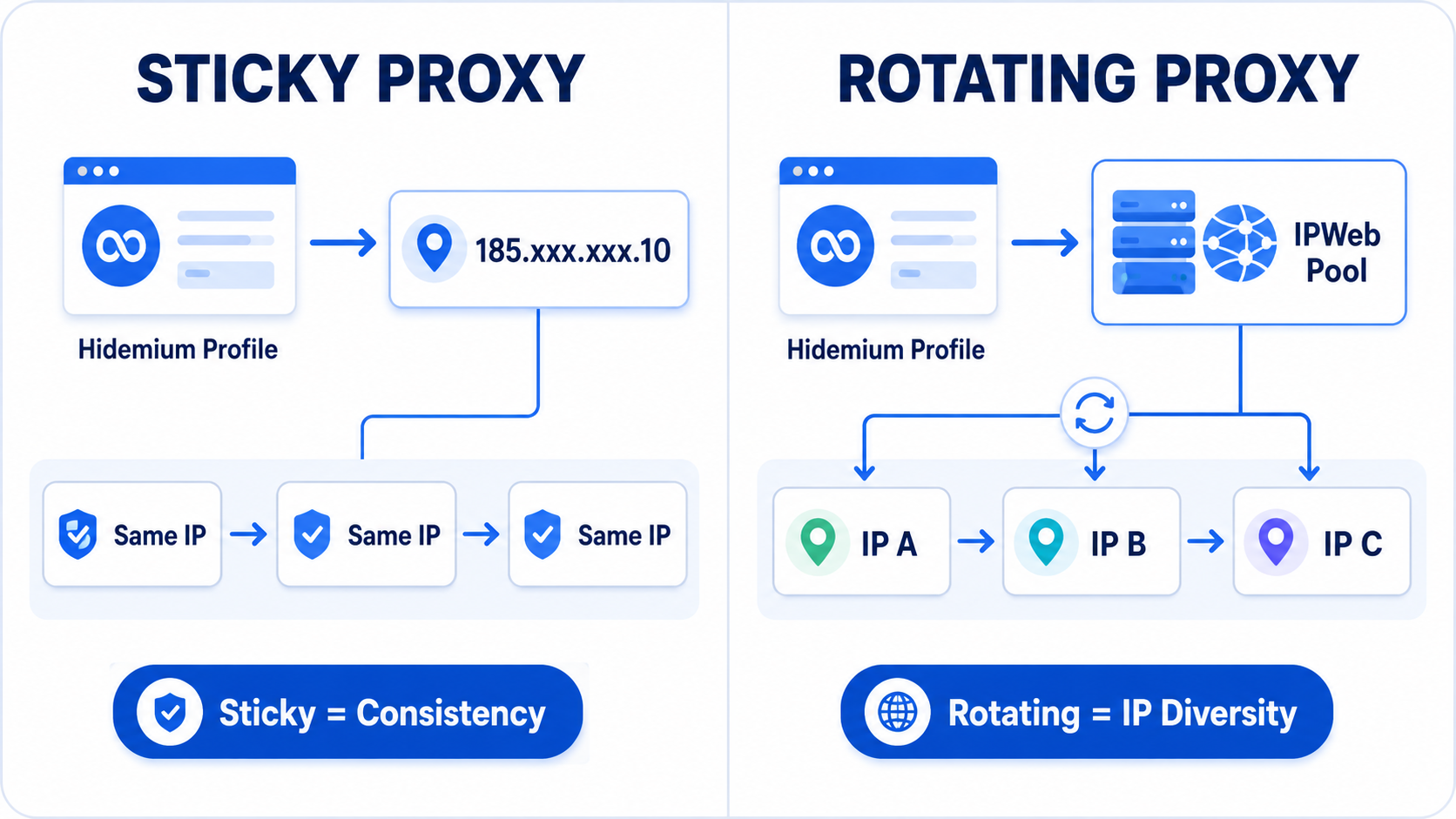
Title:Rotating vs Sticky Proxies for Hidemium: Which IPWeb Setup Should You Use? Meta description:Rotating or sticky proxy for Hidemium? Compare both IPWeb proxy setups, see which works best for stable sessions, research, geo testing and browser profiles. Rotating vs Sticky Proxies in Hidemium: Which IPWeb Proxy Setup Is Right for You?If you're using IPWeb proxies with Hidemium Antidetect[…]

Best Antidetect Browser for Dropshipping 2026Dropshipping may begin with one store, one supplier, and one operator. However, the workflow can quickly become more complicated when a business expands across multiple brands, markets, advertising accounts, storefronts, or team members.Each store may use its own email address, cookies, login sessions, product research tools, advertising accounts, and[…]

Whether you are a digital marketer gathering competitive intelligence, a sneakerhead trying to cop limited-edition shoes, or an online shopper hunting for exclusive overseas merchandise, your success relies heavily on one crucial tool: the internet. However, the internet is not as borderless as it seems. Geo-blocks, IP bans, and regional restrictions stand in the way. This is exactly why finding[…]
.png)
Residential proxies enable breathing of browsing software. Residential proxies are more effective at connecting you than data center proxies since they originate from actual devices. Reading this post right now if you’re unsure about the circumstances under which and from whom to get a residential proxy.What is a residential proxy?Proxies are more difficult to identify than datacenter IPs because[…]
