

The rapid advancement of AI and Big Data is profoundly transforming how digital platforms collect, analyze, and evaluate user data. In this context, Antidetect Browsers are playing an increasingly important role in supporting multi-account management and adapting to an ever more complex digital environment, opening up new development trends for the future.
1. The impact of AI and Big Data on Antidetect Browsers
The rapid development of AI and Big Data is reshaping how digital platforms evaluate users. Specifically, AI is increasingly enhanced with machine learning capabilities, behavioral analysis, and access pattern recognition, enabling systems to automatically detect anomalies based on large-scale data. Rather than relying solely on IP addresses or individual browser parameters, modern systems now analyze behavioral data, access patterns, and the level of consistency across multiple accounts.
In this context, Antidetect Browsers are no longer merely tools for managing multiple accounts; they have become strategic solutions that help users adapt to an increasingly complex digital environment.
2. Future development trends of Antidetect Browsers
In response to the advancement of AI and Big Data, Antidetect Browsers must continuously evolve to adapt to how platforms analyze data and user behavior. The following trends reflect the main directions of their future development.
2.1 AI-driven user behavior simulation
AI is no longer used solely for risk detection; it is increasingly being integrated into Antidetect Browsers themselves. Future trends focus on:
Simulating natural browsing behavior
Emulating mouse movements, keyboard input, and interaction timing
Diversifying browsing behavior across different sessions
Recreating user habits based on specific usage contexts
Optimizing browser interaction flows
Structuring actions in a logical, smooth sequence
Reducing repetitive or mechanical actions
Adjusting interaction speed to match real user behavior
Reducing the risk of account suspension due to abnormal behavior
Limiting sudden or inconsistent access signals
Maintaining stability between behavior patterns and browser configurations
Improving compatibility with platform evaluation systems
These advancements make multi-account management safer and more sustainable over the long term.
2.2 Big Data–driven fingerprint personalization
Big Data makes it possible to build fingerprints that closely match real-world device data. Next-generation Antidetect Browsers will:
Limit rare configurations
Future Antidetect Browsers will focus on eliminating browser configurations that rarely appear in real usage, as these are easily flagged as abnormal by AI systems. Using common configurations allows browser profiles to blend more naturally into the platform’s overall user data.Increase similarity to real users
Through Big Data analysis, fingerprints are designed to accurately reflect the characteristics of widely used devices and typical user behavior. This results in a high level of resemblance to real users, reducing deviations from normal access patterns.Reduce the likelihood of AI risk assessments
When fingerprints and access behavior are optimized in sync, abnormal signals during usage are minimized. As a result, platform AI systems are less likely to classify such activity as high risk, supporting more stable multi-account management.

3. HIDEMIUM – An Antidetect Browser solution for the AI and Big Data era
Among today’s available solutions, HIDEMIUM is highly regarded for its ability to:
Manage multiple accounts effectively
This Antidetect Browser allows multiple accounts to operate simultaneously on the same system while maintaining stability, making it easier to manage and monitor each account’s activity.Fully isolate browser profiles
Each browser profile is independently configured in terms of data and operating parameters. This prevents cross-account linkage and maintains a high level of security during use.Support team collaboration with clear permissions
The tool enables teamwork through clearly defined role-based access controls, ensuring smooth coordination and effective oversight within teams.Optimize marketing operations and market research
Antidetect Browsers facilitate multi-channel marketing execution and market analysis, allowing users to test campaigns and collect data in isolated access environments.
.webp)
Users can explore detailed information about the software here: Link: HIDEMIUM.
HIDEMIUM not only meets current needs but is also designed to adapt to future AI-driven trends.
4. The role of Antidetect Browsers in long-term strategy
In the age of AI and Big Data, Antidetect Browsers are becoming an essential part of long-term operational strategies, including:
Digital identity isolation: Antidetect Browsers create separate browser environments for each account, helping avoid fingerprint overlap and reducing the risk of linkage during platform scans.
Reduced mass suspension risk: When one account encounters an issue, the others remain safe, preserving long-term effort and data.
Scalability support: Easily manage multiple accounts across multiple markets and collaborate in teams while maintaining stability.
Alignment with sustainable strategies: Antidetect Browsers focus on long-term account nurturing and building trust naturally, rather than pursuing high-risk, short-term gains.
Integration with clean proxies: When used alongside high-quality proxies, Antidetect Browsers enable safer and more efficient long-term operations.
Choosing the right Antidetect Browser, such as HIDEMIUM, helps businesses and individuals minimize account suspension risks while optimizing long-term performance.
5. Conclusion
The future of Antidetect Browsers in the age of AI and Big Data depends on their ability to adapt to data and user behavior. As platforms become increasingly intelligent, using professional solutions for multi-account management becomes a key success factor.
With its fingerprint optimization capabilities, secure account management, and alignment with AI-driven trends, HIDEMIUM is a reliable choice for users seeking sustainable growth in today’s digital environment.
Experience and explore HIDEMIUM – the Antidetect Browser for the AI & Big Data era today.
Related Blogs

An undetectable browser, also known as a browser antidetect or anti-detection browser, is an essential tool for users to protect their online privacy and manage multiple accounts without detection. However, using unreliable antidetect software can result in various risks, such as data leaks, account bans, poor performance, and malware threats. In this article, we will analyze the potential[…]

In the digital age, online identity protection and multi-account management are crucial for many industries. Online platforms are tightening moderation policies and using digital fingerprinting technology (browser fingerprinting) to detect and restrict unusual activities. This creates challenges for individuals and businesses operating multiple accounts, running advertising campaigns, or engaging[…]

The problem of ad account deactivated Facebook is no longer a rare thing. Due to many reasons, your account “evaporated” from this social networking platform. So what causes the Facebook ad account to be disabled? Follow the article to get the most accurate answer.Reasons Ad account deactivated FacebookAd account deactivatedHow would you feel if one day you couldn’t find your ad account anymore?[…]
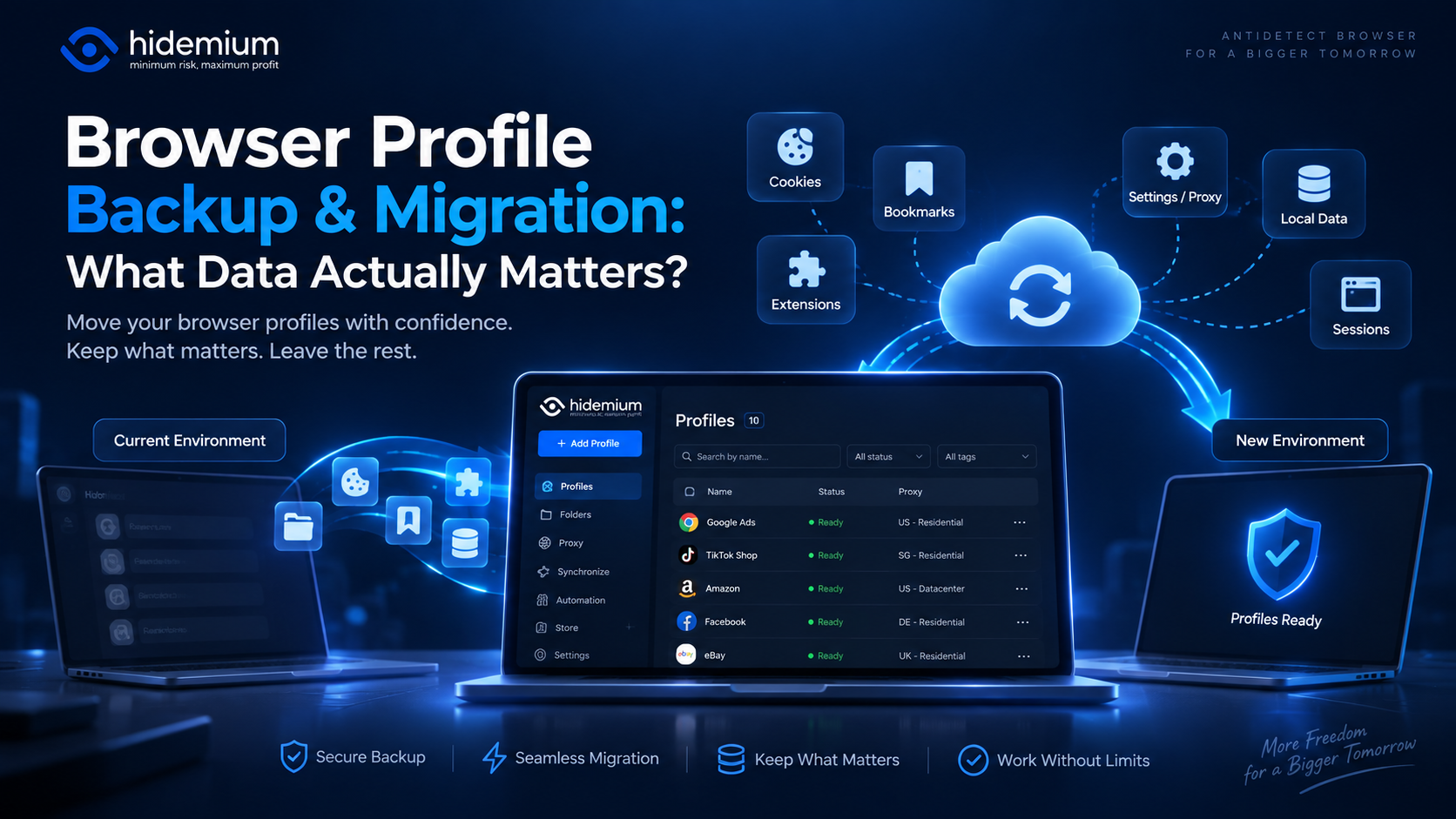
Moving a browser profile sounds easy:Export → Import → Open.But that is rarely the whole story.A migrated profile may open successfully while the user is logged out, extensions are missing, proxy settings have disappeared, or website data behaves differently.In other words:The profile moved, but the working environment did not.That is why browser profile backup migration should not be treated as[…]

Whether you are a dedicated mobile gamer looking for a competitive edge on a larger screen, an app developer testing a new interface, or someone who manages multiple accounts across platforms, finding the best android emulator is the key to a seamless experience. For those involved in multi-account management or automation workflows, the choice of emulator — and how you pair it with the right[…]

To turn off fingerprint unlock for Chrome passwords, open Google Password Manager or your device’s biometric security settings and disable fingerprint, Face ID, or Touch ID authentication where available. Chrome will then use another supported device authentication method, such as a PIN, password, or passcode.In this article, Hidemium will guide you in detail on how to disable fingerprint[…]
