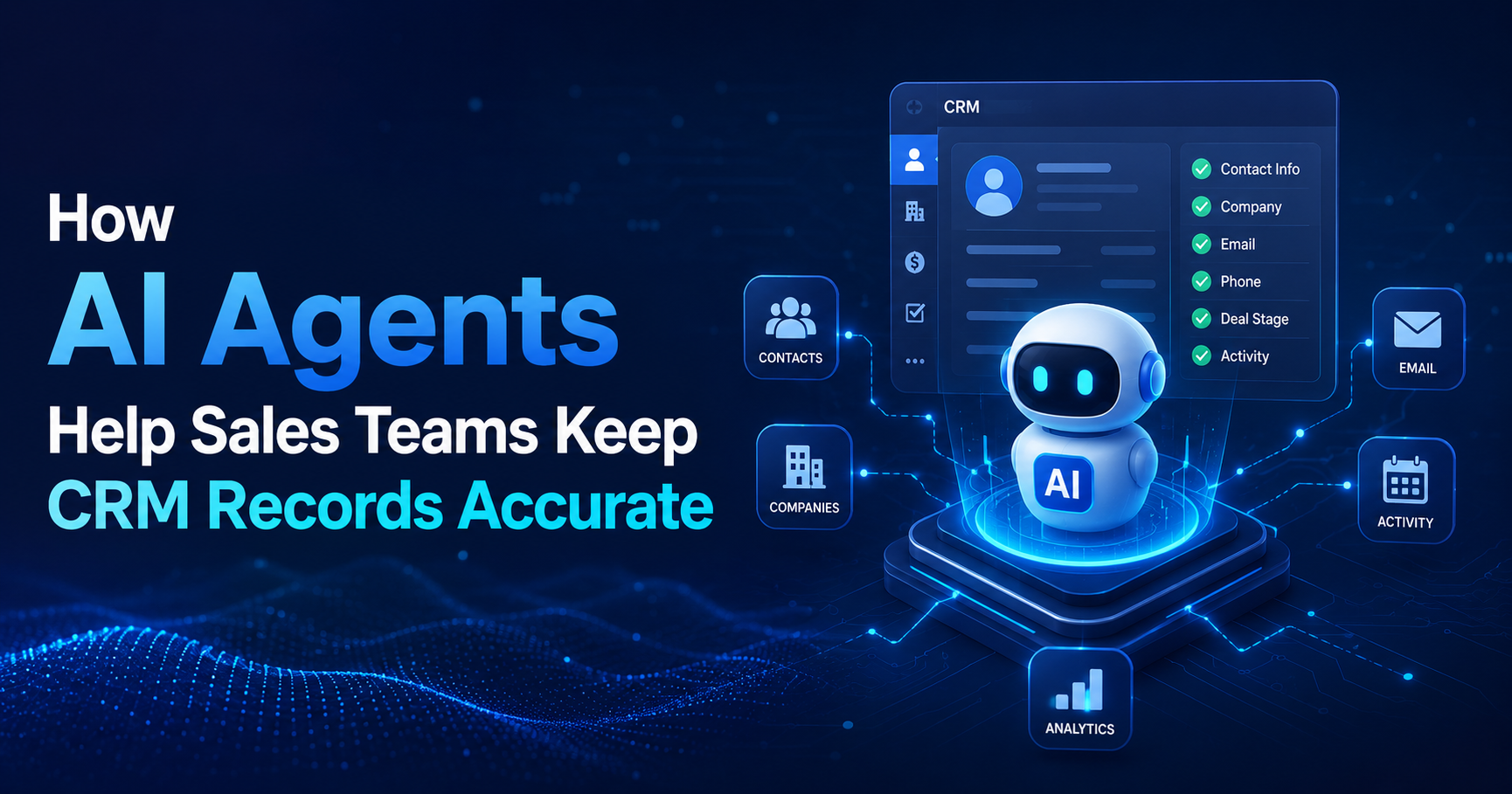

Sales teams lose more revenue to bad CRM data than to any single competitor. Reps are told the CRM is the "source of truth," yet 27% of sales data sits inaccurate at any given moment, and reps burn roughly 546 hours a year cleaning it up. That is not a workflow issue. It is a mechanism failure.
For years, the fix was more discipline: better templates, mandatory fields, quarterly hygiene projects. None of it stuck, because the system asked humans to do machine work. AI agents (not features, not chatbots, not dashboards) now handle that work in the background, reading, reasoning, and writing to the CRM without asking a rep to type.
This guide walks through how AI agent development services actually work, what they cost in effort to build, and what to look for in AI agent development companies before you buy or build.
What Is the CRM Data Accuracy Problem Sales Teams Face?
CRM data accuracy is the ongoing gap between what a record says about a contact, account, or deal, and what is actually true today. That gap is wider than most leaders admit.
According to Landbase, roughly 70% of CRM systems contain outdated, incomplete, or inaccurate information, and poor data quality costs organizations an average of $12.9 million annually. Only 35% of sales professionals completely trust their CRM data, and 67% of enterprise revenue leaders do not trust the forecasts generated from their own systems.
The missing-data problem compounds it. Coffee.ai reports that 79% of opportunity-related data never gets entered into CRMs, leaving sales leaders with real blind spots in velocity and win-rate math.
For teams with complex CRM structures or industry-specific requirements, custom-built AI agent development services can help address these data gaps through tailored automation and validation workflows.
How Much Selling Time Bad Data Consumes
The Salesforce State of Sales 2026 report shows the average B2B rep spends 40% of the workweek selling and 60% on admin, data entry, and CRM upkeep.
●71% of reps say they spend too much time on data entry.
●Reps lose about 546 hours a year validating outdated data, roughly 62 working days, or 27% of productive time.
How Fast CRM Data Actually Decays
Contact data does not go stale slowly. It falls apart on a predictable curve.
●HubSpot's 2026 Database Decay Simulation, cited by Datamagnet, confirms a 2.1% monthly B2B contact decay rate, compounding to about 22.5% annually.
●ZeroBounce's 2026 Email List Decay Report, also cited by Datamagnet, found 23% of email addresses go bad each year, with only 62% valid on first pass.
●SaaS databases experience 40-50% annual decay.
This is not a rep discipline problem. It is a physics problem.
What Are AI Agents in the Context of CRM Data?
An AI agent for CRM is a software system that uses a large language model to reason across sales data sources, decide what needs updating, and write back to the CRM with minimal human input. It is not a workflow with an AI feature bolted on.
A true agent does four things a rule-based workflow cannot:
1.Reasons over unstructured input like email threads and call transcripts.
2.Chooses which tool to call from a defined set (update a deal, enrich a contact, log an activity).
3.Persists state across multi-step tasks that unfold over hours or days.
4.Proposes changes for human approval on high-stakes writes.
The typical stack pairs LLMs (OpenAI, Anthropic Claude, LLaMA, Mistral, Gemini) with orchestration frameworks (LangChain, LangGraph, CrewAI, Microsoft AutoGen) and connects to CRM APIs. Data sources include email inboxes, calendar events, meeting transcripts from Zoom, Teams, and Google Meet, phone call recordings, enrichment APIs like Apollo and ZoomInfo, and the CRM itself.
How AI Agents Differ From Traditional CRM Automation
Traditional CRMs act as passive databases that wait for humans to enter structured data. AI agents behave as proactive systems that handle both structured and unstructured information, according to Coffee.ai.
Rule-based automation like Salesforce Flow and HubSpot workflows can trigger on events, but it cannot interpret a meeting transcript or judge whether a deal note contradicts a stage field. LLM-powered agents can. Native Salesforce features like Einstein Activity Capture and Agentforce, or HubSpot Breeze, sit in the middle: they capture activity and do light reasoning, but custom agents extend to specific business logic that native tools do not cover.
How Do AI Agents Keep CRM Records Accurate?
Three mechanisms do the real work: automated capture at the source, real-time validation and enrichment, and continuous deduplication.
Automated Activity Capture From Calls, Emails, and Meetings
Meeting bots like Gong, Otter, Colibri, Coffee, and Fathom join Zoom, Teams, or Google Meet calls, transcribe in real time, and apply LLM extraction to pull structured fields from the transcript, as documented by Coffee.ai. Extracted fields land in Opportunity, Task, Event, Contact, and Account records via API. No rep types.
What typically gets extracted:
●MEDDIC and BANT qualifiers (budget, authority, need, timing)
●Next steps and dates
●Objections and competitive mentions
●Sentiment and engagement signals
According to Gong, its models capture 99% of customer interactions, including calls, emails, meetings, and CRM updates. For teams staying inside the Salesforce stack, Einstein Activity Capture handles email and calendar events natively.
Real-Time Field Validation and Enrichment
A CRM data-hygiene agent runs on a cadence, nightly, weekly, or monthly, calling verification and enrichment APIs to check email deliverability, phone formatting, and firmographic accuracy, per DigitalApplied.
Salesforce deprecated Data.com in 2020, so every Salesforce customer now needs an external enrichment source, notes Cleanlist. Common options include Cleanlist, ZoomInfo, Cognism, Demandbase, Apollo, and Clearbit/HubSpot Breeze Intelligence.
Waterfall enrichment, which queries multiple sources in sequence, pushes match rates from around 50% single-source to 80-95%, according to Salesmotion. The best agents enrich records at the point of creation, not after the fact, so bad data never enters the system of record. For agents that need to research new prospects, a B2B data MCP server can provide access to company discovery, contact search, email verification, and enrichment tools. This helps teams gather reliable information about potential buyers and build targeted lead lists as part of their AI-assisted sales workflows.
Deduplication and Record Merging
AI handles fuzzy matching that rule-based dedupe misses, like reconciling "Acme Inc" versus "Acme, Inc" versus "ACME INC," as InfiniSynapse explains.
Most mature teams use a two-step pattern: run a bulk dedupe tool like Cloudingo, Insycle, Plauti, Validity DemandTools, or DataGroomr on the base once, then keep the base clean going forward with an AI capture layer, per goairspeed. The production pattern from Incremys is simple: the agent proposes the merge, a human approves, and every change is logged.
Which AI Agent Types Sales Teams Deploy Most
Most teams do not run one giant agent. They run several small, purpose-built agents that each own a narrow job. According to the Salesforce 2026 State of Sales announcement, 87% of sales organizations now use some form of AI, and 54% of sellers have already used an AI agent.
Common agent types:
●Meeting-to-CRM agents such as Coffee, Gong, Otter, Colibri, Fathom, SUMO Notetaker
●Enrichment agents such as HubSpot Breeze Intelligence, Cleanlist, ZoomInfo, Cognism, Apollo
●Deduplication agents such as Cloudingo, Insycle, Plauti, Validity DemandTools, DataGroomr
●Job-change and freshness agents such as KeepSync, Salesmotion, Datamagnet
●Lead enrichment and scoring agents that rank by conversion probability using behavior signals
●CRM auto-update agents that write to Salesforce or HubSpot after calls and emails using NLP
●Deal risk scorers that flag at-risk deals from activity patterns
●Meeting prep and follow-up drafter agents that produce pre-call briefings and post-call email drafts
The point is coverage, not a single hero agent.
What AI Agent Development Services Actually Include
AI agent development services cover the full lifecycle of designing, building, integrating, and maintaining a custom agent that runs against your CRM and adjacent systems. It is not just "we will fine-tune a model."
The standard service scope includes:
●Strategy and discovery: map the CRM data model, identify the highest-friction workflows, and define success metrics like forecast accuracy lift, hours saved per rep, and duplicate rate reduction.
●Architecture: select the LLM (OpenAI, Anthropic Claude, LLaMA, Mistral), orchestration
framework (LangGraph, CrewAI, AutoGen), and integration pattern (companion app, native package, or custom middleware).
●Tool definition and schema validation: each tool the agent can call, like update_hubspot_deal, needs strict input and output schemas so the agent cannot corrupt records, per MLDeep.
●Integration: connect the CRM (Salesforce, HubSpot, Dynamics, Zoho), ERP (SAP, Oracle, NetSuite), communication tools (Slack, Teams), meeting recorders, and
enrichment APIs.
●Human-in-the-loop design approval gates for high-stakes writes, audit trails for every change.
●Evaluation, monitoring, and continuous refinement track hallucination rate, false-positive dedupe merges, forecast accuracy delta, and rep adoption.
RAG-grounded architectures reduce base LLM hallucination rates from 15-20% down to under 5%, according to research from Azumo. That grounding step is what separates a demo from a system a rep will actually trust.
How to Choose AI Agent Development Companies for CRM Work
Sales teams have three real paths: use native CRM AI like Einstein, Agentforce, or Breeze; buy a specialist SaaS agent like Coffee or Gong; or engage an AI agent development company like Aalpha to build something custom against the exact data model and stage definitions.
The evaluation criteria for AI agent development companies stay consistent:
●Production track record: how many agents they have shipped that run in production today, not proof-of-concept demos.
●Framework depth: hands-on work with LangGraph, CrewAI, and AutoGen for multi-agent orchestration, not just LangChain tutorials.
●Model neutrality: willingness to select OpenAI, Anthropic, or open-weight models based on the workload, not on a single-vendor partnership.
●Enterprise data integration: actual project experience with Salesforce, HubSpot, SAP, Oracle, and ServiceNow, not just REST API familiarity.
●Security posture: SOC 2 certification, GDPR and CCPA compliance, HIPAA readiness for healthcare data.
●Human-in-the-loop discipline approval gates and audit trails designed by default, not bolted on later.
●Delivery model: dedicated team, staff augmentation, or fixed-scope; nearshore, offshore, or onshore time-zone alignment.
What Are the Common Pitfalls of AI Agents on CRM Data?
Agents fail more often than vendor marketing implies. Here is the honest picture.
●Garbage in, confident garbage out. Feed an agent two conflicting records for the same buyer and it will confidently act on the wrong one. Bulk dedupe the base first, warns DigitalApplied.
●State management failures. Multi-step workflows that wait days for a prospect reply are the most common failure point, not the LLM itself, per MLDeep.
●Missing AI-ready data. Gartner predicts that 60% of AI projects will be abandoned through 2026 for lack of AI-ready data.
●Skipping the human approval gate. High-stakes CRM writes without review erode rep trust in the agent within weeks, and once trust is gone, adoption follows.
FAQs
What are AI agent development services?
Custom-built software agents that automate multi-step sales workflows using LLMs, tool-calling, and orchestration frameworks like LangGraph or CrewAI. They plug into CRM, email, calendar, and meeting systems, then read, reason, and write records with minimal human input.
How do AI agents improve CRM data accuracy?
They capture activity automatically from calls, emails, and meetings; deduplicate records with fuzzy matching; enrich missing fields from external sources; and validate data at the point of entry rather than after it corrupts reports. The mechanism replaces rep typing with machine writing.
Which AI tools integrate with Salesforce and HubSpot?
Native options include Salesforce Einstein Activity Capture, Agentforce, and HubSpot Breeze. Third-party companions include Coffee, Gong, Otter, and Colibri. Bulk deduplication runs on tools like Cloudingo, Insycle, and Validity DemandTools.
How much time do AI agents save sales reps?
Reports across vendor and analyst research land between 8-12 hours per rep per week, roughly 17-27% of the working week, according to Coffee.ai and Backstory.ai.
How do you evaluate AI agent development companies?
Look at production track record, framework depth in LangGraph, CrewAI, and AutoGen, model neutrality, integration experience with your specific CRM and ERP, SOC 2 posture, and their default approach to human-in-the-loop approval and audit trails.
Conclusion
CRM stopped being a database that reps fill in and became a live system that agents maintain.
The clean-data problem was never a rep-effort problem; it was a mechanism problem. AI agents work because they capture, validate, and enrich at machine speed, not human speed.
The teams that win the next two years will be the ones that stop asking reps to type and start asking agents to write.
Related Blogs

Radmin VPN is a free Windows tool that creates a virtual LAN between computers over the internet. Unlike a traditional VPN, it is mainly designed for LAN gaming, remote access, and file sharing rather than hiding your public IP address.In this guide, you’ll learn what Radmin VPN does, whether it is safe, how to download and install it, and how to use it for gaming or remote work in just a few[…]

In today's online world, proxy IPs have become a key tool for businesses and individuals to improve data privacy, bypass geographic restrictions, and conduct efficient data capture. When choosing a proxy IP, you are often faced with two main choices: free proxy IPs and paid proxy IPs. Although "free" sounds attractive, can it really meet your needs? This article will delve into the key[…]
.png)
Why Your Online Activity is Constantly TrackedEvery time you click, scroll, search, or make an online purchase, a vast network of invisible trackers is quietly watching. In today’s hyper-connected digital landscape, your personal data is a highly valuable currency. Tech giants, advertising agencies, and cybercriminals are all vying for a piece of your digital footprint. This is precisely why[…]
.png)
In international flash sale campaigns, where time is of the essence and opportunities are fleeting, having an effective tool to assist in your shopping is incredibly important. Antidetect Browser is the solution that helps you manage multiple accounts and participate in flash sales without the risk of detection. This tool changes browser fingerprints, IP addresses, and personal identification[…]

Automatic CAPTCHA solving is now a standard part of data scraping, web-service testing, and other automation jobs. CAPTCHAs were built to block bots. For developers and scrapers, they are just one more barrier. Anti-CAPTCHA services remove that barrier by mixing algorithms (OCR, neural nets) with human solvers when pure automation fails. This piece runs a technical comparison of eight services:[…]
Can You Share a ChatGPT Account? Risks, Rules & Better AlternativesAs artificial intelligence continues to reshape how we work, learn, and communicate, securing access to premium AI tools has become a top priority for many users. With powerful capabilities like GPT-4, data analysis, and image generation, upgrading to a premium tier is a natural step. However, at $20 per month per user,[…]
