.png)

The rise of AI in advertising has shifted how teams produce video creatives. Instead of long production cycles, marketers now test multiple variations in hours. At the center of this shift is the AI Ad Generator, a category of tools designed to turn scripts, prompts, or product ideas into ready-to-use ad videos.
But the market is not uniform. Some tools focus on automation speed, others on design control, and a few try to bridge both worlds. This article breaks down four platforms—Nextify.ai, Blumpo, Pagepop.ai, and Plai—based on real usage patterns, workflow behavior, and creative output. Tools you might consider when working on marketing efforts for law firms.
The goal is not to crown a winner, but to understand how each tool fits into modern ad production systems.
Nextify.ai: Workflow-First AI Ad Video Production
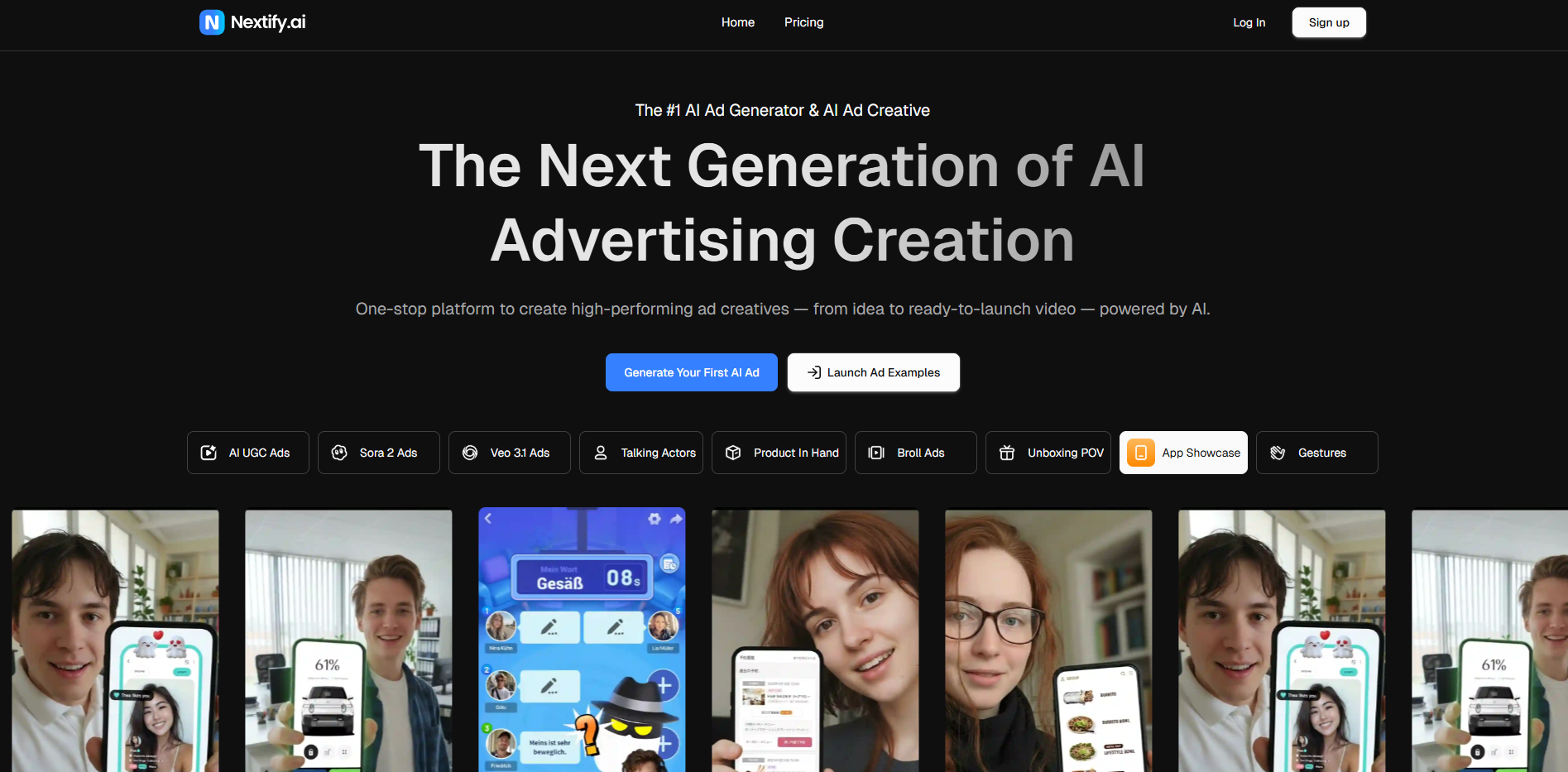
Positioning in the market
Nextify.ai operates as a structured AI Ad Generator designed for fast creative iteration. It is not just a video creator—it behaves more like a production engine for testing ad variations at scale.
What it actually does well
Nextify.ai focuses on transforming rough ideas into multiple ad-ready outputs. Instead of producing a single polished video, it encourages variation-based creation.
Key functional behavior includes:
- Rapid generation of multiple ad versions from one concept
- Structured output designed for testing campaigns
- Lightweight editing for quick adjustments
- Adaptation for short-form ad formats (TikTok, Meta, Reels)
Real usage impression
From a workflow perspective, the tool feels less like “editing software” and more like a creative factory. It reduces decision fatigue because it pushes quantity first, refinement later.
This approach aligns with modern performance marketing logic: more variants often lead to better optimization outcomes.
Limitations observed
The trade-off is control depth. Advanced cinematic editing is limited, and brand-heavy storytelling requires external polishing tools.
Still, for teams focused on rapid iteration, Nextify.ai fits naturally into early-stage testing pipelines.
Blumpo: Template-Driven Ad Video Builder with Creative Constraints

Market role
Blumpo positions itself closer to a structured video template system rather than a fully open AI generation engine. It sits between automation and manual design.
Core capabilities
Blumpo’s system relies heavily on predefined formats, which helps maintain consistency.
Key features include:
- Template-based ad video creation
- Drag-and-drop customization
- Pre-built motion and transition effects
- Simple text-to-video conversion support
Experience in practice
Blumpo feels predictable. That is both its strength and limitation.
For marketers who want stable outputs without much experimentation, it reduces uncertainty. But for users expecting generative creativity, it can feel restrictive.
Ideal usage scenario
It works best for:
- Small businesses
- Standard product ads
- Campaigns requiring visual consistency across multiple assets
In short, Blumpo prioritizes structure over experimentation.
Pagepop.ai: Conversion-Focused Ad Creative Engine
Strategic positioning
Pagepop.ai is designed around conversion optimization rather than pure content generation. It blends landing page logic with ad creative generation.
Functional highlights
Instead of just generating videos, Pagepop.ai connects ad creative to conversion pathways.
Main functions include:
- AI-assisted ad video creation tied to landing pages
- Conversion-oriented script suggestions
- Dynamic creative variations based on messaging angles
- Funnel-aware content structuring
How it feels to use
Unlike traditional AI Ad Generator tools, Pagepop.ai feels more like a marketing assistant than a video editor. It pushes users to think in terms of funnel performance rather than creative aesthetics.
This can be useful, but also slightly restrictive for purely creative experimentation.
Strengths and weaknesses
Strengths:
- Strong alignment with conversion goals
- Useful for performance marketers focused on ROI
- Integrates messaging logic into creative output
Weaknesses:
- Less flexibility in visual storytelling
- Requires more marketing knowledge to use effectively
Plai: AI-Powered Advertising Automation Platform

Industry positioning
Plai is closer to an all-in-one advertising automation platform than a pure AI Ad Generator. It integrates ad creation with campaign management.
What it offers
Plai combines AI generation with advertising infrastructure.
Core features include:
- AI-generated ad copy and video suggestions
- Campaign setup across multiple ad platforms
- Budget and targeting automation
- Performance tracking dashboards
Practical experience
Plai feels like a “campaign operator” rather than a creative tool. It reduces manual steps in launching ads, which can significantly speed up execution.
However, creative depth is not its strongest area.
Where it fits best
Plai is most useful for:
- Startups running lean ad teams
- Founders managing their own campaigns
- Users who want automation over customization
It is less suited for teams that prioritize creative experimentation.
Cross-Tool Comparison: What Actually Differs?
1. Creative Flexibility vs Structure
- Nextify.ai: High flexibility, variation-driven
- Blumpo: Structured, template-based
- Pagepop.ai: Funnel-structured creativity
- Plai: Automation-first, limited creative control
2. Primary Goal Orientation
- Nextify.ai: Speed and iteration
- Blumpo: Consistency
- Pagepop.ai: Conversion optimization
- Plai: Campaign automation
3. Workflow Philosophy
A clear divide appears in how these tools think:
Some tools optimize for creation speed, others for campaign outcomes, and a few for operational simplicity.
This reflects a broader shift in the AI Ad Generator ecosystem: tools are no longer competing only on output quality, but on workflow design.
Industry Context: Why These Tools Matter Now
Data perspective
According to Statista, digital advertising spending is expected to exceed $700 billion globally, with video ads being one of the fastest-growing formats.
At the same time, Wyzowl reports that 91% of businesses use video as a marketing tool, and demand continues to rise.
This creates a structural problem: production cannot scale at the same rate as demand.
Why AI matters here
AI ad video tools solve a specific bottleneck:
- Faster creative production
- More variation testing
- Lower dependency on large production teams
The AI Ad Generator category is essentially a response to this imbalance.
Observations from Real Workflow Use
1. Speed is becoming the real differentiator
Across all tools, the biggest advantage is not quality—it is iteration speed.
2. No tool covers the full stack
Each platform solves a different layer:
- Creation (Nextify.ai)
- Structure (Blumpo)
- Conversion logic (Pagepop.ai)
- Campaign automation (Plai)
3. Hybrid workflows are becoming standard
Most users end up combining tools instead of relying on one.
A typical workflow might look like:
- Generate variations in Nextify.ai
- Standardize in Blumpo
- Optimize funnel messaging via Pagepop.ai
- Deploy through Plai
This fragmented workflow is not a flaw—it reflects how modern marketing actually operates.
Final Perspective: The Real Shift in AI Ad Creation
The evolution of the AI Ad Generator category is not about replacing creativity. It is about redistributing it.
Less time is spent on manual production. More time is spent on deciding what to test and why.
Each tool in this space reflects a different philosophy:
- Speed-first systems
- Structure-first systems
- Conversion-first systems
- Automation-first systems
None are universally better. They simply serve different stages of the same process.
And in a market moving this fast, the advantage no longer comes from perfect ads—it comes from how quickly you can learn what works.
Related Blogs

Quick Answer: Does Clearing Cookies Change Your Browser Fingerprint?No. Clearing cookies usually does not change your browser fingerprint.Deleting cookies removes stored identifiers and website session data from your browser, but a browser fingerprint is built from characteristics such as your operating system, browser version, screen resolution, language, time zone, fonts, Canvas, WebGL, and[…]
.png)
When managing multiple accounts, performing data scraping, or ensuring online privacy, choosing a stable residential proxy is essential. LokiProxy has recently gained attention for its outstanding performance, global IP coverage, and competitive pricing. It also offers an easy-to-use control panel and integrates smoothly with tools like Hidemium.What is LokiProxy?LokiProxy is a global residential[…]
.png)
According to a Stack Overflow survey, 76% of programmers are using or planning to apply AI to their work. However, the reality is that many teams still have to modify AI-generated content and code before they can use it.Therefore, the question "Which is better, Claude or ChatGPT?" is increasingly appearing in product, engineering, and operations teams. The issue is no longer whether AI can[…]

In the digital era, making money online (MMO) has become a popular trend, offering flexible and accessible opportunities for everyone. Whether you want to earn extra income or build a long-term business, there are always suitable options available. However, for beginners, the abundance of information can be overwhelming. Don’t worry! This article will guide you through 22 practical ways to make[…]

How Does Epic Games Know If You Bought an Account?Have you ever been tempted to buy a "stacked" Fortnite or Rocket League account loaded with rare skins and premium items? You are certainly not alone — the secondary market for gaming accounts is booming. However, buying, selling, or sharing accounts strictly violates Epic Games' Terms of Service. If caught, the account gets permanently banned,[…]

If you are searching for an Ultra VPN extension, you are probably looking for a quick way to change the IP address used by your browser, access region-specific content, or add another layer of privacy while browsing.A browser VPN extension can be useful for those tasks, but it is important to understand what it actually changes.A VPN or proxy-style browser extension primarily affects network[…]
